Frederick William IV of Prussia in the context of Romanticist


Frederick William IV of Prussia in the context of Romanticist

⭐ Core Definition: Frederick William IV of Prussia

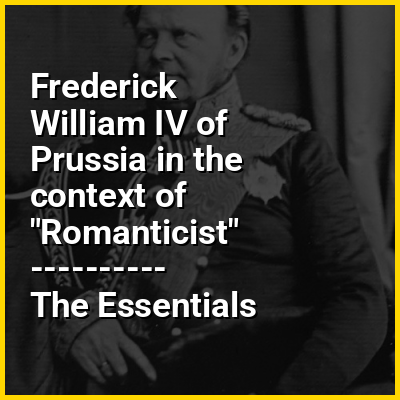
Frederick William IV (German: Friedrich Wilhelm IV.; 15 October 1795 – 2 January 1861) was King of Prussia from 7 June 1840 until his death in 1861. Also referred to as the "romanticist on the throne", he was deeply religious and believed that he ruled by divine right. He feared revolutions, and his ideal state was one governed by the Christian estates of the realm rather than a constitutional monarchy.

In spite of his conservative political philosophy, he initially pursued a moderate policy of easing press censorship, releasing political prisoners and reconciling with the Catholic population of the kingdom. During the German revolutions of 1848–1849, he was initially forced to accommodate the people's revolutionary sentiments, although he rejected the title of Emperor of the Germans offered by the Frankfurt Parliament in 1849, believing that it did not have the right to make such an offer. In December 1848, he dissolved the Prussian National Assembly when he found its constitutional proposals too radical. At the urging of his ministry, which wanted to prevent a renewal of unrest, he imposed a constitution with a parliament and a strong monarch. He then used the Prussian military to help put down revolutionary forces throughout the German Confederation.
↓ Menu
HINT:

In this Dossier

Frederick William IV of Prussia in the context of Caroline Herschel

Caroline Lucretia Herschel (/ˈhɜːrʃəl, ˈhɛərʃəl/ HUR-shəl, HAIR-shəl, German: [kaʁoˈliːnə ˈhɛʁʃl̩]; 16 March 1750 – 9 January 1848) was a German astronomer, whose most significant contributions to astronomy were the discoveries of several comets, including the periodic comet 35P/Herschel–Rigollet, which bears her name. She was the younger sister of astronomer William Herschel, with whom she worked throughout her career.

She was the first woman to receive a salary as a scientist and the first woman in England to hold a government position. She was also the first woman to publish scientific findings in the Philosophical Transactions of the Royal Society, to be awarded a Gold Medal of the Royal Astronomical Society (1828), and to be named an honorary Member of the Royal Astronomical Society (1835, with Mary Somerville). She was named an honorary member of the Royal Irish Academy (1838). The King of Prussia presented her with a Gold Medal for Science on the occasion of her 96th birthday (1846).

View the full Wikipedia page for Caroline Herschel
↑ Return to Menu

Frederick William IV of Prussia in the context of Minister President of Prussia

The minister-president (German: Ministerpräsident), or prime minister, of Prussia was the head of government of the Prussian state. The office existed from 1848, when it was formed by King Frederick William IV during the 1848–49 Revolution, until the abolition of Prussia in 1947 by the Allied Control Council.

View the full Wikipedia page for Minister President of Prussia
↑ Return to Menu

Frederick William IV of Prussia in the context of Kaiser Wilhelm II

Wilhelm II (English: Frederick William Victor Albert; German: Friedrich Wilhelm Viktor Albert; 27 January 1859 – 4 June 1941) was the last German Emperor and King of Prussia from 1888 until his abdication in 1918. His fall from power marked the end of the German Empire as well as the Hohenzollern dynasty's 500-year rule over Prussia and its predecessor state, Brandenburg.

Born during the reign of his granduncle Frederick William IV of Prussia, Wilhelm was the son of Prince Frederick William and Victoria, Princess Royal. Through his mother, he was the eldest of the 42 grandchildren of Queen Victoria of the United Kingdom. In March 1888, Wilhelm's father, Frederick William, ascended the German and Prussian thrones as Frederick III. Frederick died just 99 days later, and his son succeeded him as Wilhelm II.

View the full Wikipedia page for Kaiser Wilhelm II
↑ Return to Menu

Frederick William IV of Prussia in the context of Alte Nationalgalerie

The Alte Nationalgalerie (lit. Old National Gallery) is a listed building on the Museum Island in the historic centre of Berlin, Germany. The gallery was built from 1862 to 1876 by the order of King Frederick William IV of Prussia according to plans by Friedrich August Stüler and Johann Heinrich Strack in Neoclassical and Renaissance Revival styles. The building's outside stair features a memorial to Frederick William IV. Currently, the Alte Nationalgalerie is home to paintings and sculptures of the 19th century and hosts a variety of tourist buses daily. As part of the Museum Island complex, the gallery was inscribed on the UNESCO World Heritage List in 1999 for its outstanding architecture and its testimony to the development of museums and galleries as a cultural phenomenon in the late 19th century.

View the full Wikipedia page for Alte Nationalgalerie
↑ Return to Menu

Frederick William IV of Prussia in the context of Louise of Mecklenburg-Strelitz

Louise of Mecklenburg-Strelitz (Luise Auguste Wilhelmine Amalie; 10 March 1776 – 19 July 1810) was Queen of Prussia as the wife of King Frederick William III. The couple's happy, though short-lived, marriage produced nine children, including the future monarchs Frederick William IV of Prussia and William I, German Emperor.

Her legacy became cemented after her extraordinary 1807 meeting with French Emperor Napoleon I at Tilsit – she met with him to plead unsuccessfully for favorable terms after Prussia's disastrous losses in the War of the Fourth Coalition. She was already well loved by her subjects, but her meeting with Napoleon led Louise to become revered as "the soul of national virtue". Her early death at the age of thirty-four "preserved her youth in the memory of posterity", and caused Napoleon to reportedly remark that the king "has lost his best minister". The Order of Louise was founded by her grieving husband four years later as a female counterpart to the Iron Cross. In the 1920s, conservative and nationalist German women founded the Queen Louise League.

View the full Wikipedia page for Louise of Mecklenburg-Strelitz
↑ Return to Menu

Frederick William IV of Prussia in the context of Neues Museum

The Neues Museum (German pronunciation: [ˈnɔʏəs muˈzeːʊm], New Museum) is a listed building on the Museum Island of Berlin. Built from 1843 to 1855 by order of King Frederick William IV of Prussia in Neoclassical and Renaissance Revival styles, it is considered as the major work of Friedrich August Stüler. After suffering damage in World War II and decay in East Germany, it was restored from 1999 to 2009 by David Chipperfield. Currently, the Neues Museum is home to the Egyptian Museum (Ägyptisches Museum), the Papyrus Museum (Berlin Papyrus Collection), the Museum for Pre- and Early History(Museum für Vor- und Frühgeschichte) and parts of the Antikensammlung. As part of the Museum Island complex, the museum was inscribed on the UNESCO World Heritage List in 1999 because of its outstanding architecture and testimony to the evolution of museums as a cultural phenomenon.

View the full Wikipedia page for Neues Museum
↑ Return to Menu