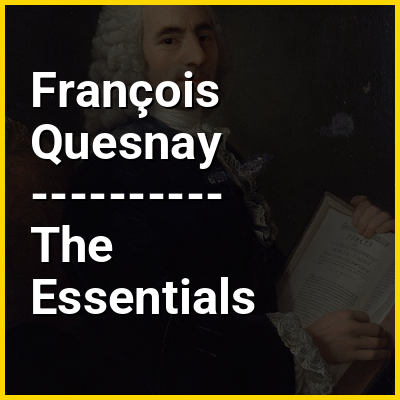
François Quesnay (/keɪˈneɪ/; French: [fʁɑ̃swa kɛnɛ]; 4 June 1694 – 16 December 1774) was a French economist and physician of the Physiocratic school. He is known for publishing the "Tableau économique" (Economic Table) in 1758, which provided the foundations of the ideas of the Physiocrats. This was perhaps the first work attempting to describe the workings of the economy in an analytical way, and as such can be viewed as one of the first important contributions to economic thought. His Le Despotisme de la Chine, written in 1767, describes Chinese politics and society, and his own political support for enlightened despotism.
HINT:
In this Dossier
- ⭐ Core Definition: François Quesnay
- François Quesnay in the context of Circular flow of income
- François Quesnay in the context of Vincent de Gournay
- François Quesnay in the context of Physiocrats
- François Quesnay in the context of Tableau économique
François Quesnay in the context of Circular flow of income
The circular flow of income or circular flow is a model of the economy in which the major exchanges are represented as flows of money, goods and services, etc. between economic agents. The flows of money and goods exchanged in a closed circuit correspond in value, but run in the opposite direction. The circular flow analysis is the basis of national accounts and hence of macroeconomics.
The idea of the circular flow was already present in the work of Richard Cantillon. François Quesnay developed and visualized this concept in the so-called Tableau économique. Important developments of Quesnay's tableau were Karl Marx's reproduction schemes in the second volume of Capital: Critique of Political Economy, and John Maynard Keynes' General Theory of Employment, Interest and Money. Richard Stone further developed the concept for the United Nations (UN) and the Organisation for Economic Co-operation and Development to the system, which is now used internationally.
View the full Wikipedia page for Circular flow of incomeFrançois Quesnay in the context of Vincent de Gournay
Jacques Claude Marie Vincent de Gournay (French: [də ɡuʁnɛ]; 28 May 1712, Saint-Malo, Province of Brittany – 27 June 1759, Cádiz), was a French economist, who became an intendant of commerce. Some historians of economics believe that he coined the phrase laissez faire, laissez passer. Evidence was to be found when the French State parted the East India Company privilege (monopoly) on the slave trade. He is also credited with coining the term "bureaucracy". Together with François Quesnay, whose disciple he was, he was a leader of the Physiocratic School.
Gournay's father was Claude Vincent, a merchant in Saint-Malo as well as a secretary to the king. Gournay didn't write much, but had a great influence on French economic thought through his conversations with many important theorists. He became instrumental in popularizing the work of Richard Cantillon in France.
View the full Wikipedia page for Vincent de GournayFrançois Quesnay in the context of Physiocrats
Physiocracy (French: physiocratie; from the Greek for "government of nature") is an economic theory developed by a group of 18th-century Age of Enlightenment French economists. They believed that the wealth of nations derived solely from the value of "land agriculture" or "land development" and that agricultural products should be highly priced. Their theories originated in France and were most popular during the second half of the 18th century. Physiocracy became one of the first well-developed theories of economics.
François Quesnay (1694–1774), the Marquis de Mirabeau (1715–1789) and Anne-Robert-Jacques Turgot (1727–1781) dominated the movement, which immediately preceded the first modern school, classical economics, which began with the publication of Adam Smith's The Wealth of Nations in 1776.
View the full Wikipedia page for PhysiocratsFrançois Quesnay in the context of Tableau économique
The Tableau économique (French pronunciation: [tablo ekɔnɔmik]) or Economic Table is an economic model first described by French economist François Quesnay in 1758, which laid the foundation of the physiocratic school of economics.
Quesnay believed that trade and industry were not sources of wealth, and instead in his 1758 manuscript Tableau économique (Economic Table) argued that agricultural surpluses, by flowing through the economy in the form of rent, wages, and purchases were the real economic movers.
View the full Wikipedia page for Tableau économique