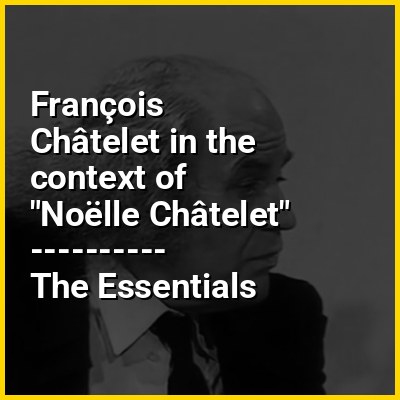
Michel François Jacques Châtelet (French: [ʃɑtlɛ]; April 27, 1925 – December 26, 1985) was a historian of philosophy and political philosophy, philosopher and professor in the socratic tradition. He was the husband of philosopher Noëlle Châtelet. Châtelet was also a co-founder of the influential French political philosophy journal Arguments.
HINT:
In this Dossier
- ⭐ Core Definition: François Châtelet
- François Châtelet in the context of Jean-François Lyotard
- François Châtelet in the context of International College of Philosophy
François Châtelet in the context of Jean-François Lyotard
Jean-François Lyotard (/liːoʊˈtɑːr/; French: [ʒɑ̃ fʁɑ̃swa ljɔtaʁ]; 10 August 1924 – 21 April 1998) was a French philosopher, sociologist, and literary theorist. His interdisciplinary discourse spans such topics as epistemology and communication, the human body, modern art and postmodern art, literature and critical theory, music, film, time and memory, space, the city and landscape, the sublime, and the relation between aesthetics and politics. He is best known for his articulation of postmodernism after the late 1970s and the analysis of the impact of postmodernity on the human condition. Lyotard was a key personality in contemporary continental philosophy and authored 26 books and many articles. He was a director of the International College of Philosophy founded by Jacques Derrida, François Châtelet, Jean-Pierre Faye, and Dominique Lecourt.
View the full Wikipedia page for Jean-François LyotardFrançois Châtelet in the context of International College of Philosophy
The Collège international de philosophie (French pronunciation: [kɔlɛʒ ɛ̃tɛʁnɑsjɔnal də filɔzɔfi]; CIPh), located in Paris' 5th arrondissement, is a tertiary education institute placed under the trusteeship of the French government department of research and chartered under the French 1901 Law on associations.
It was co-founded in 1983 by Jacques Derrida, François Châtelet, Jean-Pierre Faye and Dominique Lecourt in an attempt to re-think the teaching of philosophy in France, and to liberate it from any institutional authority (most of all from the university). Its financing is mainly through public funds. Its chairs or "directors of program" are competitively elected for 6 years (non renewable), following an international open call for proposals (every third year). Proposals are free and directors are elected after a collegial, peer-assessment of their value for philosophy. The College recognizes that philosophy is better served by being located at "intersections" such as Philosophy/Science, or Philosophy/Law. Proposals must respond to this exigency of "intersection" as wished by Jacques Derrida. The College has few registered students, who may receive the diplôme du Collège international de philosophie, which is not a university degree but may be, in some cases, validated by French or foreign universities. Otherwise, attendance to seminars is open and free.
View the full Wikipedia page for International College of Philosophy