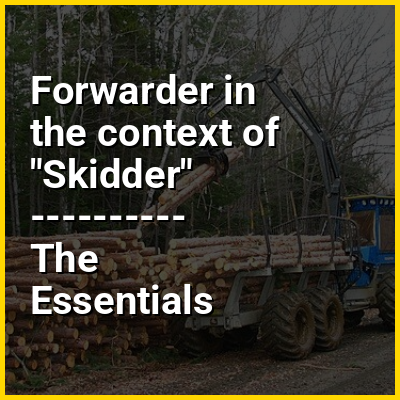
A forwarder is a forestry vehicle that carries big felled logs cut by a harvester from the stump to a roadside landing for later acquisition. Forwarders can use rubber tires or tracks. Unlike a skidder, a forwarder carries logs clear of the ground, which can reduce soil impacts but tends to limit the size of the logs it can move. They are typically employed together with harvesters in cut-to-length logging operations. It originated in Scandinavia.
>>>PUT SHARE BUTTONS HERE<<<
In this Dossier
Forwarder in the context of Timberjack
Timberjack is a manufacturer of forestry machinery for both cut-to-length and whole tree logging, and was a subsidiary of John Deere from 2000 to 2006.
Forwarder in the context of Harvester (forestry)
A harvester is a type of heavy forestry vehicle employed in cut-to-length logging operations for felling, delimbing and bucking trees. A forest harvester is typically employed together with a skidder that hauls the logs to a roadside landing, or a forwarder to pick up and haul away.
Forwarder in the context of Cut-to-length logging
Cut-to-length logging (CTL) is a mechanized harvesting system in which trees are delimbed and cut to length directly at the stump. CTL is typically a two-man, two-machine operation with a harvester felling, delimbing, and bucking trees and a forwarder transporting the logs from the felling to a landing area close to a road accessible by trucks.
CTL is the primary logging method in European countries, while full-tree logging and the even older technique of tree-length logging are more popular in North America and less developed countries, where tree sizes can exceed the capacity of the harvester's felling head, i.e., tree stems with a butt diameter of over 90 centimeters. CTL lends itself to timber harvesting in plantation forestry where stems are often harvested before they reach large dimensions.