Forbidden city in the context of Imperial City, Beijing


Forbidden city in the context of Imperial City, Beijing

⭐ Core Definition: Forbidden city

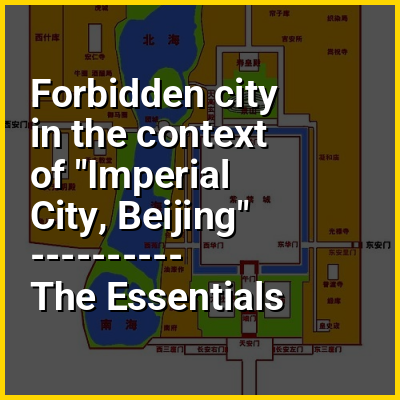
The Forbidden City (Chinese: 紫禁城; pinyin: Zǐjìnchéng) is the imperial palace complex in the center of the Imperial City in Beijing, China. It was the residence of 24 Ming and Qing dynasty Emperors, and the center of political power in China for over 500 years from 1420 to 1924. The palace is now administered by the Palace Museum as a UNESCO World Heritage Site. The Forbidden City is one the most famous palaces in all of Chinese history, and is the largest preserved royal palace complex still standing in the world.

The Forbidden City was constructed from 1406 to 1420, and was the imperial palace and winter residence of the Emperor of China from the Ming dynasty (since the Yongle Emperor) to the end of the Qing dynasty, between 1420 and 1924. The Forbidden City served as the home of Chinese emperors and their households and was the ceremonial and political center of the Chinese government for over 500 years. Since 1925, the Forbidden City has been under the charge of the Palace Museum, whose extensive collection of artwork and artifacts was built upon the imperial collections of the Ming and Qing dynasties. The Forbidden City was declared a World Heritage Site in 1987.
↓ Menu
HINT:

In this Dossier

Forbidden city in the context of Ten Thousand Nations Coming to Pay Tribute

Ten Thousand Nations Coming to Pay Tribute (Chinese: 萬國來朝圖; pinyin: Wànguó láicháo tú, 1761) is a monumental (299x207cm) Qing dynasty painting depicting foreign delegations visiting the Qianlong Emperor in the Forbidden city in Beijing during the late 1750s.

The painting was intended to show the cosmopolitanism and the centrality of the Qing Empire, since most countries of Asia and Europe are shown paying their respects to the Chinese Emperor. China already had a long tradition of such paintings (designated as "Portraits of Periodical Offering"), starting from around the 6th century CE, but such paintings ended around the time of the Opium War, which shattered the ideal of the Great Chinese Empire in the middle of the world, and gave way to the awareness of China as simply one country among others. The principle was one of more-or-less voluntary submission, with presents being periodically brought to the Chinese Emperor as a symbolic gesture of acknowledgement of Chinese overlordship. According to Ming period writings "The Emperor resides in the center and holds the reins of all other nations and all things under the sun".

View the full Wikipedia page for Ten Thousand Nations Coming to Pay Tribute
↑ Return to Menu