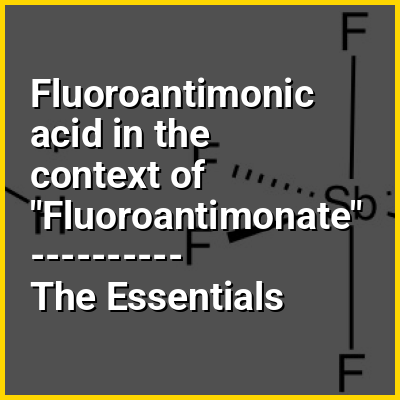
Fluoroantimonic acid is a mixture of hydrogen fluoride and antimony pentafluoride, containing various cations and anions, the simplest being fluoronium (H2F) and fluoroantimonate (SbF−6). The mixture is the strongest known superacid, stronger than pure sulfuric acid by many orders of magnitude, according to its Hammett acidity function. It even protonates some hydrocarbons to afford pentacoordinate carbocations (carbonium ions). Like its precursor hydrogen fluoride, it attacks glass, but can be stored in containers lined with PTFE (Teflon) or PFA.
HINT:
In this Dossier
- ⭐ Core Definition: Fluoroantimonic acid
- Fluoroantimonic acid in the context of Helium hydride ion
- Fluoroantimonic acid in the context of Superacid
- Fluoroantimonic acid in the context of Hexafluorophosphate
Fluoroantimonic acid in the context of Helium hydride ion
The helium hydride ion, hydridohelium(1+) ion, or helonium is a cation (positively charged ion) with chemical formula HeH. It consists of a helium atom bonded to a hydrogen atom, with one electron removed. It can also be viewed as protonated helium. It is the lightest heteronuclear ion, and is believed to be the first compound formed in the Universe after the Big Bang.
The ion was first produced in a laboratory in 1925. It is stable in isolation, but extremely reactive, and cannot be prepared in bulk, because it would react with any other molecule with which it came into contact. Noted as the strongest known acid—stronger than even fluoroantimonic acid—its occurrence in the interstellar medium had been conjectured since the 1970s, and it was finally detected in April 2019 using the airborne SOFIA telescope.
View the full Wikipedia page for Helium hydride ionFluoroantimonic acid in the context of Superacid
In chemistry, a superacid (according to the original definition) is an acid with an acidity greater than that of 100% pure sulfuric acid (H2SO4), which has a Hammett acidity function (H0) of −12. According to the modern definition, a superacid is a medium in which the chemical potential of the proton is higher than in pure sulfuric acid. Commercially available superacids include trifluoromethanesulfonic acid (CF3SO3H), also known as triflic acid, and fluorosulfuric acid (HSO3F), both of which are about a thousand times stronger (i.e. have more negative H0 values) than sulfuric acid. Most strong superacids are prepared by the combination of a strong Lewis acid and a strong Brønsted acid. A strong superacid of this kind is fluoroantimonic acid. Another group of superacids, the carborane acid group, contains some of the strongest known acids. Finally, when treated with anhydrous acid, zeolites (microporous aluminosilicate minerals) will contain superacidic sites within their pores. These materials are used on massive scale by the petrochemical industry in the upgrading of hydrocarbons to make fuels.
View the full Wikipedia page for SuperacidFluoroantimonic acid in the context of Hexafluorophosphate
Hexafluorophosphate is an anion with chemical formula of [PF6]. It is an octahedral species that imparts no color to its salts. [PF6] is isoelectronic with sulfur hexafluoride, SF6, and the hexafluorosilicate dianion, [SiF6], and hexafluoroantimonate [SbF6]. In this anion, phosphorus has a valence of 5. Being poorly nucleophilic, hexafluorophosphate is classified as a non-coordinating anion.
View the full Wikipedia page for Hexafluorophosphate