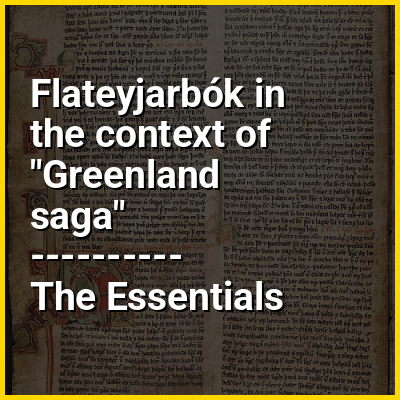
Flateyjarbók (Icelandic pronunciation: [ˈflaːtˌeiːjarˌpouːk]; "Book of Flatey") is an important medieval Icelandic manuscript. It is also known as GkS 1005 fol. and by the Latin name Codex Flateyensis. It was commissioned by the knight and lawspeaker, Jón Hákonarson, and produced by the priests and scribes Jón Þórðarson and Magnús Þórhallsson.
HINT:
In this Dossier
- ⭐ Core Definition: Flateyjarbók
- Flateyjarbók in the context of Straumfjörð
- Flateyjarbók in the context of Saga of the Greenlanders
- Flateyjarbók in the context of Þættir
- Flateyjarbók in the context of Orkneyinga saga
Flateyjarbók in the context of Straumfjörð
Straumfjörður (Icelandic), or Straumfjǫrðr (Old Norse), sometimes anglicised to Straumsfjordr, Straumfjordr, Straumsfjord or Straumfjord, is according to the Sagas of Icelanders a fjord in Vinland where Thorfinn Karlsefni set up a temporary settlement. It is described in the Saga of Erik the Red, but not in the Greenland saga. Its name translates to "Current-fjord", "Stream-fjord" or "Tide-fjord".
Two somewhat different versions of the travels of Karlsefni appear in the sagas; they are found in the Hauksbók and the Flateyjarbók. They tell that Straumsey (Current-isle) lies at the mouth of Straumfjörð; this is an island with an extreme density of birds.
View the full Wikipedia page for StraumfjörðFlateyjarbók in the context of Saga of the Greenlanders
Grœnlendinga saga (Old Norse pronunciation: [ˈgrøːnˌlendingɑ ˈsɑɣɑ]; Modern Icelandic: Grænlendinga saga, Icelandic pronunciation: [ˈkrainˌlɛntinka ˈsaːɣa] , literally Saga of the Greenlanders), is one of the sagas of Icelanders. Like the Saga of Erik the Red, it is one of the two main sources on the Norse colonization of North America. The saga recounts events that purportedly happened around 1000 and is preserved only in the late 14th century Flateyjarbók manuscript.
The Saga of the Greenlanders starts with Erik the Red, who leaves Norway and colonizes Greenland. It then relates six expeditions to North America, led respectively by Bjarni Herjolfsson, Leif Erikson, Thorvald Eriksson, Thorstein Eriksson and his wife Gudrid Thorbjarnardóttir, Thorfinn Karlsefni, and Freydís Eiríksdóttir. Bjarni and his crew discover three lands by chance during their voyage to Greenland, but they never set foot on the lands themselves. Leif learns about Bjarni's encounters and, after buying Bjarni's ship, sails to the lands to explore them. During his adventures, Leif names the three lands Helluland, Markland, and Vinland. Later, Thorvald, Leif's brother, sets sail to Vinland and lives there until he gets killed by the natives in a combat. Thorstein and Gudrid attempt to travel to Vinland but eventually fail, and thereafter Thorstein dies of an illness. Karlsefni, who then marries Gudrid, journeys to Vinland and stays there until the following spring. The final expedition is made by Freydís, who sails to Vinland with the brothers Helgi and Finnbogi but eventually slaughters their crew and returns to Greenland.
View the full Wikipedia page for Saga of the GreenlandersFlateyjarbók in the context of Þættir
The þættir (Old Norse singular þáttr, literally meaning a "strand" of rope or yarn) are short stories written mostly in Iceland during the 13th and 14th centuries.
The majority of þættir occur in two compendious manuscripts, Morkinskinna and Flateyjarbók, and within them most are found as digressions within kings' sagas. Sverrir Tómasson regards those in Morkinskinna, at least, as exempla or illustrations inseparable from the narratives that contain them, filling out the picture of the kings' qualities, good and bad, as well as adding comic relief.
View the full Wikipedia page for ÞættirFlateyjarbók in the context of Orkneyinga saga
The Orkneyinga saga (Old Norse: [ˈorknˌœyjeŋɡɑ ˈsɑɣɑ]; Scottish Gaelic: Seanchas Arcach nan Lochlannach; also called the History of the Earls of Orkney and Jarls' Saga) is a narrative of the history of the Orkney and Shetland islands and their relationship with other local polities, particularly Norway and Scotland, written in Old Norse. The saga has "no parallel in the social and literary record of Scotland" and is "the only medieval chronicle to have Orkney as the central place of action". The main focus of the work is the line of jarls who ruled the Earldom of Orkney, which constituted the Norðreyjar or Northern Isles of Orkney and Shetland and there are frequent references to both archipelagoes throughout.
The narrative commences with a brief mythical ancestry tale and then proceeds to outline the Norse take-over of the Norðreyjar by Harald Fairhair – the take-over is not in doubt although the role of the king is no longer accepted by historians as a likelihood. The saga then outlines, with varying degrees of detail, the lives and times of the many jarls who ruled the islands between the 9th and 13th centuries. The extent to which the earlier sections in particular can be considered genuine history rather than fiction has been much debated by scholars.
View the full Wikipedia page for Orkneyinga saga