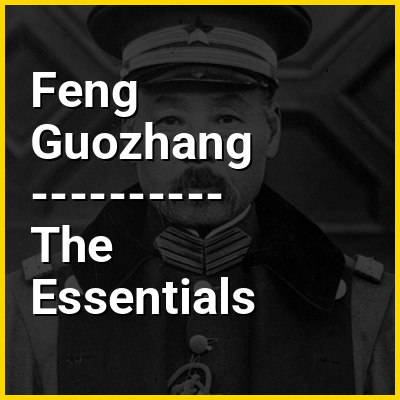
Feng Guozhang (simplified Chinese: 冯国璋; traditional Chinese: 馮國璋; pinyin: Féng Guózhāng; Wade–Giles: Feng Kuo-chang; 7 January 1859 – 12 December 1919) was a Chinese general and politician in the late Qing dynasty and early republican China who served as the acting president of China from 1917 to 1918. He had also served as the vice president from 1916 to 1917, the governor of Jiangsu from 1913 to 1917, and the governor of Zhili from 1912 to 1913. He emerged as one of the senior commanders of the Beiyang Army and was the founder of the Zhili clique, one of the main factions during the Warlord Era in China.
Feng was a first degree holder of the imperial examination and graduated from the Tianjin Military School. He served in northeastern China before and during the First Sino-Japanese War, and afterward was China's military attaché to Japan in 1895. His reports on the Japanese military reforms were brought to the attention of Yuan Shikai, who made Feng an officer in what later became the Beiyang Army. Feng rose through the ranks during the last decade of the Qing dynasty, serving as a division commander, the director of the military school for Manchu princes and nobles, and as the superintendent of the General Staff Council.