Felipe Calderón in the context of Controversies of the 2006 Mexican general election


Felipe Calderón in the context of Controversies of the 2006 Mexican general election

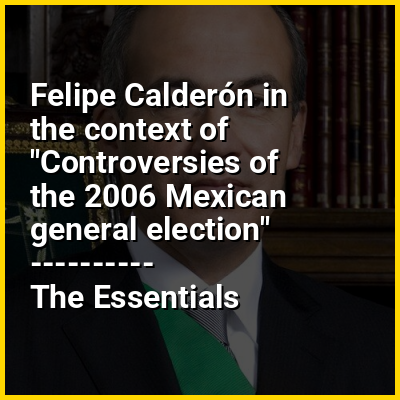
⭐ Core Definition: Felipe Calderón

Felipe de Jesús Calderón Hinojosa (Spanish: [feˈlipe kaldeˈɾon] ; born 18 August 1962) is a Mexican politician and lawyer who served as the 63rd president of Mexico from 2006 to 2012 and Secretary of Energy during the presidency of Vicente Fox between 2003 and 2004. He was a member of the National Action Party (Partido Acción Nacional, PAN) for 30 years before quitting the party in November 2018.

Calderón held positions as National President of the PAN, Federal Deputy, and Secretary of Energy in Vicente Fox's administration. He served in the previous administration's cabinet before resigning to run for president and receiving his party's candidacy. In the 2006 presidential election, he was the PAN candidate. After a contentious campaign and a controversial electoral procedure, the Federal Electoral Institute's official results gave Calderón the lead (0.6% of total votes). above PRD candidate Andrés Manuel López Obrador. While López Obrador and the PRD disputed the results and called for a complete recount of the votes, Calderón's victory was confirmed months later by the Federal Electoral Tribunal.
↓ Menu
HINT:

In this Dossier

Felipe Calderón in the context of National Action Party (Mexico)

The National Action Party (Spanish: Partido Acción Nacional, PAN) is a conservative political party in Mexico founded in 1939. It is one of the main political parties in the country, and, since the 1980s, has had success winning local, state, and national elections.

In the historic 2000 Mexican general election, PAN candidate Vicente Fox was elected president, the first time in 71 years that the Mexican presidency was not held by the traditional ruling party, the PRI. Six years later, PAN candidate Felipe Calderón succeeded Fox after winning the 2006 presidential election. In the 2006 legislative elections, the party won 207 out of 500 seats in the Chamber of Deputies and 52 out of 128 senators. In the 2012 legislative elections, the PAN won 38 seats in the Senate and 114 seats in the Chamber of Deputies, but the party did not win the presidential election in 2012, 2018, or 2024. The members of this party are colloquially called panistas.

View the full Wikipedia page for National Action Party (Mexico)
↑ Return to Menu

Felipe Calderón in the context of 2012 Mexican general election

General elections were held in Mexico on Sunday, 1 July 2012. Voters went to the polls to elect a new President of the Republic to serve a six-year term, replacing Felipe Calderón, 500 members of the Chamber of Deputies and 128 members of the Mexican Senate.

Several local ballots were held on the same day, including the election of a new Head of Government and new Legislative Assembly of the Federal District, gubernatorial elections in six states (Chiapas, Guanajuato, Jalisco, Morelos, Tabasco and Yucatán) and municipal and local congressional elections several states.

View the full Wikipedia page for 2012 Mexican general election
↑ Return to Menu

Felipe Calderón in the context of Mexican drug war

The Mexican drug war is an ongoing asymmetric armed conflict between the Mexican government and various drug trafficking syndicates. When the Mexican military intervened in 2006, the government's main objective was to reduce drug-related violence. The Mexican government has asserted that its primary focus is on dismantling the cartels and preventing drug trafficking. The conflict has been described as the Mexican theater of the global war on drugs, as led by the United States federal government. Analysts estimate wholesale earnings from illicit drug sales range from $13.6 to $49.4 billion annually.

Although Mexican drug trafficking organizations have existed for decades, their power increased after the demise of the Colombian Cali and Medellín cartels in the 1990s, and the fragmentation of the Guadalajara Cartel in the late 1980s. The conflict formally began with President Felipe Calderón (2006–2012) launching Operation Michoacán in 2006, which deployed tens of thousands of federal troops and police in a militarized campaign against the cartels initially targeted in Michoacán, Ciudad Juárez, Tijuana, and Tamaulipas. However, arrests and killings of cartel leaders caused cartels to splinter into smaller, more violent factions, escalating turf wars and contributing to rising homicide rates nationwide. By the end of Calderón's administration in 2012, the official death toll of the Mexican drug war was at least 60,000. Estimates set the death toll above 120,000 killed by 2013, not counting 27,000 missing.

View the full Wikipedia page for Mexican drug war
↑ Return to Menu