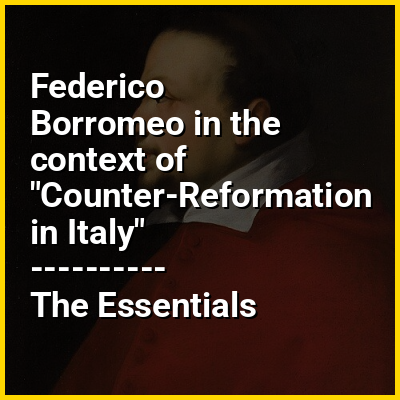
Federico Borromeo (Italian: [fedeˈriːko borroˈmɛːo]; 18 August 1564 – 21 September 1631) was an Italian cardinal, Archbishop of Milan, and prominent figure of the Counter-Reformation in Italy. His acts of charity, particularly during the famine of 1627–28, and his devoted heroism in the plague of 1630 are well known from the account in Alessandro Manzoni’s novel The Betrothed. He was a great patron of the arts and founded the Biblioteca Ambrosiana, one of the first free public libraries in Europe. In 1618 he added a picture gallery to the library, donating his own considerable collection of paintings. Borromeo’s published works, mainly in Latin and numbering over 100, exhibit his interest in ecclesiastical archaeology, sacred painting, and collecting. In 1623, he reacquired the feudal rights over what has historically been known as the “State” of the Borromeo within the Duchy of Milan, becoming the Marquess of Angera and Count of Arona, titles still used by the family as a courtesy.
HINT:
In this Dossier
Federico Borromeo in the context of Pinacoteca Ambrosiana
The Biblioteca Ambrosiana is a historic library in Milan, Italy, also housing the Pinacoteca Ambrosiana, the Ambrosian art gallery. Named after Ambrose, the patron saint of Milan, it was founded in 1609 by Cardinal Federico Borromeo, whose agents scoured Western Europe and even Greece and Syria for books and manuscripts. Some major acquisitions of complete libraries were the manuscripts of the Benedictine monastery of Bobbio (1606) and the library of the Paduan Vincenzo Pinelli, whose more than 800 manuscripts filled 70 cases when they were sent to Milan and included the famous Iliad, the Ilias Picta.
View the full Wikipedia page for Pinacoteca Ambrosiana