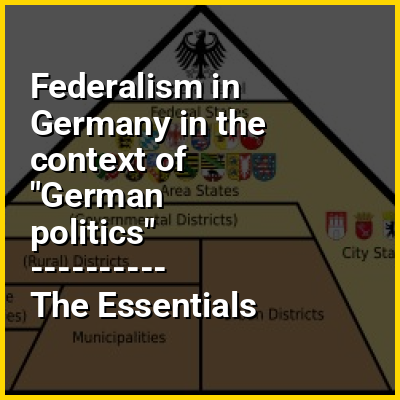
Federalism in Germany is made of the states of Germany and the federal government. The central government, the states, and the German municipalities have different tasks and partially competing regions of responsibilities ruled by a complex system of checks and balances.
HINT:
In this Dossier
- ⭐ Core Definition: Federalism in Germany
- Federalism in Germany in the context of Proclamation of the German Empire
- Federalism in Germany in the context of Politics of Germany
Federalism in Germany in the context of Proclamation of the German Empire
The proclamation of the German Empire, also known as the Deutsche Reichsgründung, took place on January 18, 1871 after the joint victory of the German states in the Franco-Prussian War. As a result of the November Treaties of 1870, the southern German states of Baden, Hesse-Darmstadt, with their territories south of the Main line, Württemberg and Bavaria, joined the Prussian-dominated "North German Confederation" on 1 January 1871. On the same day, the new Constitution of the German Confederation came into force, thereby significantly extending the federal German lands to the newly created German Empire. The Day of the founding of the German Empire, January 18, became a day of celebration, marking when the Prussian King William I was proclaimed German Emperor at the Palace of Versailles, outside Paris, France.
View the full Wikipedia page for Proclamation of the German EmpireFederalism in Germany in the context of Politics of Germany
Germany is a democratic and federal parliamentary republic, where federal legislative power is vested in the Bundestag (the parliament of Germany) and the Bundesrat (the representative body of the Länder, Germany's regional states).
The federal system has, since 1949, been dominated by the Christian Democratic Union (CDU) and the Social Democratic Party of Germany (SPD). The judiciary of Germany is independent of the executive and the legislature, while it is common for leading members of the executive to be members of the legislature as well. The political system is laid out in the 1949 constitution, the Grundgesetz (Basic Law), which remained in effect with minor amendments after German reunification in 1990.
View the full Wikipedia page for Politics of Germany