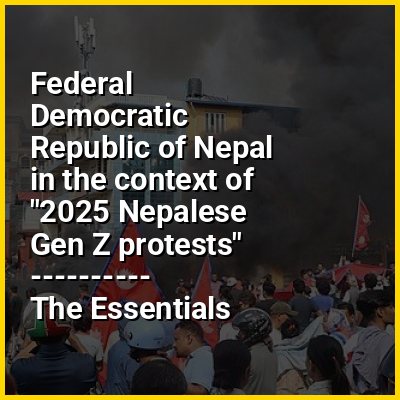
Federal Democratic Republic of Nepal in the context of "2025 Nepalese Gen Z protests"

Play Trivia Questions online!

or

Skip to study material about Federal Democratic Republic of Nepal in the context of "2025 Nepalese Gen Z protests"

Ad spacer

⭐ Core Definition: Federal Democratic Republic of Nepal

Nepal, officially the Federal Democratic Republic of Nepal, is a landlocked country in South Asia. It is mainly situated in the Himalayas, but also includes parts of the Indo-Gangetic Plain. It borders the Tibet Autonomous Region of China to the north, and India to the south, east, and west, while it is narrowly separated from Bangladesh by the Siliguri Corridor, and from Bhutan by the Indian state of Sikkim. Nepal has a diverse geography, including fertile plains, subalpine forested hills, and eight of the world's ten highest mountains, including Mount Everest, the highest point above mean sea level on Earth. Kathmandu is the nation's capital and its largest city. Nepal is a multi-ethnic, multi-lingual, multi-religious, and multi-cultural state, with Nepali as the official language.

The name "Nepal" is first recorded in texts from the Vedic period of the Indian subcontinent, the era in ancient Nepal when Hinduism was founded, the predominant religion of the country. In the middle of the first millennium BC, Gautama Buddha, the founder of Buddhism, was born in Lumbini in southern Nepal. Parts of northern Nepal were intertwined with the culture of Tibet. The centrally located Kathmandu Valley is intertwined with the culture of Indo-Aryans, and was the seat of the prosperous Newar confederacy known as Nepal Mandala. The Himalayan branch of the ancient Silk Road was dominated by the valley's traders. The cosmopolitan region developed distinct traditional art and architecture. By the 18th century, the Gorkha Kingdom achieved the unification of Nepal. The Shah dynasty established the Kingdom of Nepal and later formed an alliance with the British Empire, under its Rana dynasty of premiers. The country was never colonised but served as a buffer state between Imperial China and British India. Parliamentary democracy was introduced in 1951 but was twice suspended by Nepalese monarchs, in 1960 and 2005. The Nepalese Civil War in the 1990s and early 2000s resulted in the establishment of a secular republic in 2008, ending the world's last Hindu monarchy. The Constitution of Nepal, adopted in 2015, affirms the country as a federal parliamentary republic divided into seven provinces. In September 2025, protests against a social media ban and economic inequality caused riots, resulting in casualties and the resignation of the prime minister.
↓ Menu

>>>PUT SHARE BUTTONS HERE<<<
In this Dossier

Federal Democratic Republic of Nepal in the context of Kingdom of Nepal

The Kingdom of Nepal (Nepali: नेपाल अधिराज्य) was a Hindu kingdom in South Asia, formed in 1768 by the expansion of the Gorkha Kingdom, and disestablished and replaced by the Federal Democratic Republic of Nepal in 2008. The king of Nepal served as its head of state, and it was also known as the Gorkha Empire (Nepali: गोरखा अधिराज्य), or sometimes Asal Hindustan (Nepali: असल हिन्दुस्तान, lit.'Real Land of the Hindus'). The kingdom was founded by King Prithvi Narayan Shah, a Gorkha monarch of the Shah dynasty who claimed to be of Thakuri origin from chaubisi.

After the invasion of Tibet and plundering of Digarcha by Nepali forces under Prince Regent Bahadur Shah in 1792, the Dalai Lama and Chinese Ambans reported to the Chinese administration for military support. The Chinese and Tibetan forces under Fuk'anggan attacked Nepal but went for negotiations after failure at Nuwakot. Mulkaji Damodar Pande, who was the most influential among the four Kajis, was appointed after the removal of Bahadur Shah. Chief Kaji (Mulkaji) Kirtiman Singh Basnyat, tried to protect king Girvan Yuddha Shah and keep former king, Rana Bahadur Shah away from Nepal. However, on 4 March 1804, the former king came back and took over as Mukhtiyar and Damodar Pande was then beheaded in Thankot. The 1806 Bhandarkhal massacre instigated upon the death of Rana Bahadur Shah, set forth the rise of the authoritative Mukhtiyar Bhimsen Thapa, who became the de facto ruler of Nepal from 1806 to 1837. During the early nineteenth century, however, the expansion of the East India Company's rule in India led to the Anglo-Nepalese War (1814–1816), which resulted in Nepal's defeat.

↑ Return to Menu

Federal Democratic Republic of Nepal in the context of Prime Minister of Nepal

The prime minister of Nepal (Nepali: नेपालको प्रधानमन्त्री, romanized: Nēpālakō pradhānamantrī) is the head of government of Federal Democratic Republic of Nepal. The prime minister leads the Council of Ministers and holds the chief executive authority in the country. The prime minister must command majority support and maintain the confidence of the Pratinidhi Sabha to remain in office. If the prime minister loses this support, they are required to resign.

The official residence of the prime minister is located in Baluwatar, Kathmandu. The seat of the prime minister's office has been at Singha Darbar since Chandra Shumsher Jung Bahadur Rana's reign (1901–1929).

↑ Return to Menu