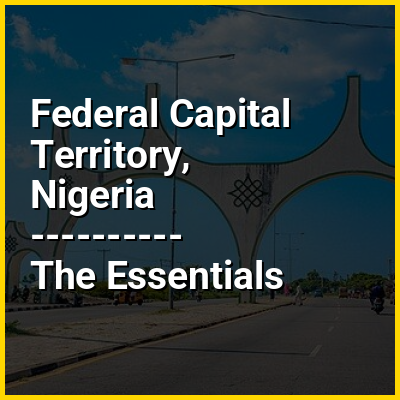
The Federal Capital Territory (FCT) is a federal territory in central Nigeria. Abuja, the capital city of Nigeria, is located in this territory. The FCT was formed in 1976 from parts of the states of old Kaduna, Kwara, Niger, and Plateau states, with the bulk of land mass carved out of Niger state. The Federal Capital Territory is within the North Central region of the country. Unlike other states of Nigeria, which are headed by elected Governors, it is administered by the Federal Capital Territory Administration, headed by a minister, who is appointed by the president.
>>>PUT SHARE BUTTONS HERE<<<
In this Dossier
Federal Capital Territory, Nigeria in the context of Nigeria
Nigeria, officially the Federal Republic of Nigeria, is a country in West Africa. It is situated between the Sahel to the north and the Gulf of Guinea in the Atlantic Ocean to the south. It covers an area of 923,769 square kilometres (356,669 sq mi). With a population of more than 236 million, it is the most populous country in Africa, and the world's sixth-most populous country. Nigeria borders Niger in the north, Chad in the northeast, Cameroon in the east, and Benin in the west. Nigeria is a federal republic comprising 36 states and the Federal Capital Territory, where its capital, Abuja, is located. The largest city in Nigeria by population is Lagos, one of the largest metropolitan areas in the world and the largest in Africa.
Nigeria has been home to several indigenous material cultures, pre-colonial states and kingdoms since the second millennium BC. The Nok culture, c. 1500 BC, marks one of the earliest known civilisations in the region. The Hausa Kingdoms inhabited the north, with the Edo Kingdom of Benin in the south, Igbo Kingdom of Nri in the southeast and in the southwest, the Oyo Empire. The present day territory of Nigeria was home to a vast array of city-states. In the early 19th century the Fula jihads culminated in the Sokoto Caliphate. The modern state originated with British colonialization in the 19th century, taking its present territorial shape with the merging of the Southern Nigeria Protectorate and the Northern Nigeria Protectorate in 1914. The British set up administrative and legal structures and incorporated traditional monarchs as a form of indirect rule. Nigeria became a formally independent federation on 1 October 1960. It experienced a civil war from 1967 to 1970, followed by a succession of military dictatorships and democratically elected civilian governments until achieving a stable government in the 1999 Nigerian presidential election.
Federal Capital Territory, Nigeria in the context of Kogi State
Kogi State is a state in the North Central region of Nigeria, bordered to the west by the states of Ekiti and Kwara, to the north by the Federal Capital Territory, to the northeast by Nasarawa State, to the northwest by Niger State, to the southwest by the states of Edo and Ondo, to the southeast by the states of Anambra and Enugu, and to the east by Benue State. It is the only state in Nigeria to border ten other states. Named for the Hausa word for river, the state was formed from parts of Benue State, Niger State, and Kwara State on 27 August 1991. The state is nicknamed the "Confluence State" as the confluence of the River Niger and the River Benue occurs next to its capital, Lokoja.
Of the 36 states of Nigeria, Kogi is the thirteenth largest in area and twentieth most populous with an estimated population of about 4.5 million as of 2016. Geographically, the state is within the tropical Guinean forest–savanna mosaic ecoregion. Important geographic features include the key rivers with the Niger flowing from the northwest and the Benue coming from the northeast before the two rivers meet in Kogi's center and bisect the state southward.