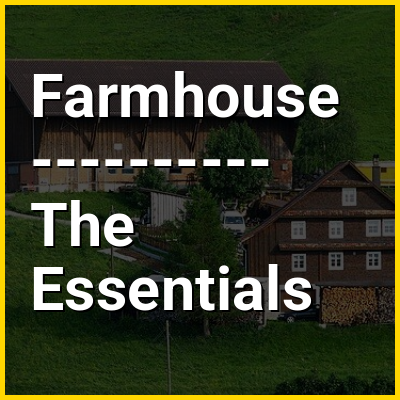
A farmhouse is a building that serves as the primary quarters in a rural or agricultural setting. Historically, farmhouses were often combined with space for animals called a housebarn. Other farmhouses may be connected to one or more barns, built to form a courtyard, or with each farm building separate from each other.
>>>PUT SHARE BUTTONS HERE<<<
👉 Farmhouse in the context of The Devil's Farmhouse
The Devil's Farmhouse, also known in Maltese as Ir-Razzett tax-Xitan, and officially as Ir-Razzett Tax-Xjaten (The Farmhouse of the Devils or The Devils' Farmhouse), is an 18th-century farmhouse in Mellieħa, Malta. The farmhouse features two unconnected buildings. The original scope for the buildings was to function as stables and a horse-riding school (Cavalerizza).
At one point, the buildings were converted into farmhouses by different farmers, and underwent some structural changes. A Maltese myth claims that the farmhouse was built by the devil, a tale from which it derives its historic name. It is a national monument and in a dilapidated state.
In this Dossier
- ⭐ Core Definition: Farmhouse
- 👉 Farmhouse in the context of The Devil's Farmhouse
- Farmhouse in the context of Homestead (building)
- Farmhouse in the context of Roman villa
- Farmhouse in the context of La Haye Sainte
- Farmhouse in the context of Plantation house
- Farmhouse in the context of Hameau de la Reine
- Farmhouse in the context of Manger
- Farmhouse in the context of Farmstead
Farmhouse in the context of Homestead (building)
A homestead is an isolated dwelling, especially a farmhouse, and adjacent outbuildings, typically on a large agricultural holding such as a ranch or station.
In North America the word "homestead" historically referred to land claimed by a settler or squatter under the Homestead Acts (United States) or the Dominion Lands Act (Canada). In Old English, the term was used to mean a human settlement, and in Southern Africa the term is used for a cluster of several houses normally occupied by a single extended family.
Farmhouse in the context of Roman villa
A Roman villa was typically a farmhouse or country house in the territory of the Roman Republic and the Roman Empire, sometimes reaching extravagant proportions.
Nevertheless, the term "Roman villa" generally covers buildings with the common features of being extra-urban (i.e. located outside urban settlements, unlike the domus which was inside them) and residential, with accommodation for the owner. The definition also changed with time: the earliest examples are mostly humble farmhouses in Italy, while from the Republican period a range of larger building types are included.
Farmhouse in the context of La Haye Sainte
La Haye Sainte (French pronunciation: [la ɛ sɛ̃t], lit. 'The Holy Hedge', named either after Jesus' crown of thorns or a nearby bramble hedge) is a walled farmhouse compound at the foot of an escarpment near Waterloo, Belgium, on the N5 road connecting Brussels and Charleroi. It has changed very little since it played a crucial part in the Battle of Waterloo on 18 June 1815.
La Haye Sainte was defended by about 400 King's German Legion troops during the Battle of Waterloo. Being greatly outnumbered by attacking French forces, the defenders held out until the late afternoon when they retired as their ammunition had run out. If Napoleon Bonaparte's army had captured La Haye Sainte earlier in the day, he would have almost certainly broken through the allied centre and defeated the Duke of Wellington's army.
Farmhouse in the context of Plantation house
A plantation house is the main house of a plantation, often a substantial farmhouse, which often serves as a symbol for the plantation as a whole. Plantation houses in the Southern United States and in other areas are known as quite grand and expensive architectural works today, though most were more utilitarian, working farmhouses.
Farmhouse in the context of Hameau de la Reine
The Hameau de la Reine (French pronunciation: [amo də la ʁɛn], The Queen's Hamlet) is a rustic retreat in the park of the Château de Versailles built for Marie Antoinette in 1783 near the Petit Trianon in Yvelines, France. It served as a private meeting place for the queen and her closest friends and as a place of leisure. Designed by Richard Mique, the queen's favoured architect, with the help of the painter Hubert Robert, it contained a meadowland with a lake and various buildings in a rustic or vernacular style, inspired by Norman or Flemish design, situated around an irregular pond fed by a stream that turned a mill wheel. The building scheme included a farmhouse, (the farm was to produce milk and eggs for the queen), a dairy, a dovecote, a boudoir, a barn that burned down during the French Revolution, a mill and a tower in the form of a lighthouse. Each building is decorated with a garden, an orchard or a flower garden. The largest and most famous of these houses is the "Queen's House", connected to the Billiard house by a wooden gallery, at the center of the village. A working farm was close to the idyllic, fantasy-like setting of the Queen's Hamlet.
The hameau is the best-known of a series of rustic garden constructions built in this era, notably the Prince of Condé's Hameau de Chantilly (1774–1775) which was the inspiration for the Versailles hamlet. Such model farms, operating under principles espoused by the Physiocrats, were fashionable among the French aristocracy at the time. One primary purpose of the hameau was to add to the ambiance of the Petit Trianon, giving the illusion that it was deep in the countryside rather than within the confines of Versailles. The rooms at the hameau allowed for more intimacy than the grand salons at Versailles or at the Petit Trianon.
Farmhouse in the context of Manger
A manger or trough is a rack for fodder, or a structure or feeder used to hold food for animals. The word comes from the Old French mangier (meaning "to eat"), from Latin mandere (meaning "to chew").
Mangers are mostly used in livestock raising and generally found at stables and farmhouses. They are also used to feed wild animals, e.g., in nature reserves.
Farmhouse in the context of Farmstead
A farmstead refers to the buildings and service areas associated with a farm. It consists of the farmhouse along with the surrounding buildings. The characteristics of a specific farmstead reflect the local landscape, which provides their environmental context. Some farmsteads have additional outlying field barns and outfarms somewhat further afield than the main cluster of buildings at the farmstead.