Fareynikte Partizaner Organizatsye in the context of "German occupation of Lithuania during World War II"

Play Trivia Questions online!

or

Skip to study material about Fareynikte Partizaner Organizatsye in the context of "German occupation of Lithuania during World War II"


⭐ Core Definition: Fareynikte Partizaner Organizatsye

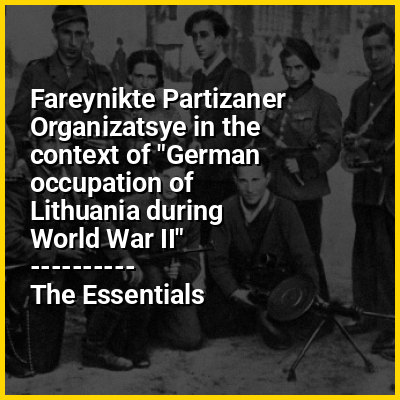
The Fareynikte Partizaner Organizatsye (Yiddish: פֿאַראײניקטע פּאַרטיזאַנער אָרגאַניזאַציע; "United Partisan Organization"; referred to as FPO by its Yiddish initials) was a Jewish resistance organization based in the Vilna Ghetto in German-occupied Lithuania and founded on January 21, 1942. The clandestine organisation was established by Communists as well as left- and right-wing Zionists. Their leaders were the Communist Yitzhak Wittenberg, Socialist Abba Kovner, and revisionist Betar member Josef Glazman.

↓ Menu

In this Dossier

Fareynikte Partizaner Organizatsye in the context of Belarusian resistance during World War II


Belarusian resistance during World War II opposed Nazi Germany from 1941 until 1944. Byelorussia was one of the Soviet republics occupied following Operation Barbarossa. The term Belarusian partisans may refer to Soviet-formed irregular military groups fighting Germany, but has also been used to refer to the disparate independent groups who also fought as guerrillas at the time, including Jewish groups (such as the Bielski partisans and Fareynikte Partizaner Organisatsye), Polish groups (such as the Home Army), and nationalist Belarusian forces opposed to Germany.

↑ Return to Menu

Fareynikte Partizaner Organizatsye in the context of Jewish partisans

Jewish partisans were fighters in irregular military groups participating in the Jewish resistance movement against Nazi Germany and its collaborators during World War II.

A number of Jewish partisan groups operated across Nazi-occupied Europe, some made up of a few escapees from the Jewish ghettos or concentration camps, while others, such as Bielski partisans, numbered in the hundreds and included women and children. They were most numerous in Eastern Europe, but groups also existed in occupied France and Belgium, where they worked with the local resistance. Many individual Jewish fighters took part in the other partisan movements in other occupied countries. In total, the Jewish partisans numbered between 20,000 and 30,000.

↑ Return to Menu