Faraday's law of induction in the context of "Electromagnetic induction"

Play Trivia Questions online!

or

Skip to study material about Faraday's law of induction in the context of "Electromagnetic induction"

Ad spacer

⭐ Core Definition: Faraday's law of induction

In electromagnetism, Faraday's law of induction describes how a changing magnetic field can induce an electric current in a circuit. This phenomenon, known as electromagnetic induction, is the fundamental operating principle of transformers, inductors, and many types of electric motors, generators and solenoids.

Faraday's law is used in the literature to refer to two closely related but physically distinct statements. One is the Maxwell–Faraday equation, one of Maxwell's equations, which states that a time-varying magnetic field is always accompanied by a circulating electric field. This law applies to the fields themselves and does not require the presence of a physical circuit.

↓ Menu

>>>PUT SHARE BUTTONS HERE<<<

👉 Faraday's law of induction in the context of Electromagnetic induction

Electromagnetic or magnetic induction is the production of an electromotive force (emf) across an electrical conductor in a changing magnetic field.

Michael Faraday is generally credited with the discovery of induction in 1831, and James Clerk Maxwell mathematically described it as Faraday's law of induction. Lenz's law describes the direction of the induced field. Faraday's law was later generalized to become the Maxwell–Faraday equation, one of the four Maxwell equations in his theory of electromagnetism.

↓ Explore More Topics
In this Dossier

Faraday's law of induction in the context of Transformer

In electrical engineering, a transformer is a passive component that transfers electrical energy from one electrical circuit to another circuit, or multiple circuits. A varying current in any coil of the transformer produces a varying magnetic flux in the transformer's core, which induces a varying electromotive force (EMF) across any other coils wound around the same core. Electrical energy can be transferred between separate coils without a metallic (conductive) connection between the two circuits. Faraday's law of induction, discovered in 1831, describes the induced voltage effect in any coil due to a changing magnetic flux encircled by the coil.

Transformers are used to change AC voltage levels, such transformers being termed step-up or step-down type to increase or decrease voltage level, respectively. Transformers can also be used to provide galvanic isolation between circuits as well as to couple stages of signal-processing circuits. Since the invention of the first constant-potential transformer in 1885, transformers have become essential for the transmission, distribution, and utilization of alternating current electric power. A wide range of transformer designs is encountered in electronic and electric power applications. Transformers range in size from RF transformers less than a cubic centimeter in volume, to units weighing hundreds of tons used to interconnect the power grid.

↑ Return to Menu

Faraday's law of induction in the context of Electromagnetic coil

An electromagnetic coil is an electrical conductor such as a wire in the shape of a coil (spiral or helix). Electromagnetic coils are used in electrical engineering, in applications where electric currents interact with magnetic fields, in devices such as electric motors, generators, inductors, electromagnets, transformers, sensor coils such as in medical MRI imaging machines. Either an electric current is passed through the wire of the coil to generate a magnetic field, or conversely, an external time-varying magnetic field through the interior of the coil generates an EMF (voltage) in the conductor.

A current through any conductor creates a circular magnetic field around the conductor due to Ampere's law. The advantage of using the coil shape is that it increases the strength of the magnetic field produced by a given current. The magnetic fields generated by the separate turns of wire all pass through the center of the coil and add (superpose) to produce a strong field there. The greater the number of turns of wire, the stronger the field produced. Conversely, a changing external magnetic flux induces a voltage in a conductor such as a wire, due to Faraday's law of induction. The induced voltage can be increased by winding the wire into a coil because the field lines intersect the circuit multiple times.

↑ Return to Menu

Faraday's law of induction in the context of Inductor

An inductor, also called a coil, choke, or reactor, is a passive two-terminal electrical component that stores energy in a magnetic field when an electric current flows through it. An inductor typically consists of an insulated wire wound into a coil.

When the current flowing through the coil changes, the time-varying magnetic field induces an electromotive force (emf), or voltage, in the conductor, described by Faraday's law of induction. According to Lenz's law, the induced voltage has a polarity (direction) which opposes the change in current that created it. As a result, inductors oppose any changes in current through them.

↑ Return to Menu

Faraday's law of induction in the context of Plasma waves

In plasma physics, waves in plasmas are an interconnected set of particles and fields which propagate in a periodically repeating fashion. A plasma is a quasineutral, electrically conductive fluid. In the simplest case, it is composed of electrons and a single species of positive ions, but it may also contain multiple ion species including negative ions as well as neutral particles. Due to its electrical conductivity, a plasma couples to electric and magnetic fields. This complex of particles and fields supports a wide variety of wave phenomena.

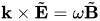
The electromagnetic fields in a plasma are assumed to have two parts, one static/equilibrium part and one oscillating/perturbation part. Waves in plasmas can be classified as electromagnetic or electrostatic according to whether or not there is an oscillating magnetic field. Applying Faraday's law of induction to plane waves, we find , implying that an electrostatic wave must be purely longitudinal. An electromagnetic wave, in contrast, must have a transverse component, but may also be partially longitudinal.

↑ Return to Menu

Faraday's law of induction in the context of Eddy current

In electromagnetism, an eddy current (also called Foucault's current) is a loop of electric current induced within conductors by a changing magnetic field in the conductor according to Faraday's law of induction or by the relative motion of a conductor in a magnetic field. Eddy currents flow in closed loops within conductors, in planes perpendicular to the magnetic field. They can be induced within nearby stationary conductors by a time-varying magnetic field created by an AC electromagnet or transformer, for example, or by relative motion between a magnet and a nearby conductor. The magnitude of the current in a given loop is proportional to the strength of the magnetic field, the area of the loop, and the rate of change of flux, and inversely proportional to the resistivity of the material. When graphed, these circular currents within a piece of metal look vaguely like eddies or whirlpools in a liquid.

By Lenz's law, an eddy current creates a magnetic field that opposes the change in the magnetic field that created it, and thus eddy currents react back on the source of the magnetic field. For example, a nearby conductive surface will exert a drag force on a moving magnet that opposes its motion, due to eddy currents induced in the surface by the moving magnetic field. This effect is employed in eddy current brakes which are used to stop rotating power tools quickly when they are turned off. The current flowing through the resistance of the conductor also dissipates energy as heat in the material. Thus eddy currents are a cause of energy loss in alternating current (AC) inductors, transformers, electric motors and generators, and other AC machinery, requiring special construction such as laminated magnetic cores or ferrite cores to minimize them. Eddy currents are also used to heat objects in induction heating furnaces and equipment, and to detect cracks and flaws in metal parts using eddy-current testing instruments.

↑ Return to Menu

Faraday's law of induction in the context of Inductance

Inductance is the tendency of an electrical conductor to oppose a change in the electric current flowing through it. The electric current produces a magnetic field around the conductor. The magnetic field strength depends on the magnitude of the electric current, and therefore follows any changes in the magnitude of the current. From Faraday's law of induction, any change in magnetic field through a circuit induces an electromotive force (EMF) (voltage) in the conductors, a process known as electromagnetic induction. This induced voltage created by the changing current has the effect of opposing the change in current. This is stated by Lenz's law, and the voltage is called back EMF.

Inductance is defined as the ratio of the induced voltage to the rate of change of current causing it. It is a proportionality constant that depends on the geometry of circuit conductors (e.g., cross-section area and length) and the magnetic permeability of the conductor and nearby materials. An electronic component designed to add inductance to a circuit is called an inductor. It typically consists of a coil or helix of wire.

↑ Return to Menu