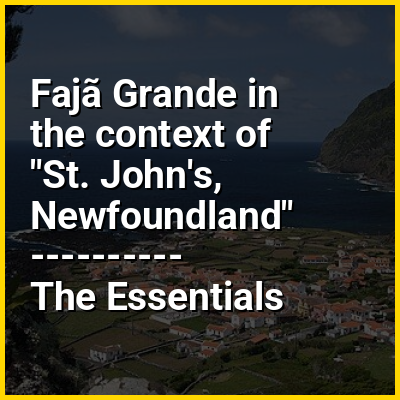
Fajã Grande is a rural civil parish in the municipality of Lajes das Flores in the Portuguese archipelago of the Azores. The population in 2021 was 220, in an area of 12.97 km. Although it is a relatively small population, it is one of the largest centers in the municipality of Lajes das Flores, about 17 kilometres (11 mi) from the municipal seat, and the westernmost settlement in Europe; the closest North American settlement is St. John's, Newfoundland and Labrador, being about 2,000 km (1,200 mi) away. The North Atlantic archipelago of Bermuda, a British Overseas Territory formerly part of British North America, is 3,089 km (1,919 mi) to the west and has close ties with the Azores through population migration.
HINT:
In this Dossier
- ⭐ Core Definition: Fajã Grande
- Fajã Grande in the context of St. John's, Newfoundland and Labrador
- Fajã Grande in the context of Monchique Islet
Fajã Grande in the context of St. John's, Newfoundland and Labrador
St. John's is the capital and largest city of the Canadian province of Newfoundland and Labrador. It is located on the eastern tip of the Avalon Peninsula on the island of Newfoundland. The city spans 446.04 km (172.22 sq mi) and is the easternmost city in North America (excluding Greenland). The closest European settlement is Fajã Grande, Azores, Portugal, about 2,000 kilometres (1,100 nautical miles) away.
Its name has been attributed to the belief that John Cabot sailed into the harbour on the Nativity of John the Baptist in 1497, although it is most likely a legend that came with British settlement. A more realistic possibility is that a fishing village with the same name existed without a permanent settlement for most of the 16th century. Indicated as São João on a Portuguese map from 1519, it is one of the oldest cities in North America. It was officially incorporated as a city in 1888. With a metropolitan population of approximately 239,316 (as of 16 January 2025), the St. John's Metropolitan Area is Canada's 22nd-largest metropolitan area and the second-largest Census Metropolitan Area (CMA) in Atlantic Canada, after Halifax, Nova Scotia.
View the full Wikipedia page for St. John's, Newfoundland and LabradorFajã Grande in the context of Monchique Islet
Monchique Islet (Portuguese: Ilhéu de Monchique, Portuguese pronunciation: [iˈʎɛw ðɨ mũˈʃikɨ]) is a small uninhabited islet off the coast of the island of Flores, west of the village of Fajã Grande, in the western part of the Portuguese archipelago of the Azores. It is the westernmost point of Portugal and, if considered part of Europe (although it sits on the North American Plate), is Europe's westernmost point as well.
Approachable only by boat, the 43-metre (141 ft) deep bay provides opportunities for scuba diving during the day in the summer. The islet and the waters around it are protected for their rich biodiversity. Ninety-six species of flora and fauna have been identified congregating in the waters near the islet, including brown algae, limpets, barnacles, and Mediterranean rainbow wrasse.
View the full Wikipedia page for Monchique Islet