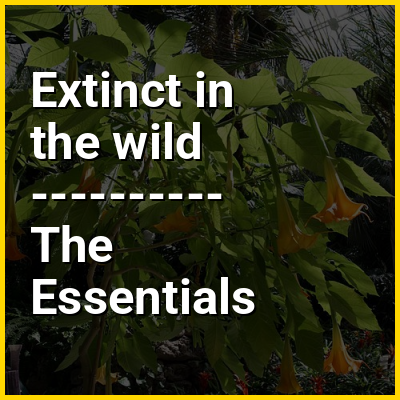
Extinct in the wild in the context of "Brugmansia"

Play Trivia Questions online!

or

Skip to study material about Extinct in the wild in the context of "Brugmansia"


⭐ Core Definition: Extinct in the wild

A species that is extinct in the wild (EW) is one that has been categorized by the International Union for Conservation of Nature as only consisting of living members kept in captivity or as a naturalized population outside its historic range. Classification requires exhaustive surveys conducted within the species' known habitat with consideration given to seasonality, time of day, and life cycle. Once a species is classified as EW, the only way for it to be downgraded is through reintroduction.

Not all EW species are rare. An example is the Brugmansia genus, where all seven species are widely cultivated, but none are found in the wild.

↓ Menu

In this Dossier

Extinct in the wild in the context of Lists of extinct species

This page features lists of species and organisms that have become extinct. The reasons for extinction range from natural occurrences, such as shifts in the Earth's ecosystem or natural disasters, to human influences on nature by hunting and destruction of natural habitats.

A species is presumed to be extinct after surveys of its expected and historical habitat demonstrates an inability to locate an individual. Species which meet this criteria but are known to be kept in captivity are extinct in the wild. If a final specimen of a moribund species is found, it is an endling.

↑ Return to Menu

Extinct in the wild in the context of Critically endangered

An IUCN Red List critically endangered (CR or sometimes CE) species is one that has been categorized by the International Union for Conservation of Nature as facing an extremely high risk of extinction in the wild. As of December 2023, of the 157,190 species currently on the IUCN Red List, 9,760 of those are listed as critically endangered, with 1,302 being possibly extinct and 67 possibly extinct in the wild.

The IUCN Red List provides the public with information regarding the conservation status of animal, fungi, and plant species. It divides various species into seven different categories of conservation that are based on habitat range, population size, habitat, threats, etc. Each category represents a different level of global extinction risk. Species that are considered to be critically endangered are placed within the "Threatened" category.

↑ Return to Menu

Extinct in the wild in the context of Bison

A bison (pl.: bison) is a large bovine in the genus Bison (from Greek, meaning 'wild ox') within the tribe Bovini. Two extant and numerous extinct species are recognised.

Of the two surviving species, the American bison, B. bison, found only in North America, is the more numerous. Although colloquially referred to as a buffalo in the United States and Canada, it is only distantly related to the true buffalo. The North American species is composed of two subspecies, the Plains bison, B. b. bison, and the generally more northern wood bison, B. b. athabascae. A third subspecies, the eastern bison (B. b. pennsylvanicus) is no longer considered a valid taxon, being a junior synonym of B. b. bison. Historical references to "woods bison" or "wood bison" from the Eastern United States refer to this synonym animal (and to their eastern woodland habitat), not to B. b. athabascae, which was not found in the region. Its European kind B. bonasus or wisent —also 'zubr' or colloquially 'European buffalo'— is found in Europe and the Caucasus, reintroduced after being extinct in the wild.

↑ Return to Menu

Extinct in the wild in the context of European bison

The European bison (pl.: bison) (Bison bonasus) or the European wood bison, also known as the wisent (/ˈvzənt/ or /ˈwzənt/), the zubr (/ˈzbər/), or sometimes colloquially as the European buffalo, is a European species of bison. It is one of two extant species of bison, alongside the American bison. The European bison is the heaviest wild land animal in Europe, and individuals in the past may have been even larger than their modern-day descendants. During late antiquity and the Middle Ages, bison became extinct in much of Europe and Asia, surviving into the 20th century only in northern-central Europe and the northern Caucasus Mountains. During the early years of the 20th century, bison were hunted to extinction in the wild.

By the late 2010s, the species numbered several thousand and had been returned to the wild by captive breeding programmes. It is no longer in immediate danger of extinction, but remains absent from most of its historical range. It is not to be confused with the aurochs (Bos primigenius), the extinct ancestor of domestic cattle, with which it once co-existed. Besides humans, bison have few predators. In the 19th century, there were scattered reports of wolves, lions, tigers, and bears hunting bison. In the past, especially during the Middle Ages, humans commonly killed bison for their hide and meat. They used their horns to make drinking horns.

↑ Return to Menu

Extinct in the wild in the context of Sturgeon

Sturgeon is the common name for the 27 species of fish belonging to the family Acipenseridae. The earliest sturgeon fossils date to the Late Cretaceous, and are descended from other, earlier acipenseriform fish, which date back to the Early Jurassic period, some 174 to 201 million years ago. They are one of two living families of the Acipenseriformes alongside paddlefish (Polyodontidae). The family is grouped into five genera: Acipenser, Huso, Scaphirhynchus, Sinosturio, and Pseudoscaphirhynchus. Two species (H. naccarii and S. dabryanus) may be extinct in the wild, and one (P. fedtschenkoi) may be entirely extinct. Sturgeons are native to subtropical, temperate and sub-Arctic rivers, lakes and coastlines of Eurasia and North America. A Maastrichtian-age fossil found in Morocco shows that they also once lived in northern Africa during the Cretaceous.

Sturgeons are long-lived, late-maturing fishes with distinctive characteristics, such as a heterocercal caudal fin similar to those of sharks, and an elongated, spindle-like body that is smooth-skinned, scaleless, and armored with five lateral rows of bony plates called scutes. Several species can grow quite large, typically ranging 2–3.5 m (7–12 ft) in length. The largest sturgeon on record was a beluga female captured in the Volga Delta in 1827, measuring 7.2 m (23 ft 7 in) long and weighing 1,571 kg (3,463 lb). Most sturgeons are anadromous bottom-feeders, migrating upstream to spawn but spending most of their lives feeding in river deltas and estuaries. Some species inhabit freshwater environments exclusively, while others primarily inhabit marine environments near coastal areas, and are known to venture into open ocean.

↑ Return to Menu

Extinct in the wild in the context of California condor

The California condor (Gymnogyps californianus) is a New World vulture and the largest North American land bird. It became extinct in the wild in 1987 when all remaining wild individuals were captured, but has since been reintroduced to northern Arizona and southern Utah (including the Grand Canyon area and Zion National Park), the coastal mountains of California, and northern Baja California in Mexico. It is the only surviving member of the genus Gymnogyps, although four extinct members of the genus are also known. The species is listed by the International Union for the Conservation of Nature as Critically Endangered, and similarly considered Critically Imperiled by NatureServe.

The plumage is black with patches of white on the underside of the wings; the head is largely bald, with skin color ranging from gray on young birds to yellow and bright orange on breeding adults. Its 3.0 m (9.8 ft) wingspan is the widest of any North American bird, and its weight of up to 12 kg (26 lb) nearly equals that of the trumpeter swan, the heaviest among native North American bird species. The condor is a scavenger and eats large amounts of carrion. It is one of the world's longest-living birds, with a lifespan of up to 60 years.

↑ Return to Menu

Extinct in the wild in the context of Arabian oryx

The Arabian oryx or white oryx (Oryx leucoryx) is a medium-sized antelope with a distinct shoulder bump, long, straight horns, and a tufted tail. It is a bovid, and the smallest member of the genus Oryx, native to desert and steppe areas of the Arabian Peninsula. The Arabian oryx was extinct in the wild by the early 1970s, but was saved in zoos and private reserves, and was reintroduced into the wild starting in 1980.

In 1986, the Arabian oryx was classified as endangered on the IUCN Red List, and in 2011, it was the first animal to revert to vulnerable status after previously being listed as extinct in the wild. It is listed in CITES Appendix I. In 2016, populations were estimated at 1,220 individuals in the wild, including 850 mature individuals, and 6,000–7,000 in captivity worldwide.

↑ Return to Menu

Extinct in the wild in the context of Przewalski's horse

Przewalski's horse (Equus ferus przewalskii or Equus przewalskii), also called the takhi, Mongolian wild horse or Dzungarian horse, is a rare and endangered wild horse originally native to the steppes of Central Asia. It is named after the Russian geographer and explorer Nikolay Przhevalsky. Once extinct in the wild, since the 1990s it has been reintroduced to its native habitat in Mongolia in the Hustai National Park, Takhin Tal Nature Reserve, Khomiin Tal, and several other locales in Central Asia and Eastern Europe.

Several genetic characteristics of Przewalski's horse differ from those seen in modern domestic horses, indicating neither is an ancestor of the other. For example, Przewalski's horse has 33 chromosome pairs, compared to 32 for the domestic horse. Their ancestral lineages split from a common ancestor between 160,000 and 38,000 years ago, long before the domestication of the horse. Przewalski's horse was long considered the only remaining truly wild horse, in contrast with the American mustang and the Australian brumby, which are instead feral horses descended from domesticated animals. That status was called into question when domestic horses of the 5,000-year-old Botai culture of Central Asia were found to be more closely related to Przewalski's horses than to E. f. caballus. The study raised the possibility that modern Przewalski's horses could be the feral descendants of the domestic Botai horses. However, it remains possible that both the Botai horses and the modern Przewalski's horses descend separately from the same ancient wild Przewalski's horse population. Its taxonomic position is still debated, with some taxonomists treating Przewalski's horse as a species, E. przewalskii, others as a subspecies of wild horse (E. ferus przewalskii) or a variety of the domesticated horse (E. ferus caballus).

↑ Return to Menu