Expressive aphasia in the context of "Broca's area"

Play Trivia Questions online!

or

Skip to study material about Expressive aphasia in the context of "Broca's area"

Ad spacer

⭐ Core Definition: Expressive aphasia

Expressive aphasia (also known as Broca's aphasia) is a type of aphasia characterized by partial loss of the ability to produce language (spoken, manual, or written), although comprehension generally remains intact. A person with expressive aphasia will exhibit effortful speech. Speech generally includes important content words but leaves out function words that have more grammatical significance than physical meaning, such as prepositions and articles. This is known as "telegraphic speech". The person's intended message may still be understood, but their sentence will not be grammatically correct. In very severe forms of expressive aphasia, a person may only speak using single word utterances. Typically, comprehension is mildly to moderately impaired in expressive aphasia due to difficulty understanding complex grammar. A better way to describe aphasia is fluent or non-fluent rather than "expressive" or "receptive" given the typical presence of both expressive and receptive language deficits in all subtypes of aphasia.

It is caused by acquired damage to the frontal regions of the brain, such as Broca's area. Expressive aphasia contrasts with receptive aphasia, in which patients are able to speak in grammatical sentences that lack semantic significance and generally also have trouble with comprehension. Expressive aphasia differs from dysarthria, which is typified by a patient's inability to properly move the muscles of the tongue and mouth to produce speech. Expressive aphasia also differs from apraxia of speech, which is a motor disorder characterized by an inability to create and sequence motor plans for conscious speech.
↓ Menu

>>>PUT SHARE BUTTONS HERE<<<

👉 Expressive aphasia in the context of Broca's area

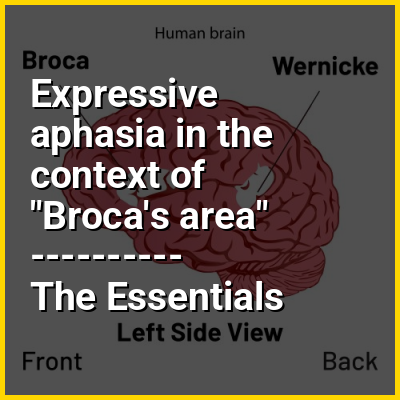
Broca's area, or the Broca area (/ˈbrkə/, also UK: /ˈbrɒkə/, US: /ˈbrkɑː/), is a region in the frontal lobe of the dominant hemisphere, usually the left, of the brain with functions linked to speech production.

Language processing has been linked to Broca's area since Pierre Paul Broca reported impairments in two patients. They had lost the ability to speak after injury to the posterior inferior frontal gyrus (pars triangularis) (BA45) of the brain. Since then, the approximate region he identified has become known as Broca's area, and the deficit in language production as Broca's aphasia, also called expressive aphasia. Broca's area is now typically defined in terms of the pars opercularis and pars triangularis of the inferior frontal gyrus, represented in Brodmann's cytoarchitectonic map as Brodmann area 44 and Brodmann area 45 of the dominant hemisphere.

↓ Explore More Topics
In this Dossier

Expressive aphasia in the context of Stroke

Stroke is a medical condition in which poor blood flow to a part of the brain causes cell death. There are two main types of stroke: ischemic, due to lack of blood flow, and hemorrhagic, due to bleeding. Both cause parts of the brain to stop functioning properly.

Signs and symptoms of stroke may include an facial drooping, inability to walk, move or feel on one side of the body, problems understanding or speaking, dizziness, or loss of vision to one side. Signs and symptoms often appear soon after the stroke has occurred. If symptoms last less than 24 hours, the stroke is a transient ischemic attack (TIA), also called a mini-stroke. Hemorrhagic stroke may also be associated with a severe headache. The symptoms of stroke can be permanent. Long-term complications may include pneumonia and loss of bladder control.

↑ Return to Menu

Expressive aphasia in the context of Aphasiology

Aphasiology is the study of language impairment usually resulting from brain damage, due to neurovascular accident—hemorrhage, stroke—or associated with a variety of neurodegenerative diseases, including different types of dementia. These specific language deficits, termed aphasias, may be defined as impairments of language production or comprehension that cannot be attributed to trivial causes such as deafness or oral paralysis. A number of aphasias have been described, but two are best known: expressive aphasia (Broca's aphasia) and receptive aphasia (Wernicke's or sensory aphasia).

↑ Return to Menu