Exponentiate in the context of Exponential function


Exponentiate in the context of Exponential function

Exponentiate Study page number 1 of 1

Play TriviaQuestions Online!

or

Skip to study material about Exponentiate in the context of "Exponential function"


⭐ Core Definition: Exponentiate

In mathematics, exponentiation, denoted b, is an operation involving two numbers: the base, b, and the exponent or power, n. When n is a positive integer, exponentiation corresponds to repeated multiplication of the base: that is, b is the product of multiplying n bases:In particular, .
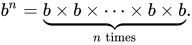
The exponent is usually shown as a superscript to the right of the base as b or in computer code as b^n. This binary operation is often read as "b to the power n"; it may also be referred to as "b raised to the nth power", "the nth power of b", or, most briefly, "b to the n".
↓ Menu
HINT:

In this Dossier

Exponentiate in the context of Square metre

The square metre (international spelling as used by the International Bureau of Weights and Measures) or square meter (American spelling) is the unit of area in the International System of Units (SI) with symbol m. It is the area of a square with sides one metre in length.

Adding and subtracting SI prefixes creates multiples and submultiples; however, as the unit is exponentiated, the quantities grow exponentially by the corresponding power of 10. For example, 1 kilometre is 10 (one thousand) times the length of 1 metre, but 1 square kilometre is (10) (10, one million) times the area of 1 square metre, and 1 cubic kilometre is (10) (10, one billion) cubic metres.

View the full Wikipedia page for Square metre
↑ Return to Menu