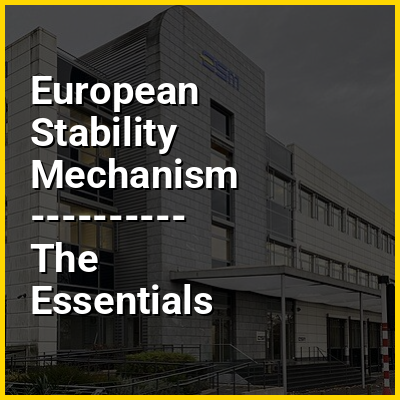
The European Stability Mechanism (ESM) is an intergovernmental organization located in Luxembourg City, which operates under public international law for all eurozone member states having ratified a special ESM intergovernmental treaty. It was established on 27 September 2012 as a permanent firewall for the eurozone, to safeguard and provide instant access to financial assistance programmes for member states of the eurozone in financial difficulty, with a maximum lending capacity of €500 billion. It has replaced two earlier temporary EU funding programmes: the European Financial Stability Facility (EFSF) and the European Financial Stabilisation Mechanism (EFSM).
HINT:
In this Dossier
- ⭐ Core Definition: European Stability Mechanism
- European Stability Mechanism in the context of Bodies of the European Union and Euratom
- European Stability Mechanism in the context of Agencies of the European Union
- European Stability Mechanism in the context of European Communities
- European Stability Mechanism in the context of Economy of Spain
- European Stability Mechanism in the context of Treaty Establishing the European Stability Mechanism
- European Stability Mechanism in the context of European Financial Stability Facility
- European Stability Mechanism in the context of 2008–2014 Spanish financial crisis
European Stability Mechanism in the context of Bodies of the European Union and Euratom
The main bodies of the European Union and Euratom are:
- the seven principal institutions of the European Union, including the one which is an international entity (the European Central Bank)
- other bodies of the EU established through primary (treaty) legislation, either as international law bodies (the European Investment Bank Group entities, the European University Institute, the European Stability Mechanism and the Unified Patent Court) or as bodies without juridical personality (the European Ombudsman, the advisory bodies to the European Union)
- the agencies, decentralised independent bodies and joint undertakings of the European Union and Euratom, which are bodies of the EU established as juridical persons through secondary legislation,
- other bodies of the EU established through secondary legislation, which lack juridical personality (e.g. European Data Protection Supervisor)
- the inter-institutional services
Apart from them, some several other bodies exist.
View the full Wikipedia page for Bodies of the European Union and EuratomEuropean Stability Mechanism in the context of Agencies of the European Union
The European Union and Euratom have agencies, decentralised independent bodies, corporate bodies and joint undertakings which are established as juridical persons through secondary EU legislation and tasked with a specific narrow field of work. They are a part of the wider set of bodies of the European Union and Euratom and are therefore distinct from:
- international law juridical persons established through primary (treaty) legislation, either as an EU institution (the European Central Bank) or as an EU body of another type (such as the European Investment Bank Group entities, the European University Institute, the European Stability Mechanism or the Unified Patent Court)
- other EU institutions
- other EU bodies lacking juridical personality, including the advisory bodies, the independent offices held by a single person (European Ombudsman, European Data Protection Supervisor), and the (non-independent, auxiliary) EU inter-institutional services, regardless of whether established through treaty or through secondary legislation
- the pan-EU organisational forms which are not considered constituent bodies of the EU or Euratom, regardless of whether possessing juridical personality (European Research Infrastructure Consortium, European political party, European political foundation, European grouping of territorial cooperation, Societas Europaea, Societas Cooperativa Europaea) or lacking it (European economic interest grouping)
European Stability Mechanism in the context of European Communities
The European Communities (EC) were three international organizations that were governed by the same set of institutions. These were the European Coal and Steel Community (ECSC), the European Atomic Energy Community (EAEC or Euratom), and the European Economic Community (EEC), the last of which was renamed the European Community (EC) in 1993 by the Maastricht Treaty establishing the European Union. The European Union was established at that time more as a concept rather than an entity, while the Communities remained the actual subjects of international law impersonating the rather abstract Union, becoming at the same time its first pillar. In popular language, however, the singular European Community was sometimes used interchangeably with the plural phrase, in the sense of referring to all three entities.
The European Coal and Steel Community ceased to exist in 2002 when its founding treaty expired. The European Community was merged with the second and third EU pillars by the Treaty of Lisbon in 2009, finally allowing the European Union to move beyond being only a concept and to assume the shape of a legally incorporated international organization with juridical personality, designated as the legal successor to the Community. However, the reformed EU has not become entirely unified, because Euratom, though governed with the EU by the common set of institutions, has been retained as an entity distinct from the EU, along with a number of other international entities, such as the European Investment Bank, the European University Institute, the European Stability Mechanism, and the Unified Patent Court.
View the full Wikipedia page for European CommunitiesEuropean Stability Mechanism in the context of Economy of Spain
The nation of Spain has a highly developed social market economy. It is the world's 12th largest by nominal GDP and the sixth-largest in Europe (fifth excluding Russia). Spain is a member of the European Union and the eurozone, as well as the Organization for Economic Co-operation and Development and the World Trade Organization. In 2024, Spain ranked as both the 17th-largest exporter and the 17th-largest importer in the world. Furthermore, Spain is listed 28th in the United Nations Human Development Index and 30th in GDP per capita by the International Monetary Fund. Some main areas of economic activity are the automotive industry, medical technology, chemicals, shipbuilding, tourism and the textile industry. Among OECD members, Spain has a highly efficient and strong social security system, which comprises roughly 23% of GDP.
During the Great Recession, Spain's economy was also in a recession. Compared to the EU and US averages, the Spanish economy entered recession later, but stayed there longer. The boom of the 2000s was reversed, leaving over a quarter of Spain's workforce unemployed by 2012. In aggregate, GDP contracted almost 9% during 2009–2013. In 2012, the government officially requested a credit from the European Stability Mechanism to restructure its banking sector in the face of the crisis. The ESM approved assistance and Spain drew €41 billion. The ESM programme for Spain ended with the full repayment of the credit drawn 18 months later.
View the full Wikipedia page for Economy of SpainEuropean Stability Mechanism in the context of Treaty Establishing the European Stability Mechanism
The Treaty Establishing the European Stability Mechanism was signed by the member states of the eurozone to found the European Stability Mechanism (ESM), an international organisation located in Luxembourg, to act as a permanent source of financial assistance for member states in financial difficulty, with a maximum lending capacity of €500 billion. It replaced two earlier temporary EU funding programmes: the European Financial Stability Facility (EFSF) and the European Financial Stabilisation Mechanism (EFSM). All new bailouts of eurozone member states will be covered by ESM, while the EFSF and EFSM will continue to handle money transfers and program monitoring for bailouts previously approved for Ireland, Portugal and Greece.
The treaty stipulated that the organization would be established if member states representing 90% of its original capital requirements ratified the founding treaty. This threshold was surpassed with Germany's ratification on 27 September 2012, bringing the treaty into force on that date for the sixteen states which had ratified the agreement. The ESM commenced its operations at a meeting on 8 October 2012. A separate treaty, amending Article 136 of the Treaty on the Functioning of the European Union (TFEU) to authorize the establishment of the ESM under EU law, was planned to enter into force on 1 January 2013. However, the last of the 27 European Union member states to ratify the amendment, the Czech Republic, did not do so until 23 April 2013, resulting in its entry into force on 1 May 2013. In June 2015, an updated EMU reform plan was released which envisaged that in the medium-term (between July 2017 and 2025) the ESM should be transposed from being an intergovernmental agreement to become fully integrated into the EU law framework applying to all eurozone member states, so that the ESM can be governed more smoothly by the EU institutions - under the competence provided for by the amended article 136 of the TFEU.
View the full Wikipedia page for Treaty Establishing the European Stability MechanismEuropean Stability Mechanism in the context of European Financial Stability Facility
The European Financial Stability Facility (EFSF) is a special purpose vehicle financed by members of the eurozone to address the European sovereign-debt crisis. It was agreed by the Council of the European Union on 9 May 2010, with the objective of preserving financial stability in Europe by providing financial assistance to eurozone states in economic difficulty. The Facility's headquarters are in Luxembourg City, as are those of the European Stability Mechanism. Treasury management services and administrative support are provided to the Facility by the European Investment Bank through a service level contract. Since the establishment of the European Stability Mechanism, the activities of the EFSF are carried out by the ESM.
The EFSF is authorised to borrow up to €440 billion, of which €250 billion remained available after the Irish and Portuguese bailout. A separate entity, the European Financial Stabilisation Mechanism (EFSM), a programme reliant upon funds raised on the financial markets and guaranteed by the European Commission using the budget of the European Union as collateral, has the authority to raise up to €60 billion.
View the full Wikipedia page for European Financial Stability FacilityEuropean Stability Mechanism in the context of 2008–2014 Spanish financial crisis
The 2008–2014 Spanish financial crisis, also known as the Great Recession in Spain or the Great Spanish Depression, began in 2008 during the 2008 financial crisis. In 2012, it made Spain a late participant in the European sovereign debt crisis when the country was unable to bail out its financial sector and had to apply for a €100 billion rescue package provided by the European Stability Mechanism (ESM).
The main cause of Spain's crisis was the housing bubble and the accompanying unsustainably high GDP growth rate. The ballooning tax revenues from the booming property investment and construction sectors kept the Spanish government's revenue in surplus, despite strong increases in expenditure, until 2007. The Spanish government supported the critical development by relaxing supervision of the financial sector and thereby allowing the banks to violate International Accounting Standards Board standards. The banks in Spain were able to hide losses and earnings volatility, mislead regulators, analysts, and investors, and thereby finance the Spanish real estate bubble. The results of the crisis were devastating for Spain, including a strong economic downturn, a severe increase in unemployment, and bankruptcies of major companies.
View the full Wikipedia page for 2008–2014 Spanish financial crisis