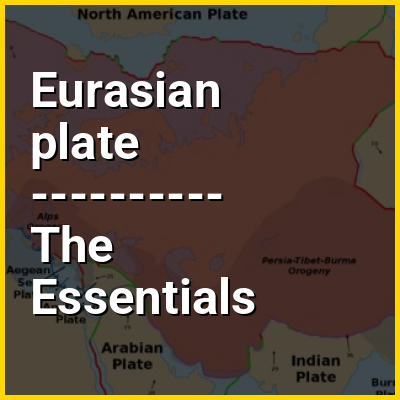
The Eurasian plate is a tectonic plate that includes most of Eurasia (a landmass consisting of the traditional continents of Asia and Europe), with the notable exceptions of the Arabian Peninsula, the Indian subcontinent, and the area east of the Chersky Range in eastern Siberia. It also includes oceanic crust extending westward to the Mid-Atlantic Ridge and northward to the Gakkel Ridge.
>>>PUT SHARE BUTTONS HERE<<<
In this Dossier
- ⭐ Core Definition: Eurasian plate
- Eurasian plate in the context of South Aegean Volcanic Arc
- Eurasian plate in the context of Iranian plateau
- Eurasian plate in the context of Arabian plate
- Eurasian plate in the context of Apulian Plate
- Eurasian plate in the context of Mid-Atlantic Ridge
- Eurasian plate in the context of African plate
- Eurasian plate in the context of Aegean arc
Eurasian plate in the context of South Aegean Volcanic Arc
The South Aegean Volcanic Arc is a volcanic arc in the South Aegean Sea formed by plate tectonics. The prior cause was the subduction of the African plate beneath the Eurasian plate, raising the Aegean arc across what is now the North Aegean Sea. In the Holocene, the process of back-arc extension began, probably stimulated by pressure from the Arabian plate compressing the region behind the arc. The extension deformed the region into its current configuration. First, the arc moved to the south and assumed its arcuate configuration. Second, the Aegean Sea opened behind the arc because the crust was thinned and weakened there. Third, magma broke through the thinned crust to form a second arc composed of a volcanic chain. And finally, the Aegean Sea plate broke away from Eurasia in the new fault zone to the north.
The extension is still ongoing. The current southern Aegean is one of the most rapidly deforming regions of the Himalayan-Alpine mountain belt. It is approximately 450 km long and 20 km to 40 km wide and runs from the Isthmus of Corinth on the Greek mainland to the Bodrum peninsula on the Turkish mainland.
Eurasian plate in the context of Iranian plateau
The Iranian plateau or Persian plateau is a geological feature spanning parts of the Caucasus, Central Asia, South Asia, and West Asia. It makes up part of the Eurasian plate, and is wedged between the Arabian plate and the Indian plate. The plateau is situated between the Zagros Mountains to the west, the Caspian Sea and the Köpet Dag to the north, the Armenian Highlands and the Caucasus Mountains to the northwest, the Strait of Hormuz and the Persian Gulf to the south, and the Indian subcontinent to the southeast.
As a historical region, it includes Parthia, Media, Persis, and some of the previous territories of Greater Iran. The Zagros form the plateau's western boundary, and its eastern slopes may also be included in the term. The Encyclopædia Britannica excludes "lowland Khuzestan" explicitly and characterizes Elam as spanning "the region from the Mesopotamian plain to the Iranian Plateau".
Eurasian plate in the context of Arabian plate
The Arabian plate is a minor tectonic plate in the Northern and Eastern Hemispheres.
It is one of the three continental plates (along with the African and Indian plates) that have been moving northward in geological history and colliding with the Eurasian plate. This collision is resulting in a mingling of plate pieces and mountain ranges extending in the west from the Pyrenees, crossing Southern Europe to Iranian plateau, forming the Alborz and the Zagros Mountains, to the Himalayas and ranges of Southeast Asia.
Eurasian plate in the context of Apulian Plate
The Adriatic or Apulian plate is a small tectonic plate carrying primarily continental crust that broke away from the African plate along a large transform fault in the Cretaceous period. The name Adriatic plate is usually used when referring to the northern part of the plate. This part of the plate was deformed during the Alpine orogeny, when the Adriatic/Apulian plate collided with the Eurasian plate.
The Adriatic/Apulian plate is thought to still move independently of the Eurasian plate in NNE direction with a small component of counter-clockwise rotation. The fault zone that separates the two is the Periadriatic Seam that runs through the Alps. Studies indicate that in addition to deforming, the Eurasian continental crust has actually subducted to some extent below the Adriatic/Apulian plate, an unusual circumstance in plate tectonics. Oceanic crust of the African plate is also subducting under the Adriatic/Apulian plate off the western and southern coasts of the Italian Peninsula, creating a berm of assorted debris which rises from the seafloor and continues onshore. This subduction is also responsible for the volcanic interactions of southern Italy.
Eurasian plate in the context of Mid-Atlantic Ridge
The Mid-Atlantic Ridge is a mid-ocean ridge (a divergent or constructive plate boundary) located along the floor of the Atlantic Ocean, and part of the longest mountain range in the world. In the North Atlantic, the ridge separates the North American from the Eurasian plate and the African plate, north and south of the Azores triple junction. In the South Atlantic, it separates the African and South American plates. The ridge extends from a junction with the Gakkel Ridge (Mid-Arctic Ridge) northeast of Greenland southward to the Bouvet triple junction in the South Atlantic. Although the Mid-Atlantic Ridge is mostly an underwater feature, portions of it have enough elevation to extend above sea level, for example in Iceland. The ridge has an average spreading rate of about 2.5 centimetres (1 in) per year.
Eurasian plate in the context of African plate
The African plate, also known as the Nubian plate, is a major tectonic plate that includes most of the continent of Africa (except for its easternmost part) and the adjacent oceanic crust to the west and south. It also includes a narrow strip of Western Asia along the Mediterranean Sea, including much of Israel and Lebanon. It is bounded by the North American plate and South American plate to the west (separated by the Mid-Atlantic Ridge); the Arabian plate and Somali plate to the east; the Eurasian plate, Aegean Sea plate and Anatolian plate to the north; and the Antarctic plate to the south.
Between 60 million years ago and 10 million years ago, the Somali plate began rifting from the African plate along the East African Rift. Since the continent of Africa consists of crust from both the African and the Somali plates, some literature refers to the African plate as the Nubian plate to distinguish it from the continent as a whole.
Eurasian plate in the context of Aegean arc
The Hellenic arc or Aegean arc is an arcuate mountain chain of the southern Aegean Sea located on the southern margin of the Aegean Sea plate. Geologically it results from the subduction of the African plate under it along the Hellenic subduction zone. The Hellenic Trench trends parallel to its southern side. The Aegean Sea plate, a microplate, is often considered part of the Eurasian plate from which it is in the process of diverging. The arc itself is mainly marine, the mountaintops appearing as islands in the Ionian Sea, Crete and its environs, or in the Dodecanese group. It encroaches on mainland terrain in the Peloponnesus, on Crete, on Rhodes, and on the southern coast of Anatolia, thus being encompassed by both Greece and Turkey.
The direction of subduction is northward. Locations on the arc or near it on the north side are therefore called "outer" as they are at the outer margin of the plate. Locations further north are "inner." Generally the motion of subduction is from outer to inner. It so happens that, due to back-arc extension, the Hellenic Arc and Trench are moving in the reverse direction, from inner to outer, accounting for the severe arcuate form. There are in essence two layers at the subduction zone, a bottom one moving from outer to inner, and a top one moving from inner to outer.