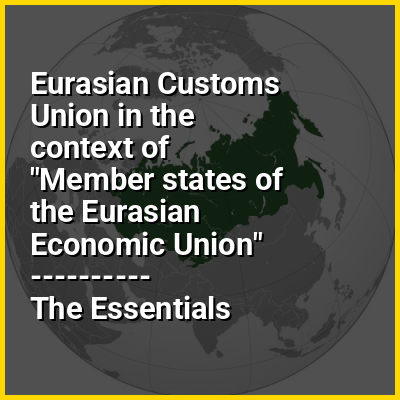
The Customs Union of the Eurasian Economic Union (Russian: Таможенный союз Евразийского экономического союза) or EAEU Customs Union (Russian: Таможенный союз ЕАЭС) is a customs union of 5 post-Soviet states consisting of all the member states of the Eurasian Economic Union (Armenia, Belarus, Kazakhstan, Kyrgyzstan, Russia) which initially became effective on January 1, 2010 at the date of implementation of the common external tariff (CET) as the Customs Union of the Eurasian Economic Community or Customs Union of Russia, Belarus and Kazakhstan. It was inherited from the Eurasian Economic Community (terminated on January 1, 2015) and is now regulated by Part Two of the Treaty on the Eurasian Economic Union (which entered into force on January 1, 2015), EAEU Customs Code, other international agreements and by decisions of supranational bodies as Supreme Eurasian Economic Council, Intergovernmental Council and Eurasian Economic Commission.
No customs are levied on goods travelling within the customs union and – unlike a free-trade area – members of the customs union impose a common external tariff on all goods entering the union (the transition period for Armenia and Kyrgyzstan has ended, but Kazakhstan de jure has some opt-outs due to its obligations during WTO accession). The Union's rules are based on World Trade Organisation rules and WTO principles are binding on all members, but the Union is not a collective WTO member (in contrast the European Union). One of the consequences of the customs union is that the EAEU negotiates as a single entity in international trade agreements, such as free trade agreements in goods, instead of individual member states negotiating for themselves (Article 35 of the EAEU Treaty). The members states can be a separate members of WTO (all except Belarus as of 2024).