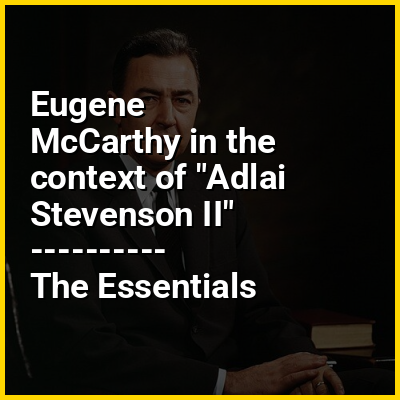
Eugene McCarthy in the context of "Adlai Stevenson II"

Play Trivia Questions online!

or

Skip to study material about Eugene McCarthy in the context of "Adlai Stevenson II"


⭐ Core Definition: Eugene McCarthy

Eugene Joseph McCarthy (March 31, 1916 – December 10, 2005) was an American politician, writer, and academic who represented Minnesota in both houses of the United States Congress for over 22 years, first in the U.S. House of Representatives from 1949 to 1959, then in the U.S. Senate from 1959 until his resignation in 1971. A member of the Democratic Party, McCarthy sought the party's presidential nomination in the 1968 presidential election, challenging incumbent President Lyndon B. Johnson on an anti–Vietnam War platform, and ran unsuccessfully for the Democratic nomination for president four more times.

Born in Watkins, Minnesota, McCarthy became an economics professor after earning a graduate degree from the University of Minnesota. He served as a code breaker for the United States Department of War during World War II. McCarthy became a member of the Minnesota Democratic–Farmer–Labor Party (the state affiliate of the Democratic Party) and in 1948 was elected to the House of Representatives, where he served until being elected to the U.S. Senate in 1958. McCarthy was a prominent supporter of Adlai Stevenson II for the Democratic presidential nomination in 1960, and was himself a candidate for the Democratic vice-presidential nomination in 1964. He co-sponsored the Immigration and Nationality Act of 1965, though he later expressed regret about its impact and became a member of the Federation for American Immigration Reform.
↓ Menu

In this Dossier

Eugene McCarthy in the context of 1968 United States presidential election

Presidential elections were held in the United States on November 5, 1968. The Republican ticket of former Vice President Richard Nixon and Maryland governor Spiro Agnew defeated the Democratic ticket of incumbent Vice President Hubert Humphrey and Senator Edmund Muskie and the American Independent Party ticket of former Alabama governor George Wallace and general Curtis LeMay. The election cycle was tumultuous and chaotic, and is often characterized as one of the most violent in American history. It was marked by the assassination of Martin Luther King Jr. in early April and the subsequent 54 days of riots across the US; the assassination of Robert F. Kennedy in early June; and widespread opposition to the Vietnam War across university campuses as well as at the Democratic National Convention, which saw police crackdowns on protesters, reporters, and bystanders.

Incumbent president Lyndon B. Johnson was the early frontrunner for the Democratic nomination, but withdrew from the race after only narrowly winning the New Hampshire primary. Humphrey, Eugene McCarthy, and Robert F. Kennedy emerged as the three major candidates in the Democratic primaries until Kennedy was assassinated. Humphrey, who supported the Vietnam War, defeated the anti-war McCarthy to win the Democratic nomination, sparking protests. Humphrey's promise to continue the Johnson administration's war on poverty and support for the civil rights movement eroded his support in the South, prompting a third-party run by Wallace that campaigned for racial segregation on the basis of "states' rights." Wallace attracted socially conservative voters throughout the South (including Southern Democrats and former Barry Goldwater supporters), as well as white working-class voters in the North and Midwest through his economic populism and anti-establishment rhetoric.

↑ Return to Menu

Eugene McCarthy in the context of 1968 Democratic National Convention protests

A series of protests against the United States' involvement in the Vietnam War took place prior to and during the 1968 Democratic National Convention in Chicago, Illinois. The protests lasted approximately seven days, from August 23 to August 29, 1968, and drew an estimated 7,000 to 10,000 anti-war protesters in total.

In the weeks after the 1967 March on the Pentagon, many left-wing counterculture and anti-Vietnam War groups, as well as supporters of anti-war Democratic presidential candidate Eugene McCarthy, began planning demonstrations in response to the Democratic National Convention and the impending presidential nomination of Democratic nominee, Vice President Hubert Humphrey. Chicago authorities attempted to prevent the protests from occurring but were unsuccessful, and the city promised "law and order" to suppress the protesters.

↑ Return to Menu

Eugene McCarthy in the context of Withdrawal of Lyndon B. Johnson from the 1968 United States presidential election

On March 31, 1968, then-incumbent U.S. president Lyndon B. Johnson made a surprise announcement during a televised address to the nation that began around 9 p.m., declaring that he would not seek re-election for another term and was withdrawing from the 1968 United States presidential election. Johnson stated, "I shall not seek, and I will not accept, the nomination of my party for another term as your president."

At first, Johnson's only significant challenger in the 1968 Democratic Party presidential primaries was Eugene McCarthy, an anti-war U.S. senator from Minnesota. Johnson's announcement to drop out of the race came after McCarthy nearly won the New Hampshire primary and Senator Robert F. Kennedy, another critic of the war and the brother of the late president John F. Kennedy, entered the race. Johnson's decision and the assassination of Kennedy opened the door for Vice President Hubert Humphrey to become the Democratic Party's nominee. The 1968 Democratic National Convention, held in Chicago, was marked by significant protests and clashes between demonstrators and police, reflecting the deep divisions within the nation.

↑ Return to Menu

Eugene McCarthy in the context of Robert F. Kennedy 1968 presidential campaign

The Robert F. Kennedy presidential campaign began on March 16, 1968, when Kennedy, a United States Senator from New York, mounted an unlikely challenge to incumbent Democratic United States President Lyndon B. Johnson. Following a near-upset in the New Hampshire primary, Johnson announced on March 31 that he would not seek re-election to a second full term. Kennedy still faced two rival candidates for the Democratic Party's presidential nomination: the leading challenger United States Senator Eugene McCarthy and Vice President Hubert Humphrey. Humphrey had entered the race after Johnson's withdrawal, but Kennedy and McCarthy remained the main challengers to the policies of the Johnson administration. During the spring of 1968, Kennedy led a leading campaign in presidential primary elections throughout the United States. Kennedy's campaign was especially active in Indiana, Nebraska, Oregon, South Dakota, California, and Washington, D.C. After declaring victory in the California primary on June 4, 1968, Kennedy was assassinated at the Ambassador Hotel in Los Angeles. He died on June 6, 1968 at Good Samaritan Hospital. Had Kennedy been elected president, he would have been the first brother of a former U.S. president (John F. Kennedy) to win the presidency himself.

↑ Return to Menu