Euclidean geometry in the context of "Hyperbolic geometry"

Play Trivia Questions online!

or

Skip to study material about Euclidean geometry in the context of "Hyperbolic geometry"

Ad spacer

⭐ Core Definition: Euclidean geometry

Euclidean geometry is a mathematical system attributed to Euclid, an ancient Greek mathematician, which he described in his textbook on geometry, Elements. Euclid's approach consists in assuming a small set of intuitively appealing axioms (postulates) and deducing many other propositions (theorems) from these. One of those is the parallel postulate which relates to parallel lines on a Euclidean plane. Although many of Euclid's results had been stated earlier, Euclid was the first to organize these propositions into a logical system in which each result is proved from axioms and previously proved theorems.

The Elements begins with plane geometry, still taught in secondary school (high school) as the first axiomatic system and the first examples of mathematical proofs. It goes on to the solid geometry of three dimensions. Much of the Elements states results of what are now called algebra and number theory, explained in geometrical language.

↓ Menu

>>>PUT SHARE BUTTONS HERE<<<
In this Dossier

Euclidean geometry in the context of Euclid

Euclid (/ˈjklɪd/; Ancient Greek: Εὐκλείδης; fl. 300 BC) was an ancient Greek mathematician active as a geometer and logician. Considered the "father of geometry", he is chiefly known for the Elements treatise, which established the foundations of geometry that largely dominated the field until the early 19th century. His system, now referred to as Euclidean geometry, involved innovations in combination with a synthesis of theories from earlier Greek mathematicians, including Eudoxus of Cnidus, Hippocrates of Chios, Thales and Theaetetus. With Archimedes and Apollonius of Perga, Euclid is generally considered among the greatest mathematicians of antiquity, and one of the most influential in the history of mathematics.

Very little is known of Euclid's life, and most information comes from the scholars Proclus and Pappus of Alexandria many centuries later. Medieval Islamic mathematicians invented a fanciful biography, and medieval Byzantine and early Renaissance scholars mistook him for the earlier philosopher Euclid of Megara. It is now generally accepted that he spent his career in Alexandria and lived around 300 BC, after Plato's students and before Archimedes. There is some speculation that Euclid studied at the Platonic Academy and later taught at the Musaeum; he is regarded as bridging the earlier Platonic tradition in Athens with the later tradition of Alexandria.

↑ Return to Menu

Euclidean geometry in the context of Pythagorean theorem

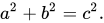
In mathematics, the Pythagorean theorem or Pythagoras's theorem is a fundamental relation in Euclidean geometry between the three sides of a right triangle. It states that the area of the square whose side is the hypotenuse (the side opposite the right angle) is equal to the sum of the areas of the squares on the other two sides.

The theorem can be written as an equation relating the lengths of the sides a, b and the hypotenuse c, sometimes called the Pythagorean equation:The theorem is named for the Greek philosopher Pythagoras, born around 570 BC. The theorem has been proved numerous times by many different methods – possibly the most for any mathematical theorem. The proofs are diverse, including both geometric proofs and algebraic proofs, with some dating back thousands of years.

↑ Return to Menu

Euclidean geometry in the context of Euclid's Elements

The Elements (Ancient Greek: Στοιχεῖα Stoikheîa) is a mathematical treatise written c. 300 BC by the Ancient Greek mathematician Euclid.

The Elements is the oldest extant large-scale deductive treatment of mathematics. Drawing on the works of earlier mathematicians such as Hippocrates of Chios, Eudoxus of Cnidus, and Theaetetus, the Elements is a collection in 13 books of definitions, postulates, geometric constructions, and theorems with their proofs that covers plane and solid Euclidean geometry, elementary number theory, and incommensurability. These include the Pythagorean theorem, Thales' theorem, the Euclidean algorithm for greatest common divisors, Euclid's theorem that there are infinitely many prime numbers, and the construction of regular polygons and polyhedra.

↑ Return to Menu

Euclidean geometry in the context of Geometry

Geometry is a branch of mathematics concerned with properties of space such as the distance, shape, size, and relative position of figures. Geometry is, along with arithmetic, one of the oldest branches of mathematics. A mathematician who works in the field of geometry is called a geometer. Until the 19th century, geometry was almost exclusively devoted to Euclidean geometry, which includes the notions of point, line, plane, distance, angle, surface, and curve, as fundamental concepts.

Originally developed to model the physical world, geometry has applications in almost all sciences, and also in art, architecture, and other activities that are related to graphics. Geometry also has applications in areas of mathematics that are apparently unrelated. For example, methods of algebraic geometry are fundamental in Wiles's proof of Fermat's Last Theorem, a problem that was stated in terms of elementary arithmetic, and remained unsolved for several centuries.

↑ Return to Menu

Euclidean geometry in the context of Axiom

An axiom, postulate, or assumption is a statement that is taken to be true, to serve as a premise or starting point for further reasoning and arguments. The word comes from the Ancient Greek word ἀξίωμα (axíōma), meaning 'that which is thought worthy or fit' or 'that which commends itself as evident'.

The precise definition varies across fields of study. In classic philosophy, an axiom is a statement that is so evident or well-established, that it is accepted without controversy or question. In modern logic, an axiom is a premise or starting point for reasoning.

↑ Return to Menu

Euclidean geometry in the context of Compass-and-straightedge construction

In geometry, straightedge-and-compass construction – also known as ruler-and-compass construction, Euclidean construction, or classical construction – is the construction of lengths, angles, and other geometric figures using only an idealized ruler and a compass.

The idealized ruler, known as a straightedge, is assumed to be infinite in length, have only one edge, and no markings on it. The compass is assumed to have no maximum or minimum radius, and is assumed to "collapse" when lifted from the page, so it may not be directly used to transfer distances. (This is an unimportant restriction since, using a multi-step procedure, a distance can be transferred even with a collapsing compass; see compass equivalence theorem. Note however that whilst a non-collapsing compass held against a straightedge might seem to be equivalent to marking it, the neusis construction is still impermissible and this is what unmarked really means: see Markable rulers below.) More formally, the only permissible constructions are those granted by the first three postulates of Euclid's Elements.

↑ Return to Menu

Euclidean geometry in the context of Regular polygons

In Euclidean geometry, a regular polygon is a polygon that is direct equiangular (all angles are equal in measure) and equilateral (all sides have the same length). Regular polygons may be either convex or star. In the limit, a sequence of regular polygons with an increasing number of sides approximates a circle, if the perimeter or area is fixed, or a regular apeirogon (effectively a straight line), if the edge length is fixed.

↑ Return to Menu

Euclidean geometry in the context of Projective geometry

In mathematics, projective geometry is the study of geometric properties that are invariant with respect to projective transformations. This means that, compared to elementary Euclidean geometry, projective geometry has a different setting (projective space) and a selective set of basic geometric concepts. The basic intuitions are that projective space has more points than Euclidean space, for a given dimension, and that geometric transformations are permitted that transform the extra points (called "points at infinity") to Euclidean points, and vice versa.

Properties meaningful for projective geometry are respected by this new idea of transformation, which is more radical in its effects than can be expressed by a transformation matrix and translations (the affine transformations). The first issue for geometers is what kind of geometry is adequate for a novel situation. Unlike in Euclidean geometry, the concept of an angle does not apply in projective geometry, because no measure of angles is invariant with respect to projective transformations, as is seen in perspective drawing from a changing perspective. One source for projective geometry was indeed the theory of perspective. Another difference from elementary geometry is the way in which parallel lines can be said to meet in a point at infinity, once the concept is translated into projective geometry's terms. Again this notion has an intuitive basis, such as railway tracks meeting at the horizon in a perspective drawing. See Projective plane for the basics of projective geometry in two dimensions.

↑ Return to Menu