The Estonian War of Independence, also known as the War of Freedom in Estonia, was an offensive campaign of the Estonian Army and its allies, most notably the United Kingdom, against Soviet Russia, in order to secede. westward offensive of 1918–1919 and the 1919 aggression of the pro–German Baltische Landeswehr. The campaign was the struggle of the newly established state of Estonia for separation from Russia in the aftermath of World War I. It resulted in a victory for Estonia and was concluded in the 1920 Treaty of Tartu.

HINT:
👉 Estonian War of Independence in the context of Lithuanian–Soviet War
The Lithuanian–Soviet War or Lithuanian–Bolshevik War (Lithuanian: karas su bolševikais) was fought between newly independent Lithuania and the Russian Socialist Federative Soviet Republic in the aftermath of World War I. It was part of the larger Soviet westward offensive of 1918–1919. The offensive followed the retreat of German troops and sought to establish Soviet republics in Ukraine, Belarus, Lithuania, Latvia, Estonia, and Poland, and to link up with the German Revolution. By the end of December 1918, Soviet forces reached Lithuanian borders. Largely unopposed, they occupied one town after another and by the end of January 1919, they controlled about two thirds of the Lithuanian territory. In February, the Soviet advance was stopped by Lithuanian and German volunteers, who prevented the Soviets from capturing Kaunas, the temporary capital of Lithuania. From April 1919, the Lithuanian war went parallel with the Polish–Soviet War. Poland had territorial claims over Lithuania, especially the Vilnius Region; these tensions spilt over into the Polish–Lithuanian War.
British-Polish historian Norman Davies summarized the situation: "the German army was supporting the Lithuanian nationalists, the Soviets were supporting the Lithuanian communists and the Polish Army was fighting them all." In mid-May, the Lithuanian army, now commanded by General Silvestras Žukauskas, began an offensive against the Soviets in Northeastern Lithuania. By mid-June, the Lithuanians reached the Latvian border and cornered the Soviets among lakes and hills near Zarasai, where the Soviets held out until the end of August 1919. The Soviets and Lithuanians, separated by the Daugava River, maintained their fronts until the Battle of Daugavpils in January 1920. As early as September 1919, the Soviets offered to negotiate a peace treaty, but talks began only in May 1920. The Soviet–Lithuanian Peace Treaty was signed on July 12, 1920. Soviet Russia fully recognized independent Lithuania.
In this Dossier
- ⭐ Core Definition: Estonian War of Independence
- 👉 Estonian War of Independence in the context of Lithuanian–Soviet War
- Estonian War of Independence in the context of Rõuge
- Estonian War of Independence in the context of Occupation of Estonia by Nazi Germany
Estonian War of Independence in the context of Rõuge
Rõuge (Võro: Rõugõ; German: Rauge) is a small borough (alevik) in Võru County in southeastern Estonia. It is the administrative centre of Rõuge Parish.
-
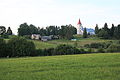 St. Mary's church
 -
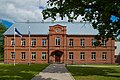 Rõuge school
 -
 Monument to the Estonian War of Independence
 -
 Rõuge Museum
 -
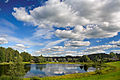 Kaussjärv (also known as Rõuge Mõisajärv)
 -
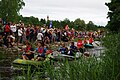 Boat rally


Estonian War of Independence in the context of Occupation of Estonia by Nazi Germany
In the course of Operation Barbarossa, Nazi Germany invaded Estonia in July–December 1941, and occupied the country until 1944. Estonia had gained independence in 1918 from the then-warring German and Russian Empires. However, in the wake of the August 1939 Nazi-Soviet Pact, the Soviet Union had invaded and occupied Estonia in June 1940, and the country was formally annexed into the USSR in August 1940.
In the summer of 1941, the German invaders were at first seen by most Estonians as liberators from Soviet terror, since the Germans arrived only a week after the mass deportation of tens of thousands of people from Estonia and other territories occupied by the USSR in 1939–1941: eastern Poland, Latvia, Lithuania, Bessarabia and Northern Bukovina. Despite high hopes for Estonian independence, the people there soon realized that the Germans were just a different occupying power.
View the full Wikipedia page for Occupation of Estonia by Nazi Germany