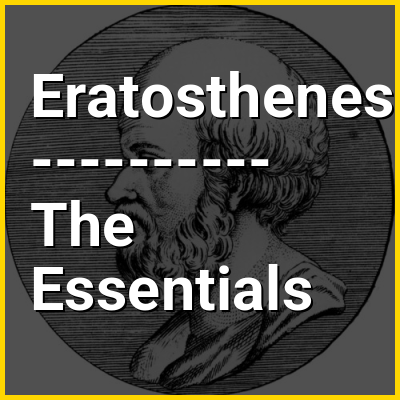
Eratosthenes of Cyrene (/ɛrəˈtɒsθəniːz/; Ancient Greek: Ἐρατοσθένης [eratostʰénɛːs]; c. 276 BC – c. 195/194 BC) was an Ancient Greek philosopher, polymath and scholar. He was known as a mathematician, geographer, poet, astronomer, and music theorist. Eratosthenes became the chief librarian at the Library of Alexandria. His work was the precursor to the modern discipline of geography, and he introduced some of its terminology, coining the terms geography and geographer.
He is best remembered as the first known person to calculate the Earth's circumference. He was also the first to calculate Earth's axial tilt, which similarly proved to have remarkable accuracy. He created the first global projection of the world incorporating parallels and meridians based on the available geographic knowledge of his era. Eratosthenes was the founder of scientific chronology; he used Egyptian and Persian records to estimate the dates of the main events of the Trojan War, dating the sack of Troy to 1184 BC. In number theory, he introduced the sieve of Eratosthenes, an efficient method of identifying prime numbers and composite numbers.