English longbow in the context of "Battle of Crécy"

Play Trivia Questions online!

or

Skip to study material about English longbow in the context of "Battle of Crécy"


⭐ Core Definition: English longbow

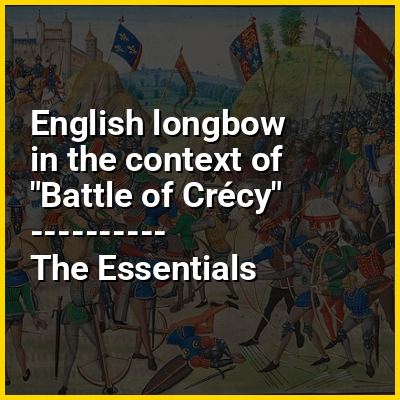
The English longbow was a powerful medieval type of bow, about 6 ft (1.8 m) long. While it is debated whether it originated in England or in Wales from the Welsh bow, by the 14th century the longbow was being used by both the English and the Welsh as a weapon of war and for hunting. English longbows were effective against the French during the Hundred Years' War, particularly in the battles of Sluys (1340), Crécy (1346), Poitiers (1356), and Agincourt (1415). They were less successful later on, as longbowmen had their lines broken at the Battle of Verneuil (1424), although the English won a decisive victory there; they were completely routed at the Battle of Patay (1429) when they were charged by the French mounted men-at-arms before they had prepared the terrain and finished defensive arrangements. The Battle of Pontvallain (1370) had also previously shown longbowmen were not particularly effective when not given the time to set up defensive positions.

No English longbows survive from the period when the longbow was dominant (c. 1250–1450), probably because bows became weaker, broke, and were replaced rather than being handed down through generations. More than 130 bows survive from the Renaissance period, however. More than 3,500 arrows and 137 whole longbows were recovered from the Mary Rose, a ship of Henry VIII's navy that sank at Portsmouth in 1545.
↓ Menu

In this Dossier

English longbow in the context of Yeoman

In medieval and early modern England, a yeoman /ˈjmən/ was a member of a social class ranking between the peasantry and the landed gentry. The class was first documented in mid-14th century England, where it included people who cultivated their own land as well as the middle ranks of servants in an English royal or noble household.

The 14th century witnessed the rise of the yeoman longbowmen during the Hundred Years' War, and the yeoman outlaws celebrated in the Robin Hood ballads. Yeomen joined the English Navy during the Hundred Years' War as seamen and archers. In the early 15th century, yeoman was the rank of chivalry between page and squire. By the late 17th century, yeoman became a rank in the Royal Navy for the common seamen who were in charge of ship's stores, such as foodstuffs, gunpowder, and sails.

↑ Return to Menu

English longbow in the context of Spring (device)

A spring is a device consisting of an elastic but largely rigid material (typically metal) bent or molded into a form (especially a coil) that can return into shape after being compressed, extended or twisted. Springs can store energy when compressed, when extended, and/or when twisted. In everyday use, the term most often refers to coil springs, but there are many different spring designs. Modern springs are typically manufactured from spring steel. An example of a non-metallic spring is the bow, made traditionally of flexible yew wood, which when drawn stores energy to propel an arrow.

When a conventional spring, without stiffness variability features, is compressed or stretched from its resting position, it exerts an opposing force approximately proportional to its change in length (this approximation breaks down for larger deflections). The rate or spring constant of a spring is the change in the force it exerts, divided by the change in deflection of the spring. That is, it is the gradient of the force versus deflection curve. An extension or compression spring's rate is expressed in units of force divided by distance, for example or N/m or lbf/in. A torsion spring is a spring that works by twisting; when it is twisted about its axis by an angle, it produces a torque proportional to the angle. A torsion spring's rate is in units of torque divided by angle, such as N·m/rad or ft·lbf/degree. The inverse of spring rate is compliance, that is: if a spring has a rate of 10 N/mm, it has a compliance of 0.1 mm/N. The stiffness (or rate) of springs in parallel is additive, as is the compliance of springs in series.

↑ Return to Menu

English longbow in the context of St Briavels Castle

St Briavels Castle (most likely named after Saint Brioc) is a moated Norman castle at St Briavels in the English county of Gloucestershire. The castle is noted for its huge Edwardian gatehouse that guards the entrance.

St Briavels Castle was originally built between 1075 and 1129 as a royal administrative centre for the Forest of Dean. During the 13th century the castle became first a favourite hunting lodge of King John, and then the primary centre in England for the manufacture of arrows for use with the longbow, the predominant missile weapon of the English in the later medieval period, and quarrels, large numbers of which were required for crossbows in medieval warfare.

↑ Return to Menu