Emperor Yang of Sui in the context of "604"

Play Trivia Questions online!

or

Skip to study material about Emperor Yang of Sui in the context of "604"


⭐ Core Definition: Emperor Yang of Sui

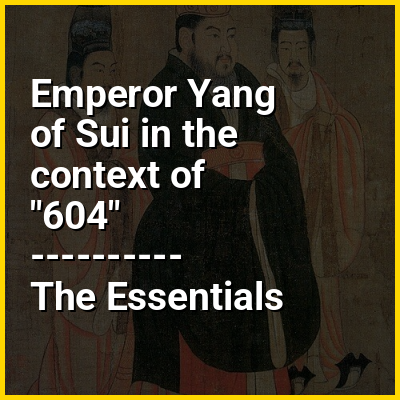
Emperor Yang of Sui (Chinese: 隋煬帝, 569 – 11 April 618), personal name Yang Guang (楊廣), alternative name Ying (), childhood name Amo (阿摩), Xianbei name Puliuru Guang (普六茹廣), was the second emperor of the Sui dynasty of China.

Emperor Yang's original name was Yang Ying, but he was renamed by his father Emperor Wen, after consulting with oracles, to Yang Guang. Yang Guang was made the Prince of Jin after Emperor Wen established the Sui dynasty in 581. In 588, he was granted command of the five armies that invaded the Chen dynasty in southern China and was widely praised for the success of this campaign. These military achievements, as well as his machinations against his older brother Yang Yong, led to him becoming crown prince in 600. After the death of his father in 604, generally considered, though unproven, by most traditional historians to be a murder ordered by Yang Guang, he ascended the Sui throne.
↓ Menu

👉 Emperor Yang of Sui in the context of 604

Year 604 (DCIV) was a leap year starting on Wednesday of the Julian calendar. The denomination 604 for this year has been used since the early medieval period, when the Anno Domini calendar era became the prevalent method in Europe for naming years.

↓ Explore More Topics
In this Dossier

Emperor Yang of Sui in the context of Old City of Luoyang

34°43′43″N 112°37′21″E / 34.72861°N 112.62250°E / 34.72861; 112.62250

The Old City of Luoyang is a site located 15 kilometers east of the urban area of modern Luoyang. It was the capital of the Northern Wei dynasty. Emperor Yang of Sui rebuilt the city in 605. The Old City was listed as major cultural heritage sites under national-level protection in 1961, and as a UNESCO World Cultural Heritage site in 2014, as one part of the larger Silk Roads: the Routes Network of Chang'an-Tianshan Corridor designation.

↑ Return to Menu

Emperor Yang of Sui in the context of Jinshi (imperial examination)

Jinshi (Chinese: 進士; pinyin: jìnshì) was the highest and final degree in the imperial examination in Imperial China. The examination was usually taken in the imperial capital in the palace, and was also called the Metropolitan Exam. Recipients are sometimes referred to in English-language sources as Imperial Scholars.

The jinshi degree was first created after the institutionalization of the civil service exam. Initially it had been "for six categories" but was later consolidated into a single degree. The examination system first appeared during the Han dynasty, but the jinshi degree first appeared under the reign of Emperor Yang of Sui. During the Tang dynasty, every year around one to two percent of test takers would obtain a jinshi title out of a total of one to two thousand test takers. By the second half of the Tang dynasty, the majority of senior government officials were jinshi degree holders.

↑ Return to Menu

Emperor Yang of Sui in the context of Yang Yong (Sui dynasty)

Yang Yong (Chinese: 楊勇; died August 604), Xianbei name Xiandifa (睍地伐), also known by his posthumous title of Prince of Fangling (房陵王), was a crown prince of Sui dynasty. He was the oldest son of Emperor Wen and Empress Dugu. He drew ire from his parents for wastefulness (which Emperor Wen disliked) and having many concubines (which Empress Dugu disliked), while his younger brother, Yang Guang, whom Emperor Wen and Empress Dugu thought lacked these faults, was favored by them. In 600, Emperor Wen deposed Yang Yong and replaced him with Yang Guang. Subsequently, after Emperor Wen died on 13 August 604 (a death that most historians, while acknowledging a lack of conclusive evidence, believed to be a murder ordered by Yang Guang), Yang Guang had Yang Yong put to death.

↑ Return to Menu