Emperor Wu of Jin in the context of "Sima Zhao"

Play Trivia Questions online!

or

Skip to study material about Emperor Wu of Jin in the context of "Sima Zhao"

Ad spacer

⭐ Core Definition: Emperor Wu of Jin

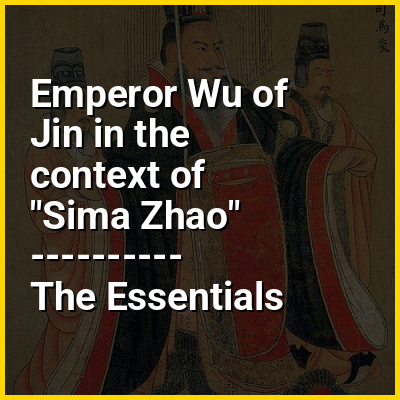
Emperor Wu of Jin (simplified Chinese: 晋武帝; traditional Chinese: 晉武帝; pinyin: Jìn Wǔ Dì; Wade–Giles: Chin Wu-Ti; 236 – 16 May 290), personal name Sima Yan (Chinese: 司馬炎; pinyin: Sīmǎ Yán), courtesy name Anshi (安世), was a grandson of Sima Yi, nephew of Sima Shi and son of Sima Zhao. He became the first emperor of the Jin dynasty after forcing Cao Huan, last emperor of the state of Cao Wei, to abdicate to him. He reigned from 266 to 290, and after conquering the state of Eastern Wu in 280, was the emperor of a reunified China. Emperor Wu was also known for his extravagance and sensuality, especially after the unification of China; legends boasted of his incredible potency among ten thousand concubines.

Emperor Wu was commonly viewed as generous and kind, but also wasteful. His generosity and kindness undermined his rule, as he became overly tolerant of the noble families' (世族 or 士族, a political/bureaucratic landlord class from Eastern Han to Tang dynasty) corruption and wastefulness, which drained the people's resources. Further, when Emperor Wu established the Jin Dynasty, he was concerned about his regime's stability, and, believing that the predecessor state, Cao Wei, had been doomed by its failures to empower the princes of the imperial clan, he greatly empowered his uncles, his cousins, and his sons with authority, including independent military authority. This ironically led to the destabilization of the Western Jin, as the princes engaged in an internecine struggle known as the War of the Eight Princes soon after his death, and then the "Five Barbarians" uprisings that destroyed the Western Jin and forced its successor, Eastern Jin, to relocate to the region south of the Huai River.
↓ Menu

>>>PUT SHARE BUTTONS HERE<<<
In this Dossier

Emperor Wu of Jin in the context of Cao Wei

Wei (Chinese: ), also known as Cao Wei (曹魏) or Former Wei, was one of the major dynastic states in China during the Three Kingdoms period. The state was established in 220 by Cao Pi based upon the foundations laid by his father Cao Cao during the end of the Han dynasty. Its capital was initially located at Xuchang, and was later moved to Luoyang.

The name Wei first became associated with Cao Cao when he was named the Duke of Wei by the Eastern Han government in 213, and became the name of the state when Cao Pi proclaimed himself emperor in 220. Historians often add the prefix "Cao" to distinguish it from other Chinese states known as Wei. The authority of the ruling Cao family dramatically weakened following the deposition and execution of Cao Shuang, a regent for the dynasty's third emperor Cao Fang. Beginning in 249, another regent in Sima Yi gradually consolidated state authority for himself and his relatives, with the last Wei emperors largely being puppets of the Sima family. In 266, Sima Yi's grandson Sima Yan forced Emperor Yuan to abdicate, proclaiming himself to be emperor of the newly established Jin dynasty; he would be posthumously known as Emperor Wu (of Jin).

↑ Return to Menu

Emperor Wu of Jin in the context of Jin dynasty (266–420)

The Jin dynasty or the Jin Empire, officially Jin, sometimes distinguished as the Sima Jin or the Two Jins, was an imperial dynasty in China that existed from 266 to 420. It was founded by Sima Yan, eldest son of Sima Zhao, who had previously been declared the King of Jin. There are two main divisions in the history of the dynasty. The Western Jin (266–316) was established as the successor to Cao Wei after Sima Yan usurped the throne from Cao Huan. The capital of the Western Jin was initially in Luoyang, though it later moved to Chang'an (modern Xi'an). In 280, after conquering Eastern Wu, the Western Jin ended the Three Kingdoms period and reunited China proper for the first time since the end of the Han dynasty.

From 291 to 306, a series of civil wars known as the War of the Eight Princes were fought over control of the Jin state which weakened it considerably. In 304, the dynasty experienced a wave of rebellions by non-Han ethnicities termed by exonym as "Five Barbarians". The "barbarians" went on to establish nonpermanent dynastic states in northern China. This helped to usher in the Sixteen Kingdoms era of Chinese history, in which states in the north rose and fell in rapid succession, constantly fighting both one another and the Jin. Han-Zhao, one of the northern states established during the disorder, sacked Luoyang in 311, captured Chang'an in 316, and executed Emperor Min of Jin in 318, ending the Western Jin era. Sima Rui, who succeeded Emperor Min, then reestablished the Jin dynasty with its capital in Jiankang (modern Nanjing), inaugurating the Eastern Jin (317–420).

↑ Return to Menu

Emperor Wu of Jin in the context of Conquest of Wu by Jin

The conquest of Wu by Jin was a military campaign launched by the Jin dynasty against the state of Wu from late 279 to mid 280 at the end of the Three Kingdoms period of China. The campaign, which started in December 279 or January 280, concluded with complete victory for the Jin dynasty on 1 May 280 when the Wu emperor Sun Hao surrendered. After the campaign, the Jin emperor Sima Yan (Emperor Wu) changed the era name of his reign from "Xianning" to "Taikang". Hence, the campaign has also been referred to as the Taikang campaign.

The campaign is significant in pre-1911 Chinese military history as it not only ended the chaos of the Three Kingdoms period and reunified China under the Jin dynasty, but was also the first successful large-scale military operation in Chinese history that involved a massive invasion force crossing the Yangtze. Among other aspects, its multi-directional approach, invasions by both land and water, and the sending of a naval fleet downstream along the Yangtze, have had strong influences on subsequent battles in Chinese military history.

↑ Return to Menu

Emperor Wu of Jin in the context of Guozijian

The Guozijian, sometimes translated as the Imperial College, Imperial Academy, Imperial University, National Academy, or National University, was the highest level academic and educational institution throughout most of imperial China's history. It was created under the reign of Emperor Wu of Jin (r. 265–289) and became the highest level academic institution in China over the next 200 years. After the demise of the Song dynasty (960–1279), it became synonymous with the previous highest level academic institution, the Taixue. The Guozijian was abolished in 1907 during the Qing dynasty.

↑ Return to Menu

Emperor Wu of Jin in the context of Cao Fang

Cao Fang (pronunciation) (232–274), courtesy name Lanqing, was the third and longest-reigning emperor of the state of Cao Wei during the Three Kingdoms period. He was an adopted son of Cao Rui, the second ruler of Wei. Cao Fang ruled from January 239 to October 254 as a nominal emperor before he was deposed by the regent Sima Shi, after which he became known as the "Prince of Qi". After the fall of Wei in February 266, Cao Fang was conferred the title of "Duke of Shaoling" by Emperor Wu of the Jin dynasty. When he died in 274, he was granted the posthumous name "Li", so his full posthumous title became "Duke Li of Shaoling".

↑ Return to Menu