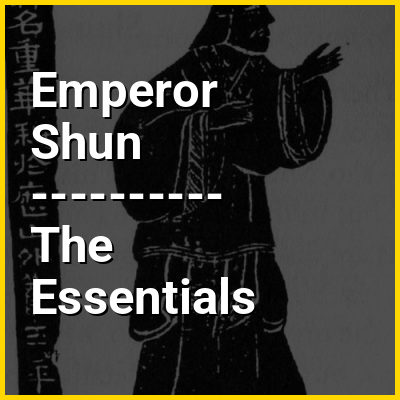
Emperor Shun (Chinese: 帝舜; pinyin: Dì Shùn) was a legendary leader of ancient China, regarded by some sources as the last of the Five Emperors among the Three Sovereigns and Five Emperors. Tradition holds that he lived sometime between 2294 BC and 2184 BC. Tradition also holds that those with the surname Hu (胡) are descendants of Emperor Shun. Subsequent rulers of the Chen state and the Chen dynasty claimed descent from Shun.
>>>PUT SHARE BUTTONS HERE<<<
In this Dossier
Emperor Shun in the context of Xia dynasty
The Xia dynasty (/ʃiɑː/; Chinese: 夏朝, romanized: Xià cháo) is the first dynasty in traditional Chinese historiography. According to tradition, it was established by the likely legendary figure Yu the Great, after Shun, the last of the Five Emperors, gave the throne to him. In traditional historiography, the Xia dynasty was succeeded by the Shang dynasty.
There are no contemporaneous records of the Xia, and they are not mentioned in the oldest Chinese texts, the earliest oracle bone inscriptions dating from the Late Shang period (13th century BC). The earliest mentions occur in the oldest chapters of the Book of Documents, which report speeches from the early Western Zhou period and are accepted by most scholars as dating from that time. The speeches justify the Zhou conquest of the Shang as the passing of the Mandate of Heaven and liken it to the succession of the Xia by the Shang. That political philosophy was promoted by the Confucian school in the Eastern Zhou period. The succession of dynasties was incorporated into the Bamboo Annals and Shiji and became the official position of imperial historiography and ideology. Some scholars consider the Xia dynasty legendary or at least unsubstantiated. Others identify it with the archaeological Erlitou culture (c. 1900–1700 BC), although there is no firm evidence, such as surviving written records, to support such a linkage.
Emperor Shun in the context of Chen (state)
Chen (simplified Chinese: 陈; traditional Chinese: 陳; pinyin: Chén) was a state founded by Duke Hu of Chen during the Zhou dynasty of ancient China. It existed from c. 1045 BC–479 BC. Its capital was Wanqiu, in present-day Huaiyang County in the plains of eastern Henan province. Chen, the 4th most popular Chinese surname in the world, and members of the Hu clan, the 13th most popular Chinese surname in the world, would claim descent from the Duke Hu of Chen who was in turn descended from the legendary Emperor Shun. At its peak, Chen encompassed fourteen cities in modern-day Henan and Anhui.
Emperor Shun in the context of Hou Ji
Hou Ji (or Houji; Chinese: 后稷; pinyin: Hòu Jì; Wade–Giles: Hou Chi) was a legendary Chinese culture hero credited with introducing millet to humanity during the time of the Xia dynasty. Millet was the original staple grain of northern China, prior to the introduction of wheat. His name translates as Lord of Millet and was a title granted to him by Emperor Shun, according to Records of the Grand Historian. Houji was credited with developing the philosophy of Agriculturalism and with service during the Great Flood in the reign of Yao; he was also claimed as an ancestor of the Ji clan that became the ruling family of the Zhou dynasty or a founder of the Zhou.
After the Zhou dynasty, ancient Chinese historians, folklorists, and religious practitioners had a variety of opinions on Hou Ji, including the opinion that he became deified as the god Shennong after his death.