Elizabeth of Russia in the context of Anna of Russia


Elizabeth of Russia in the context of Anna of Russia

⭐ Core Definition: Elizabeth of Russia

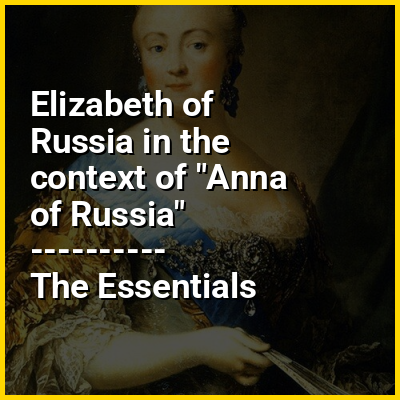
Elizabeth or Elizaveta Petrovna (Russian: Елизаве́та Петро́вна; 29 December [O.S. 18 December] 1709 – 5 January [O.S. 25 December] 1762) was Empress of Russia from 1741 until her death in 1762. She remains one of the most popular Russian monarchs because of her decision not to execute a single person during her reign, her numerous construction projects, and her strong opposition to Prussian policies. She was the last person on the agnatic line of the Romanovs as her nephew ascended, thus creating the house of Holstein-Gottorp-Romanov.

The second-eldest daughter of Tsar Peter the Great (r. 1682–1725), Elizabeth lived through the confused successions of her father's descendants following her half-brother Alexei's death in 1718. The throne first passed to her mother Catherine I of Russia (r. 1725–1727), then to her nephew Peter II, who died in 1730 and was succeeded by Elizabeth's first cousin Anna (r. 1730–1740). After the brief rule of Anna's infant great-nephew, Ivan VI, Elizabeth seized the throne with the military's support and declared her own nephew, the future Peter III, her heir.
↓ Menu
HINT:

In this Dossier

Elizabeth of Russia in the context of Elizabethan Baroque

Elizabethan Baroque (Russian: Елизаветинское барокко, romanizedYelizavetinskoye barokko or Elizavetinskoe barokko) is a term for the Russian Baroque architectural style, developed during the reign of Elizabeth of Russia between 1741 and 1762. It is also called style Rocaille or Rococo style. The Italian architect Francesco Bartolomeo Rastrelli is the key figure of this trend, which is still given the name 'Rastrellian Baroque'. The Russian architect Savva Chevakinsky is also a renowned figure representing this style.

View the full Wikipedia page for Elizabethan Baroque
↑ Return to Menu

Elizabeth of Russia in the context of Great Northern Expedition

The Great Northern Expedition (Russian: Великая Северная экспедиция) or Second Kamchatka Expedition (Russian: Вторая Камчатская экспедиция) was a major Russian Arctic expedition between roughly 1733 and 1743, which mapped most of the Arctic coast of Siberia and much of the Arctic coast of North America, greatly reducing "white areas" on maps. It was conceived by Russian emperor Peter the Great, and took place under empresses Anna and Elizabeth. Peter hoped for the 18th-century Russian Navy to map a Northern Sea Route from Europe to the Pacific. The endeavour was sponsored by the Admiralty College in Saint Petersburg. The main organiser and leader of the expedition was Vitus Bering, who had been commissioned by Peter to lead the earlier First Kamchatka Expedition (1725 to 1731). With over 3,000 people directly or indirectly involved, it was one of the largest expeditions in history.

The expedition's primary objective was reaching the eastern reaches of Siberia, and from there the western shores of North America. The expedition included the European discovery of Alaska, the Aleutian Islands, the Commander Islands, and Bering Island—as well as a detailed cartographic assessment of the northern and north-eastern coast of Russia and the Kuril Islands. Any large landmass in the North Pacific, as well as any economically viable Northeast Passage sought since the 16th century, were both proven not to exist. Other findings included ethnographic, historic, and scientific research into Siberia and Kamchatka. Its cost was an estimated 1.5 million rubles, financed entirely by the Russian state, equal to roughly one-sixth of state income in 1724.

View the full Wikipedia page for Great Northern Expedition
↑ Return to Menu

Elizabeth of Russia in the context of Kropyvnytskyi

Kropyvnytskyi (Ukrainian: Кропивницький, IPA: [kropɪu̯ˈnɪtsʲkɪj] ) is a city in central Ukraine, situated on the Inhul River. It serves as the administrative center of Kirovohrad Oblast. Population: 219,676 (2022 estimate).

Over its history, Kropyvnytskyi has changed its name several times. The settlement was known as Yelysavethrad after Empress Elizabeth of Russia from 1752 to 1924, or simply Elysavet. In 1924, as part of the Soviet Union, it became known as Zinovievsk after the revolutionary Grigory Zinoviev, who was born there. Following the assassination of Sergei Kirov in 1934, the town was renamed Kirovo.

View the full Wikipedia page for Kropyvnytskyi
↑ Return to Menu

Elizabeth of Russia in the context of Maria Gendrikova

Countess Maria Semenovna Choglokova (Russian: Мария Симоновна Чоглокова; née Gendrikova or Hendrikova; 1723 – 19 March 1756), was a Russian lady-in-waiting and noble. She was a cousin and confidante of Empress Elizabeth of Russia, and chief lady-in-waiting to the future Catherine the Great. She played an important part in the early married life of Catherine, and is given a prominent place in Catherine's memoirs.

View the full Wikipedia page for Maria Gendrikova
↑ Return to Menu

Elizabeth of Russia in the context of Ivan VI of Russia

Ivan VI Antonovich (Russian: Иван VI Антонович; 23 August [O.S. 12 August] 1740 – 16 July [O.S. 5 July] 1764), also known as Ioann Antonovich, was Emperor of Russia from October 1740 until he was overthrown by his cousin Elizabeth Petrovna in December 1741. He was only two months old when he was proclaimed emperor and his mother, Anna Leopoldovna, named regent, but the throne was seized in a coup after little more than a year. Ivan and his parents were imprisoned far from the capital, and spent the rest of their lives in captivity.

View the full Wikipedia page for Ivan VI of Russia
↑ Return to Menu

Elizabeth of Russia in the context of Russian Baroque

Russian Baroque is a term used to describe the Baroque artistic style that emerged in the Russian Tsardom and the Russian Empire during the late 17th and early 18th centuries. This style was mainly seen in Saint Petersburg and Moscow during the reigns of Peter the Great and Elizabeth of Russia.

View the full Wikipedia page for Russian Baroque
↑ Return to Menu

Elizabeth of Russia in the context of Abram Petrovich Gannibal

Abram Petrovich Gannibal, also Hannibal or Ganibal, or Abram Hannibal or Abram Petrov (Russian: Абра́м Петро́вич Ганниба́л; c. 1696 – 14 May 1781), was a Russian Chief Military Engineer, General-in-Chief, and nobleman of African origin. As a child, Gannibal was captured by Ottomans and brought to Russia as a gift for Peter the Great. He was then raised in the emperor's court, with the emperor becoming his godfather at his baptism.

Gannibal eventually rose to become a prominent member of the imperial court in the reign of Peter's daughter Elizabeth. He had ten children, most of whom became members of the Russian nobility. One of his great-grandsons was the author and poet Alexander Pushkin.

View the full Wikipedia page for Abram Petrovich Gannibal
↑ Return to Menu

Elizabeth of Russia in the context of Peterhof Palace

The Peterhof Palace (Russian: Петерго́ф, romanized: Petergóf, IPA: [pʲɪtʲɪrˈɡof]; an emulation of German "Peterhof", meaning "Peter's Court") is a series of palaces and gardens located in Petergof, Saint Petersburg, Russia, commissioned by Peter the Great as a direct response to the Palace of Versailles by Louis XIV of France. Originally intending it in 1709 for country habitation, Peter the Great sought to expand the property as a result of his visit to the French royal court in 1717, inspiring the nickname of "The Russian Versailles". The architect between 1714 and 1728 was Domenico Trezzini, and the style he employed became the foundation for the Petrine Baroque style favored throughout Saint Petersburg. Also in 1714, Jean-Baptiste Alexandre Le Blond, likely chosen due to his previous collaborations with Versailles landscaper André Le Nôtre, designed the gardens. Francesco Bartolomeo Rastrelli completed an expansion from 1747 to 1756 for Elizabeth of Russia. The palace-ensemble along with the city center is recognized as a UNESCO World Heritage Site.

View the full Wikipedia page for Peterhof Palace
↑ Return to Menu