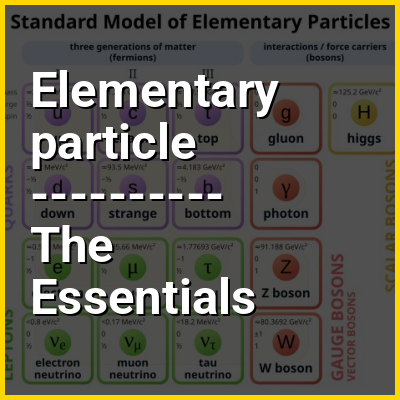
In particle physics, an elementary particle or fundamental particle is a subatomic particle that is not composed of other particles. The Standard Model recognizes seventeen distinct particles—twelve fermions and five bosons. As a consequence of flavor and color combinations and antimatter, the fermions and bosons are known to have 48 and 13 variations, respectively. These 61 elementary particles include electrons and other leptons, quarks, and the fundamental bosons. Subatomic particles such as protons or neutrons, which contain two or more elementary particles, are known as composite particles.
Ordinary matter is composed of atoms, themselves once thought to be indivisible elementary particles. The name atom comes from the Ancient Greek word ἄτομος (atomos) which means indivisible or uncuttable. Despite the theories about atoms that had existed for thousands of years, the factual existence of atoms remained controversial until 1905. In that year, Albert Einstein published his paper on Brownian motion, putting to rest theories that had regarded molecules as mathematical illusions. Einstein subsequently identified matter as ultimately composed of various concentrations of energy.