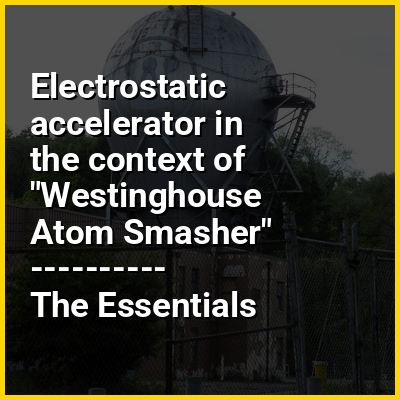
An electrostatic particle accelerator is a particle accelerator in which charged particles are accelerated to a high energy by a static high-voltage potential. The reason that only charged particles can be accelerated is that only charged particles are influenced by an electric field, according to the formula F=qE, which causes them to move. This contrasts with the other major category of particle accelerator, oscillating field particle accelerators, in which the particles are accelerated by oscillating electric fields.
Owing to their simpler design, electrostatic types were the first particle accelerators. The two most common types are the Van de Graaff generator invented by Robert Van de Graaff in 1929, and the Cockcroft–Walton accelerator invented by John Cockcroft and Ernest Walton in 1932. The maximum particle energy produced by electrostatic accelerators is limited by the maximum voltage which can be achieved the machine. This is in turn limited by insulation breakdown to a few megavolts. Oscillating accelerators do not have this limitation, so they can achieve higher particle energies than electrostatic machines.