Electromagnetic force in the context of Atoms


Electromagnetic force in the context of Atoms

Electromagnetic force Study page number 1 of 1

Play TriviaQuestions Online!

or

Skip to study material about Electromagnetic force in the context of "Atoms"


⭐ Core Definition: Electromagnetic force

In physics, electromagnetism is an interaction that occurs between particles with electric charge via electromagnetic fields. The electromagnetic force is one of the four fundamental forces of nature. It is the dominant force in the interactions of atoms and molecules. Electromagnetism can be thought of as a combination of electrostatics and magnetism, which are distinct but closely intertwined phenomena. Electromagnetic forces occur between any two charged particles. Electric forces cause an attraction between particles with opposite charges and repulsion between particles with the same charge, while magnetism is an interaction that occurs between charged particles in relative motion. These two forces are described in terms of electromagnetic fields. Macroscopic charged objects are described in terms of Coulomb's law for electricity and Ampère's force law for magnetism; the Lorentz force describes microscopic charged particles.

The electromagnetic force is responsible for many of the chemical and physical phenomena observed in daily life. The electrostatic attraction between atomic nuclei and their electrons holds atoms together. Electric forces also allow different atoms to combine into molecules, including the macromolecules such as proteins that form the basis of life. Meanwhile, magnetic interactions between the spin and angular momentum magnetic moments of electrons also play a role in chemical reactivity; such relationships are studied in spin chemistry. Electromagnetism also plays several crucial roles in modern technology: electrical energy production, transformation and distribution; light, heat, and sound production and detection; fiber optic and wireless communication; sensors; computation; electrolysis; electroplating; and mechanical motors and actuators.

↓ Menu
HINT:

In this Dossier

Electromagnetic force in the context of Photon

A photon (from Ancient Greek φῶς, φωτός (phôs, phōtós) 'light') is an elementary particle that is a quantum of the electromagnetic field, including electromagnetic radiation such as light and radio waves, and the force carrier for the electromagnetic force. Photons are massless particles that can only move at one speed, the speed of light measured in vacuum. The photon belongs to the class of boson particles.

As with other elementary particles, photons are best explained by quantum mechanics and exhibit wave–particle duality, their behavior featuring properties of both waves and particles. The modern photon concept originated during the first two decades of the 20th century with the work of Albert Einstein, who built upon the research of Max Planck. While Planck was trying to explain how matter and electromagnetic radiation could be in thermal equilibrium with one another, he proposed that the energy stored within a material object should be regarded as composed of an integer number of discrete, equal-sized parts. To explain the photoelectric effect, Einstein introduced the idea that light itself is made of discrete units of energy. In 1926, Gilbert N. Lewis popularized the term photon for these energy units. Subsequently, many other experiments validated Einstein's approach.

View the full Wikipedia page for Photon
↑ Return to Menu

Electromagnetic force in the context of Radioactive decay

Radioactive decay (also known as nuclear decay, radioactivity, radioactive disintegration, or nuclear disintegration) is the process by which an unstable atomic nucleus loses energy by radiation. A material containing unstable nuclei is considered radioactive. Three of the most common types of decay are alpha, beta, and gamma decay. The weak force is the mechanism that is responsible for beta decay, while the other two are governed by the electromagnetic and nuclear forces.

Radioactive decay is a random process at the level of single atoms. According to quantum theory, it is impossible to predict when a particular atom will decay, regardless of how long the atom has existed. However, for a significant number of identical atoms, the overall decay rate can be expressed as a decay constant or as a half-life. The half-lives of radioactive atoms have a huge range: from nearly instantaneous to far longer than the age of the universe.

View the full Wikipedia page for Radioactive decay
↑ Return to Menu

Electromagnetic force in the context of Elongation (materials science)

A deformation can occur because of external loads, intrinsic activity (e.g. muscle contraction), body forces (such as gravity or electromagnetic forces), or changes in temperature, moisture content, or chemical reactions, etc.

View the full Wikipedia page for Elongation (materials science)
↑ Return to Menu

Electromagnetic force in the context of Quantum fluctuation

In quantum physics, a quantum fluctuation (also known as a vacuum state fluctuation or vacuum fluctuation) is the temporary random change in the amount of energy in a point in space, as prescribed by Werner Heisenberg's uncertainty principle. They are minute random fluctuations in the values of the fields which represent elementary particles, such as electric and magnetic fields which represent the electromagnetic force carried by photons, W and Z fields which carry the weak force, and gluon fields which carry the strong force.

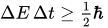
The uncertainty principle states the uncertainty in energy and time can be related by , where 1/2ħ5.27286×10 J⋅s. This means that pairs of virtual particles with energy and lifetime shorter than are continually created and annihilated in empty space. Although the particles are not directly detectable, the cumulative effects of these particles are measurable. For example, without quantum fluctuations, the "bare" mass and charge of elementary particles would be infinite; from renormalization theory the shielding effect of the cloud of virtual particles is responsible for the finite mass and charge of elementary particles.

View the full Wikipedia page for Quantum fluctuation
↑ Return to Menu

Electromagnetic force in the context of Hydrogen anion

The hydrogen anion, H, is a negative ion of hydrogen, that is, a hydrogen atom that has captured an extra electron. The hydrogen anion is an important constituent of the atmosphere of stars, such as the Sun. In chemistry, this ion is called hydride. The ion has two electrons bound by the electromagnetic force to a nucleus containing one proton.

The binding energy of H equals the binding energy of an extra electron to a hydrogen atom, called electron affinity of hydrogen. It is measured to be 0.754195(19) eV or 0.02771616(70) hartree (see Electron affinity (data page)). The total ground state energy thus becomes −14.359888 eV.

View the full Wikipedia page for Hydrogen anion
↑ Return to Menu

Electromagnetic force in the context of Yang–Mills theory

Yang–Mills theory is a quantum field theory for nuclear binding devised by Chen Ning Yang and Robert Mills in 1953, as well as a generic term for the class of similar theories. The Yang–Mills theory is a gauge theory based on a special unitary group SU(n), or more generally any compact Lie group. A Yang–Mills theory seeks to describe the behavior of elementary particles using these non-abelian Lie groups and is at the core of the unification of the electromagnetic force and weak forces (i.e. U(1) × SU(2)) as well as quantum chromodynamics, the theory of the strong force (based on SU(3)). Thus it forms the basis of the understanding of the Standard Model of particle physics.

View the full Wikipedia page for Yang–Mills theory
↑ Return to Menu