Elastic energy in the context of Energy (biology)


Elastic energy in the context of Energy (biology)

⭐ Core Definition: Elastic energy

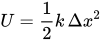
Elastic energy is the mechanical potential energy stored in the configuration of a material or physical system as it is subjected to elastic deformation by work performed upon it. Elastic energy occurs when objects are impermanently compressed, stretched or generally deformed in any manner. Elasticity theory primarily develops formalisms for the mechanics of solid bodies and materials. The elastic potential energy equation is used in calculations of positions of mechanical equilibrium. The energy is potential as it will be converted into other forms of energy, such as kinetic energy and sound energy, when the object is allowed to return to its original shape (reformation) by its elasticity.

↓ Menu
HINT:

In this Dossier

Elastic energy in the context of Energy

Energy (from Ancient Greek ἐνέργεια (enérgeia) 'activity') is the quantitative property that is transferred to a body or to a physical system, recognizable in the performance of work and in the form of heat and light. Energy is a conserved quantity—the law of conservation of energy states that energy can be converted in form, but not created or destroyed. The unit of measurement for energy in the International System of Units (SI) is the joule (J).

Forms of energy include the kinetic energy of a moving object, the potential energy stored by an object (for instance due to its position in a field), the elastic energy stored in a solid object, chemical energy associated with chemical reactions, the radiant energy carried by electromagnetic radiation, the internal energy contained within a thermodynamic system, and rest energy associated with an object's rest mass. These are not mutually exclusive.

View the full Wikipedia page for Energy
↑ Return to Menu

Elastic energy in the context of Kinetic energy weapon

A kinetic energy weapon (also known as kinetic weapon, kinetic energy warhead, kinetic warhead, kinetic projectile, kinetic kill vehicle) is a projectile weapon based solely on a projectile's kinetic energy to inflict damage to a target, instead of using any explosive, incendiary, chemical or radiological payload. All kinetic weapons work by attaining a high flight speed – generally supersonic or even up to hypervelocity – and collide with their targets, converting their kinetic energy and relative impulse into destructive shock waves, heat and cavitation. In kinetic weapons with unpowered flight, the muzzle velocity or launch velocity often determines the effective range and potential damage of the kinetic projectile.

Kinetic weapons are the oldest and most common ranged weapons used in human history, with the projectiles varying from blunt projectiles such as rocks and round shots, pointed missiles such as arrows, bolts, darts, and javelins, to modern tapered high-velocity impactors such as bullets, flechettes, and penetrators. Typical kinetic weapons accelerate their projectiles mechanically (by muscle power, mechanical advantage devices, elastic energy or pneumatics) or chemically (by propellant combustion, as with firearms), but newer technologies are enabling the development of potential weapons using electromagnetically launched projectiles, such as railguns, coilguns and mass drivers. There are also concept weapons that are accelerated by gravity, as in the case of kinetic bombardment weapons designed for space warfare.

View the full Wikipedia page for Kinetic energy weapon
↑ Return to Menu