El Dorado in the context of Lake Guatavita


El Dorado in the context of Lake Guatavita

⭐ Core Definition: El Dorado

El Dorado (Spanish: [el doˈɾaðo]) is a mythical city of gold supposedly located somewhere in South America. The king of this city was said to be so rich that he would cover himself from head to foot in gold dust – either daily or on certain ceremonial occasions – before diving into a sacred lake to wash it off. The legend was first recorded in the 16th century by Spanish colonists in the Americas; they referred to the king as el Dorado, the Golden One, a name which eventually came to be applied to the city itself.

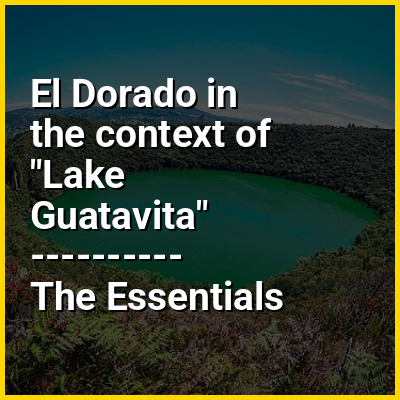
The legend is inspired by the culture of the Muisca, an indigenous people who inhabited a plateau in the Andean Mountains range in present-day Colombia. Each time a new leader or Zipa was crowned, his body was covered in gold dust and offerings were transported along to the depths of Lake Guatavita, invoking the goddess who inhabited the lake. This ritual is known as the Muisca Golden Ceremony.
↓ Menu
HINT:

In this Dossier

El Dorado in the context of Gonzalo Jiménez de Quesada

Gonzalo Jiménez de Quesada y Rivera, also spelled as Ximénez and De Quezada, (Spanish: [gonˈθalo xiˈmeneθ ðe keˈsaða]; 1509 – 16 February 1579) was a Spanish explorer and conquistador in northern South America, territories currently known as Colombia. He explored the territory named by him, New Kingdom of Granada, and founded its capital, Santafé de Bogotá. As a well-educated lawyer he was one of the intellectuals of the Spanish conquest. He was an effective organizer and leader, designed the first legislation for the government of the area, and was its historian. He was governor of Cartagena between 1556 and 1557, and after 1569 he undertook explorations toward the east, searching for the elusive El Dorado. The campaign didn't succeed and Jiménez then returned to New Granada in 1573. He has been suggested as a possible model for Cervantes' Don Quixote.

View the full Wikipedia page for Gonzalo Jiménez de Quesada
↑ Return to Menu

El Dorado in the context of German Venezuela

Klein-Venedig (German for 'Little Venice') or Welserland (German pronunciation: [ˈvɛlzɐlant]) was the most significant territory of the German colonization of the Americas, from 1528 to 1546, in which the Welser banking and patrician family of the Free Imperial Cities of Augsburg and Nuremberg obtained colonial rights in the Province of Venezuela in return for debts owed by the Holy Roman Emperor Charles V, who was also King of Spain. In 1528, Charles V issued a charter by which the House of Welser possessed the rights to explore, rule and colonize the area, also with the motivation of searching for the legendary golden city of El Dorado. The venture was led at first by Ambrosius Ehinger, who founded Maracaibo in 1529. After the deaths of Ehinger (1533) and then his successor Georg von Speyer (1540), Philipp von Hutten continued exploration in the interior, and in his absence from the capital of the province, the crown of Spain claimed the right to appoint the governor. On Hutten's return to the capital, Santa Ana de Coro, in 1546, the Spanish governor Juan de Carvajal had von Hutten and Bartholomeus VI. Welser executed. King Charles V revoked Welser's charter.

Welser transported to the colony German miners, and 4,000 African slaves as labor to work sugar cane plantations. Many of the German colonists died of tropical diseases or were attacked and killed during frequent journeys deep into native territory in search of gold.

View the full Wikipedia page for German Venezuela
↑ Return to Menu

El Dorado in the context of The Discovery of Guiana

The Discovery of Guiana is a book by Sir Walter Raleigh, who wrote this account one year after his 1595 journey to Guiana, the Venezuelan region of Guayana. He also visited Trinidad. The book includes some material of a factual nature, but postulates the existence of a gold-rich civilisation (El Dorado) on the basis of little evidence.

View the full Wikipedia page for The Discovery of Guiana
↑ Return to Menu

El Dorado in the context of Saint Joseph, Trinidad and Tobago

Saint Joseph was founded in 1592 by Antonio de Berrio and is the oldest town in Trinidad and Tobago. Originally named San José de Oruña, it was the capital of Spanish Trinidad between 1592 and 1783. In 1595, it was attacked and held by Sir Walter Raleigh and was used as a base for his exploration of the Orinoco River in search of the fabled city of El Dorado. Soon after his return the place was burnt and sacked.

St. Joseph is not an incorporated municipality. It falls within the boundaries of the Tunapuna–Piarco region.

View the full Wikipedia page for Saint Joseph, Trinidad and Tobago
↑ Return to Menu