El Cid in the context of "Jimena Díaz"

Play Trivia Questions online!

or

Skip to study material about El Cid in the context of "Jimena Díaz"


⭐ Core Definition: El Cid

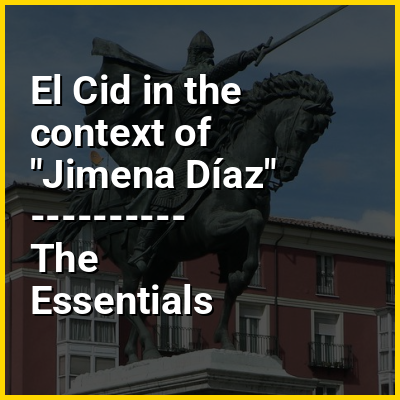
Rodrigo Díaz de Vivar (c. 1043 – 10 July 1099) was a Castilian knight and ruler in medieval Spain. Fighting with both Christian and Muslim armies during his lifetime, he earned the Arabic honorific as-Sayyid ("the Lord" or "the Master"), which would evolve into El Çid (Spanish: [el ˈθið], Old Spanish: [el ˈts̻id]), and the Spanish honorific El Campeador ("the Champion"). He was born in Vivar, a village near the city of Burgos.

As the head of his loyal knights, he came to dominate the Levante of the Iberian Peninsula at the end of the 11th century. He reclaimed the Taifa of Valencia from Moorish control for a brief period, ruling the Principality of Valencia from 17 June 1094 until his death in 1099. His wife, Jimena Díaz, inherited the city and maintained it until 1102 when it was reconquered by the Moors.
↓ Menu

In this Dossier

El Cid in the context of Le Cid

Le Cid is a five-act French tragicomedy written by Pierre Corneille, first performed in December 1636 at the Théâtre du Marais in Paris and published the same year. It is based on Guillén de Castro's play Las Mocedades del Cid. Castro's play in turn is based on the legend of El Cid.

An enormous popular success, Corneille's Le Cid was the subject of a heated polemic over the norms of dramatic practice known as the Querelle du Cid (Quarrel of The Cid). Cardinal Richelieu's Académie française acknowledged the play's success, but determined that it was defective, in part because it did not respect the classical unities.

↑ Return to Menu

El Cid in the context of King of Valencia

For the majority of the Middle Ages, Valencia was a constituent part of larger polities. From the time of the Muslim conquest of the Iberian Peninsula, Valencia was controlled by the Umayyad Caliphate in Damascus and the Emirate/Caliphate of Cordoba. Following the latter's collapse, Valencia became the seat of a Taifa state ruled by a succession of local dynasties from 1010 until it was conquered by Rodrigo Díaz de Vivar, El Cid, in 1095. He ruled until his death, when his widow swore fealty to Castile, but was forced out in 1102 and Valencia fell back under the control of a Muslim Caliphate.

Again in the 1140s, Caliphate collapse led to the return of local rule, but following four changes of leadership in two years it fell under the control of neighboring Murcia, and later the Almohad Caliphate. A third time, in 1229, Valencia saw almost a decade of local rule before being conquered by Aragon in 1237. Valencia was reorganized into an administrative 'Kingdom of Valencia' within the Crown of Aragon, ruled by Governors appointed by the Aragonese monarch. This arrangement continued until the formal creation of the Crown of Spain and abolition of the previous administrative kingdoms by the Nueva Planta Decrees in 1714.

↑ Return to Menu

El Cid in the context of Alfonso VI of León and Castile

Alfonso VI (c. 1040/1041 – 1 July 1109), nicknamed the Brave (El Bravo) or the Valiant, was king of León (1065–1109), Galicia (1071–1109), and Castile (1072–1109).

After the conquest of Toledo in 1085, Alfonso proclaimed himself victoriosissimo rege in Toleto, et in Hispania et Gallecia (most victorious king of Toledo, and of Spain and Galicia). This conquest, along with El Cid's taking of Valencia would greatly expand the territory and influence of the Leonese/Castilian realm, but also provoked an Almoravid invasion that Alfonso would spend the remainder of his reign resisting. The Leonese and Castilian armies suffered decisive defeats in the battles of Sagrajas (1086), Consuegra (1097) and Uclés (1108), in the latter of which his only son and heir, Sancho Alfónsez, died, and Valencia was abandoned but Toledo remained part of an expanded realm that he passed to his daughter.

↑ Return to Menu

El Cid in the context of Cantar de mio Cid

El Cantar de mio Cid, or El Poema de mio Cid ("The Song of My Cid"; "The Poem of My Cid"), is an anonymous cantar de gesta and the oldest preserved Castilian epic poem. Based on a true story, it tells of the deeds of the Castilian hero and knight in medieval Spain Rodrigo Díaz de Vivar—known as El Cid—and takes place during the eleventh century, an era of conflicts in the Iberian Peninsula between the Kingdom of Castile and various Taifa principalities of Al-Andalus. It is considered a national epic of Spain.

The work survives in a medieval manuscript which is now in the Spanish National Library.

↑ Return to Menu

El Cid in the context of Taifa of Valencia

The Taifa of Valencia was a medieval Muslim kingdom which existed in and around Valencia, Spain. It gained independence from the Caliphate of Córdoba circa 1010 and became its own small kingdom, or Taifa, for most of the 11th century. It was absorbed by the Taifa of Toledo in 1065, which in turn fell to Alfonso VI of León and Castile in 1085. From 1094 to 1099, the kingdom was ruled directly by the Castilian military commander known as El Cid, then by his wife Jimena after his death, until being annexed by the Almoravids in 1102.

Following the collapse of Almoravid power, Valencia became independent again in 1145. From 1147 to 1172, it was under the control of Ibn Mardanish, after which it was annexed by the Almohads. When the Almohads retreated from al-Andalus, Valencia became independent once again from around 1229 to 1238 under the rule of Zayyan ibn Mardanish. It was finally conquered by the Crown of Aragon in 1238.

↑ Return to Menu