Edgar of England in the context of New Minster, Winchester


Edgar of England in the context of New Minster, Winchester

⭐ Core Definition: Edgar of England

Edgar (or Eadgar; c. 944 – 8 July 975), also known as Edgar the Peacemaker and the Peaceable, was King of the English from 959 until his death in 975. He became king of all England on his brother Eadwig's death. He was the younger son of King Edmund I and his first wife, Ælfgifu. A detailed account of Edgar's reign is not possible, because only a few events were recorded by chroniclers and monastic writers, who were more interested in recording the activities of the leaders of the church.

Edgar mainly followed the political policies of his predecessors, but there were major changes in the religious sphere. The English Benedictine Reform, which he strongly supported, became a dominant religious and social force. It is seen by historians as a major achievement, and it was accompanied by a literary and artistic flowering, mainly associated with Æthelwold, Bishop of Winchester. Monasteries aggressively acquired estates from lay landowners with Edgar's assistance, leading to disorder when he died and former owners sought to recover their lost property, sometimes by force. Edgar's major administrative reform was the introduction of a standardised coinage in the early 970s to replace the previous decentralised system. He also issued legislative codes which mainly concentrated on improving procedures for enforcement of the law.
↓ Menu
HINT:

👉 Edgar of England in the context of New Minster, Winchester

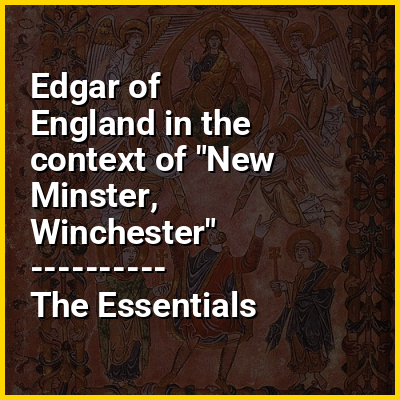
The New Minster in Winchester was a royal Benedictine abbey founded in 901 (1124 years ago) (901) in Winchester in the English county of Hampshire.

Alfred the Great had intended to build the monastery, but only got around to buying the land. His son, Edward the Elder, finished the project according to Alfred's wishes, with the help of Saint Grimbald who became its first abbot. It stood so close to the Old Minster that the voices of the two choirs merged with chaotic results. The body of King Alfred was transferred to the New Minster, Saint Grimbald joined him and it was also given the body of the Breton Saint Judoc (Saint Josse), making it an important pilgrimage centre. It became a Benedictine house in 963.

↓ Explore More Topics
In this Dossier

Edgar of England in the context of Haddington, East Lothian

The Royal Burgh of Haddington (Scots: Haidintoun, Scottish Gaelic: Baile Adainn) is a town in East Lothian, Scotland. It is the main administrative, cultural and geographical centre for East Lothian. It lies about 17 miles (27 kilometres) east of Edinburgh. The name Haddington is Anglo-Saxon, dating from the sixth or seventh century AD when the area was incorporated into the Kingdom of Bernicia. The town, like the rest of the Lothian region, was ceded by King Edgar of England and became part of Scotland in the tenth century. Haddington received Burgh status, one of the earliest to do so, during the reign of David I (1124–1153), giving it trading rights which encouraged its growth into a market town.

Today, Haddington is a small town with a population of about 10,000 people, but during the High Middle Ages it was the fourth-biggest town in Scotland (after Aberdeen, Roxburgh and Edinburgh). In the middle of the town is the Haddington Town House, completed in 1745 based on a plan by William Adam. When first built, it contained markets on the ground floor, and an assembly hall on the first floor to which improvements were made in 1788, and a spire was added in 1831. Nearby is the corn exchange (1854) and the county courthouse (1833). Other notable nearby sites include: the Jane Welsh Carlyle House; Mitchell's Close; and a building on the High Street that was the birthplace of the author and government reformer Samuel Smiles and is marked by a commemorative plaque. John Knox was probably born in Haddington and Knox Academy, the local high school, is named after him.

View the full Wikipedia page for Haddington, East Lothian
↑ Return to Menu

Edgar of England in the context of Æthelwald, Ealdorman of East Anglia

Æthelwold or Æthelwald (died 962) was ealdorman of East Anglia. He is mentioned in Byrhtferth's life of Oswald of Worcester along with other members of his family.

He was probably the oldest son of Æthelstan Half-King and succeeded to some of his father's offices in 956 when Æthelstan became a monk at Glastonbury Abbey. He was a benefactor of Ramsey Abbey and a supporter of the Benedictine reform movement which began in the reign of King Edgar.

View the full Wikipedia page for Æthelwald, Ealdorman of East Anglia
↑ Return to Menu

Edgar of England in the context of Æthelstan Rota

Æthelstan (floruit 940–970) was an Anglo-Saxon nobleman. He served as an Ealdorman in southern Mercia in the reigns of Kings Eadwig and Edgar. He is referred to as Æthelstan Rota (Æthelstan the Red) in one charter, and is so known to distinguish him from Æthelstan Half-King, and another Æthelstan (fl. 940–949), who were Ealdormen in the same period.

Æthelstan rose to prominence in the reign of King Eadwig; Æthelflæd of Damerham, second wife of Eadwig's father King Edmund I, and thus Eadwig's stepmother, was married to this Æthelstan. Æthelflæd was a woman of considerable influence, and not merely as a relict of King Edmund; her father Ælfgar is described as a dux and Ealdorman of Essex.

View the full Wikipedia page for Æthelstan Rota
↑ Return to Menu