Edgar, King of England in the context of "King of the English"

Play Trivia Questions online!

or

Skip to study material about Edgar, King of England in the context of "King of the English"

Ad spacer

⭐ Core Definition: Edgar, King of England

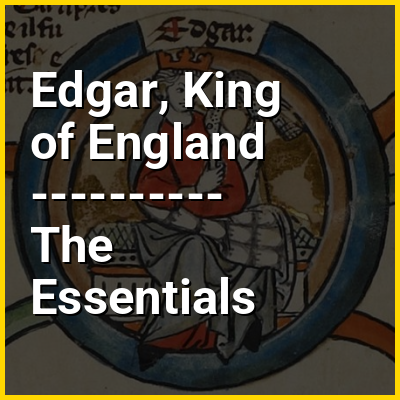
Edgar (or Eadgar), c. 944 – 8 July 975, also known as Edgar the Peacemaker and the Peaceable, was King of the English from 959 until his death in 975. He became king of all England on his brother Eadwig's death. He was the younger son of King Edmund I and his first wife, Ælfgifu. A detailed account of Edgar's reign is not possible, because only a few events were recorded by chroniclers and monastic writers, who were more interested in recording the activities of the leaders of the church.

Edgar mainly followed the political policies of his predecessors, but there were major changes in the religious sphere. The English Benedictine Reform, which he strongly supported, became a dominant religious and social force. It is seen by historians as a major achievement, and it was accompanied by a literary and artistic flowering, mainly associated with Æthelwold, Bishop of Winchester. Monasteries aggressively acquired estates from lay landowners with Edgar's assistance, leading to disorder when he died and former owners sought to recover their lost property, sometimes by force. Edgar's major administrative reform was the introduction of a standardised coinage in the early 970s to replace the previous decentralised system. He also issued legislative codes which mainly concentrated on improving procedures for enforcement of the law.
↓ Menu

>>>PUT SHARE BUTTONS HERE<<<
In this Dossier

Edgar, King of England in the context of Æthelred the Unready

Æthelred II c.968 – 23 April 1016), known as Æthelred the Unready, was King of the English from March 978 to December 1013 and again from February 1014 until his death in April 1016. He was the son of King Edgar (reigned 959–975) and Queen Ælfthryth. Æthelred came to the throne after the assassination of his older half-brother, King Edward the Martyr, a crime which deeply shocked people. The epithet "Unready" is a pun on his name in Old English, Æthel (noble) and ræd (counsel).

Shortly after Æthelred's accession Viking attacks resumed after a generation of peace. Minor raids in the 980s escalated to large scale attacks from the 990s, and as the English were rarely victorious in battle the king and his advisers resorted to giving the Vikings tribute to leave England, payments which are often (incorrectly) called Danegeld. In the 1000s increasingly destructive raids by Viking armies wore down English resistance, and in December 1013 King Swein Forkbeard of Denmark conquered England. Æthelred fled to Normandy, but when Swein died in February 1014 he was able to return to the throne and drive out Swein's son Cnut. In early 1015 civil war broke out when Æthelred's favourite Eadric Streona murdered close allies of Æthelred's oldest surviving son, Edmund Ironside. Cnut returned soon afterwards and Edmund and Æthelred tried to unite against him, but they were hampered by suspicion between them, Eadric's treachery and Æthelred's poor health. He died in April 1016 and Edmund carried on the war until he died in December 1016 and Cnut became king of all England.

↑ Return to Menu

Edgar, King of England in the context of Ælfthryth (wife of Edgar)

Ælfthryth (c. 945 – 1000 or 1001, also Alfrida, Elfrida or Elfthryth) was Queen of the English from her marriage to King Edgar in 964 or 965 until Edgar's death in 975. She was a leading figure in the regency during the minority of her son King Æthelred the Unready between 978 and 984.

Ælfthryth was the first wife of an English king known to have been crowned and anointed as queen. She had two sons with Edgar, the ætheling Edmund (who died young) and King Æthelred the Unready. Ælfthryth was a powerful political figure and possibly orchestrated the murder of her stepson, King Edward the Martyr, in order to place her son Æthelred on the throne. She appeared as a stereotypical bad queen and evil stepmother in many medieval histories.

↑ Return to Menu

Edgar, King of England in the context of Edward the Martyr

Edward the Martyr (c. 962 – 18 March 978) was King of the English from 8 July 975 until he was killed in 978. He was the eldest son of King Edgar (r. 959–975). On Edgar's death, the succession to the throne was contested between Edward's supporters and those of his younger half-brother, the future King Æthelred the Unready. As they were both children, it is unlikely that they played an active role in the dispute, which was probably between rival family alliances. Edward's principal supporters were Dunstan, Archbishop of Canterbury, and Æthelwine, Ealdorman of East Anglia, while Æthelred was backed by his mother, Queen Ælfthryth and her friend Æthelwold, Bishop of Winchester. The dispute was quickly settled. Edward was chosen as king and Æthelred received the lands traditionally allocated to the king's eldest son in compensation.

Edgar had been a strong and overbearing king and a supporter of the monastic reform movement. He had forced the lay nobility and secular clergy to surrender land and sell it at low prices to the monasteries. Æthelwold had been the most active and ruthless in seizing land for his monasteries with Edgar's assistance. The nobles took advantage of Edgar's death to get their lands back, mainly by legal actions but sometimes by force. The leading magnates were split into two factions, the supporters of Ælfhere, Ealdorman of Mercia, and Æthelwine, who both seized some monastic lands which they believed belonged to them, but also estates claimed by their rivals. The disputes never led to warfare.

↑ Return to Menu

Edgar, King of England in the context of Eadwig

Eadwig (also Edwy or Eadwig All-Fair, c. 940 – 1 October 959) was King of England from 23 November 955 until his death in 959. He was the elder son of Edmund I and his first wife Ælfgifu, who died in 944. Eadwig and his brother Edgar were young children when their father was killed trying to rescue his seneschal from attack by an outlawed thief on 26 May 946. As Edmund's sons were too young to rule he was succeeded by his brother Eadred, who suffered from ill health and died unmarried in his early 30s.

Eadwig became king in 955 aged about fifteen and was no more than twenty when he died in 959. He clashed at the beginning of his reign with Dunstan, the powerful Abbot of Glastonbury and future Archbishop of Canterbury, and exiled him to Flanders. He later came to be seen as an enemy of monasteries, but most historians think that this reputation is unfair. In 956, he issued more than sixty charters transferring land, a yearly total unmatched by any other European king before the twelfth century, and this is seen by some historians as either an attempt to buy support or rewarding his favourites at the expense of the powerful old guard of the previous reign.

↑ Return to Menu

Edgar, King of England in the context of Edmund I

Edmund I or Eadmund I (920/921 – 26 May 946) was King of the English from 27 October 939 until his death in 946. He was the elder son of King Edward the Elder and his third wife, Queen Eadgifu, and a grandson of King Alfred the Great. After Edward died in 924, he was succeeded by his eldest son, Edmund's half-brother Æthelstan. Edmund was crowned after Æthelstan died childless in 939. He had two sons, Eadwig and Edgar, by his first wife Ælfgifu, and none by his second wife Æthelflæd. His sons were young children when he was killed in a brawl with an outlaw at Pucklechurch in Gloucestershire, and he was succeeded by his younger brother Eadred, who died in 955 and was followed by Edmund's sons in succession.

Æthelstan had succeeded as the king of England south of the Humber and he became the first king of all England when he conquered Viking-ruled York in 927, but after his death Anlaf Guthfrithson was accepted as King of York and extended Viking rule to the Five Boroughs of north-east Mercia. Edmund was initially forced to accept the reverse, the first major setback for the West Saxon dynasty since Alfred's reign, but he was able to recover his position following Anlaf's death in 941. In 942, Edmund took back control of the Five Boroughs and in 944 he regained control over the whole of England when he expelled the Viking kings of York. Eadred had to deal with further revolts when he became king, and York was not finally conquered until 954. Æthelstan had achieved a dominant position over other British kings and Edmund maintained this, perhaps apart from Scotland. The north Welsh king Idwal Foel may have allied with the Vikings as he was killed by the English in 942. The British kingdom of Strathclyde may also have sided with the Vikings as Edmund ravaged it in 945 and then ceded it to Malcolm I of Scotland. Edmund also continued his brother's friendly relations with Continental rulers, several of whom were married to his half-sisters.

↑ Return to Menu

Edgar, King of England in the context of Ælfgifu of Shaftesbury

Ælfgifu of Shaftesbury (died 944) was the first wife of King Edmund I (r. 939–946). She was Queen of the English from her marriage in around 939 until her death in 944. Ælfgifu and Edmund were the parents of two future English kings, Eadwig (r. 955–959) and Edgar (r. 959–975). Like her mother Wynflaed, Ælfgifu had a close and special if unknown connection with the royal nunnery of Shaftesbury (Dorset), founded by King Alfred, where she was buried and soon revered as a saint. According to a pre-Conquest tradition from Winchester, her feast day is 18 May.

↑ Return to Menu

Edgar, King of England in the context of King Æthelred the Unready

Æthelred II (c. 968 – 23 April 1016), known as Æthelred the Unready, was King of the English from March 978 to December 1013 and again from February 1014 until his death in April 1016. He was the son of King Edgar (reigned 959–975) and Queen Ælfthryth. Æthelred came to the throne after the assassination of his older half-brother, King Edward the Martyr (reigned 975–978), a crime which deeply shocked people. The epithet "Unready" is a pun on his name in Old English, Æthel (noble) and ræd (counsel).

Shortly after Æthelred's accession Viking attacks resumed after a generation of peace. Minor raids in the 980s escalated to large scale attacks from the 990s. As the English were rarely victorious in battle the king and his advisers resorted to giving the Vikings tribute to leave England, payments which are often (incorrectly) called Danegeld. In the 1000s increasingly destructive raids by Viking armies wore down English resistance, and in December 1013 King Swein Forkbeard of Denmark conquered England. Æthelred fled to Normandy, but when Swein died in February 1014 he was able to return to the throne and drive out Swein's son Cnut. In early 1015 civil war broke out when Æthelred's favourite Eadric Streona murdered close allies of Æthelred's oldest surviving son, Edmund Ironside. Cnut returned soon afterwards and Edmund and Æthelred tried to unite against him, but they were hampered by suspicion between them, Eadric's treachery, and Æthelred's poor health. Æthelred died in April 1016 and Edmund carried on the war until he died in December 1016 and Cnut became king of all England.

↑ Return to Menu

Edgar, King of England in the context of Eadred

Eadred (also Edred, c. 923 – 23 November 955) was King of the English from 26 May 946 until his death in 955. He was the younger son of Edward the Elder and his third wife Eadgifu, and a grandson of Alfred the Great. His elder brother, Edmund, was killed trying to protect his seneschal from an attack by a violent thief. Edmund's two sons, Eadwig and Edgar, were then young children, so Eadred became king. He suffered from ill health in the last years of his life and he died at the age of a little over thirty, having never married. He was succeeded successively by his nephews, Eadwig and Edgar.

Eadred's elder half-brother Æthelstan inherited the kingship of England south of the Humber in 924, and conquered the south Northumbrian Viking kingdom of York in 927. Edmund and Eadred both inherited kingship of the whole kingdom, lost it shortly afterwards when York accepted Viking kings, and recovered it by the end of their reigns. In 954, the York magnates expelled their last king, Erik Bloodaxe, and Eadred appointed Osullf, the Anglo-Saxon ruler of the north Northumbrian territory of Bamburgh, as the first ealdorman of the whole of Northumbria.

↑ Return to Menu

Edgar, King of England in the context of Æthelstan Half-King

Æthelstan Half-King (fl. 932 – 956) was an Ealdorman of East Anglia who served five kings of England, including Edgar, who was brought up by Æthelstan's wife Ælfwynn, following the death of Edgar's mother. He was called the "half-king" because he was respected so highly that kings were said to depend on his advice. Many of Æthelstan's close relatives were also involved in important affairs. Soon after the death of King Eadred in 955 he left his position and became a monk at Glastonbury Abbey.

↑ Return to Menu