Edessa, Mesopotamia in the context of Şanlıurfa Castle


Edessa, Mesopotamia in the context of Şanlıurfa Castle

⭐ Core Definition: Edessa, Mesopotamia

Edessa (/əˈdɛsə/; Ancient Greek: Ἔδεσσα, romanizedÉdessa) was an ancient city (polis) in Upper Mesopotamia, in what is now Urfa or Şanlıurfa, Turkey. It was founded during the Hellenistic period by Macedonian general and self proclaimed king Seleucus I Nicator (r. 305–281 BC), founder of the Seleucid Empire. He named it after an ancient Macedonian capital. The Greek name Ἔδεσσα (Édessa) means "tower in the water". It later became capital of the Kingdom of Osroene, and continued as capital of the Roman province of Osroene. In Late Antiquity, it became a prominent center of Christian learning and seat of the Catechetical School of Edessa. During the Crusades, it was the capital of the County of Edessa.

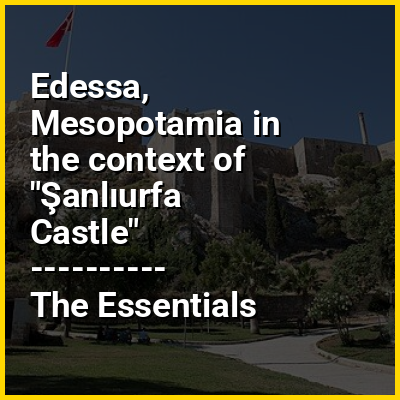
The city was situated on the banks of the Daysan River (Ancient Greek: Σκίρτος; Latin: Scirtus; Turkish: Kara Koyun), a tributary of the Khabur, and was defended by Şanlıurfa Castle, the high central citadel.
↓ Menu
HINT:

In this Dossier

Edessa, Mesopotamia in the context of Battle of Edessa

The Battle of Edessa took place between the armies of the Roman Empire, under the command of Emperor Valerian, and the Sasanian Empire under Shapur I, in Edessa (now the Turkish city of Urfa) in 260. The Roman army was defeated and captured in its entirety by the Sasanian forces; for the first time, a Roman emperor was taken prisoner.

View the full Wikipedia page for Battle of Edessa
↑ Return to Menu

Edessa, Mesopotamia in the context of Diversity in early Christian theology

Traditionally in Christianity, orthodoxy and heresy have been viewed in relation to the "orthodoxy" as an authentic lineage of tradition; other forms of Christianity were viewed as deviant streams of thought and therefore heterodox. This view was challenged by the publication of Walter Bauer's Rechtgläubigkeit und Ketzerei im ältesten Christentum ("Orthodoxy and Heresy in Earliest Christianity") in 1934. Bauer endeavored to rethink early Christianity historically, independent from the views of the current church. He stated that the 2nd-century church was very diverse and included many "heretical" groups that had an equal claim to apostolic tradition. Bauer interpreted the struggle between the orthodox and heterodox to be the "mainstream" Church of Rome struggling to attain dominance. He presented Edessa and Egypt as places where the "orthodoxy" of Rome had little influence during the 2nd century. As he saw it, the theological thought of the "Orient" (in this case the Eastern Roman Empire) at the time would later be labeled "heresy". The response by modern scholars has been mixed. Some scholars clearly support Bauer's conclusions and others express concerns about his "attacking [of] orthodox sources with inquisitional zeal and exploiting to a nearly absurd extent the argument from silence." However, modern scholars have critiqued and updated Bauer's model.

According to Keith Hopkins, the claimed institutional unity of the Christian Church was propaganda constantly repeated by orthodox Christian writers, rather than a genuine historical reality.

View the full Wikipedia page for Diversity in early Christian theology
↑ Return to Menu

Edessa, Mesopotamia in the context of Imad al-Din Zengi

Imad al-Din Zengi (Arabic: عماد الدین زنكي; c. 1084/88 – 14 September 1146), also romanized as Zangi, Zengui, Zenki, and Zanki, was a Turkoman atabeg of the Seljuk Empire, who ruled Mosul, Aleppo, Hama, and, later, Edessa. He was the namesake and founder of the Zengid dynasty of atabegs.

View the full Wikipedia page for Imad al-Din Zengi
↑ Return to Menu

Edessa, Mesopotamia in the context of Osroene (Roman province)

Osroene (Ancient Greek: Ὀσροηνή), also spelled Osrohene and Osrhoene, was a Roman province which existed for nearly 400 years. It was formed after the absorption of the Kingdom of Osroene in 214 CE and served as a frontier province against the Sassanid Empire until the Muslim conquests of the 7th century.

For the whole of its existence, the province would remain a bone of contention between the Romans and their eastern neighbors, the Sassanid Persians, suffering heavily in the recurrent Roman–Persian Wars. War broke out after the death of the Roman emperor Decius in 251 and the province was invaded by the Persians. In the second half of the 250s, the Persian shah Shapur I (r. ca. 240–270) attacked the Roman east, which was defended by the Roman emperor Valerianus (r. 253–260), whom he captured at Edessa in 260. In the next year however, Shapur was heavily defeated by Odaenathus of Palmyra and driven out of Osroene and Mesopotamia.

View the full Wikipedia page for Osroene (Roman province)
↑ Return to Menu

Edessa, Mesopotamia in the context of Thoros of Edessa

Thoros (short in Armenian for Theodoros; Թորոս կուրապաղատ, T'oros the Curopalates; d. March 9, 1098) was an Armenian ruler of Edessa at the time of the First Crusade. Thoros was a former officer (curopalates) in the Byzantine Empire and a lieutenant of Philaretos Brachamios. He was Armenian but practiced the Greek Orthodox faith.

The Chronicle of Matthew of Edessa records that "Thoros son of Hethum" was installed as governor of Edessa by Tutush, who had defeated and killed emir Bouzan in the year 543 of the Armenia era (26 Feb. 1094 – 25 Feb. 1095). According to Sturdza, Hethum [I] was descended from the Pahlavouni, an important family in Caucasian Armenia. He conquered land to the east of that conquered by his fellow Armenian Rupen. Steven Runciman calls Thoros the "son-in-law" of Gabriel of Melitene.

View the full Wikipedia page for Thoros of Edessa
↑ Return to Menu

Edessa, Mesopotamia in the context of Nizip

Nizip (Medieval Greek: Nisibis or Nisibina; Ottoman Turkish: نزيب) is a municipality and district of Gaziantep Province, Turkey. Its area is 944 km, and its population is 148,386 (2022).

It is located 45 km from the city of Gaziantep, 95 km from Şanlıurfa (Edessa), and 35 km from Karkamış.

View the full Wikipedia page for Nizip
↑ Return to Menu