Early Dynastic Period of Egypt in the context of "First Dynasty of Egypt"

Play Trivia Questions online!

or

Skip to study material about Early Dynastic Period of Egypt in the context of "First Dynasty of Egypt"

Ad spacer

⭐ Core Definition: Early Dynastic Period of Egypt

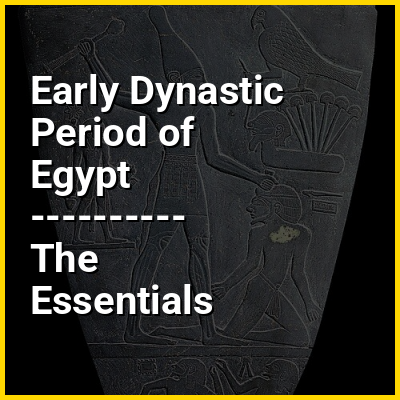
The Early Dynastic Period, also known as Archaic Period or the Thinite Period (from Thinis, the hometown of its rulers), is the era of ancient Egypt that immediately follows the unification of Upper and Lower Egypt in c. 3150 BC. It is generally taken to include the First Dynasty and the Second Dynasty, lasting from the end of the archaeological culture of Naqada III until c. 2686 BC, or the beginning of the Old Kingdom. With the First Dynasty, the Egyptian capital moved from Thinis to Memphis, with the unified land being ruled by an Egyptian god-king. In the south, Abydos remained the major centre of ancient Egyptian religion; the hallmarks of ancient Egyptian civilization, such as Egyptian art, Egyptian architecture, and many aspects of Egyptian religion, took shape during the Early Dynastic Period.

Before the unification of Egypt, the land was settled with autonomous villages. With the early dynasties, and for much of Egypt's history thereafter, the country came to be known as "The Two Lands" (referencing Upper and Lower Egypt). The pharaohs established a national administration and appointed royal governors, and buildings of the central government were typically open-air temples constructed of wood or sandstone. The earliest Egyptian hieroglyphs appear just before this period, though little is known of the spoken language that they represent.
↓ Menu

>>>PUT SHARE BUTTONS HERE<<<
In this Dossier

Early Dynastic Period of Egypt in the context of Centralised government

A centralized government (also united government) is one in which both executive and legislative power is concentrated centrally at the higher level as opposed to it being more distributed at various lower level governments. In a national context, centralization occurs in the transfer of power to a typically unitary sovereign nation state. Executive and/or legislative power is then minimally delegated to unit subdivisions (state, county, municipal and other local authorities). Menes, an ancient Egyptian pharaoh of the early dynastic period, is credited by classical tradition with having united Upper and Lower Egypt, and as the founder of the first dynasty (Dynasty I), became the first ruler to institute a centralized government.

All constituted governments are, to some degree, necessarily centralized, in the sense that even a federation exerts an authority or prerogative beyond that of its constituent parts. To the extent that a base unit of society – usually conceived as an individual citizen – vests authority in a larger unit, such as the state or the local community, authority is centralized. The extent to which this ought to occur, and the ways in which centralized government evolves, forms part of social contract theory.

↑ Return to Menu

Early Dynastic Period of Egypt in the context of Conventional Egyptian chronology

The Conventional Egyptian chronology reflects the broad scholarly consensus about the outline and many details of the chronology of Ancient Egypt. It places the beginning of the Old Kingdom in the 27th century BC, the beginning of the Middle Kingdom in the 21st century BC and the beginning of the New Kingdom in the mid-16th century BC.

Disagreements remain within this consensus, and various chronologies diverge by about 300 years for the Early Dynastic Period, up to 30 years in the New Kingdom, and a few years in the Late Period.

↑ Return to Menu

Early Dynastic Period of Egypt in the context of Second Dynasty

The Second Dynasty of ancient Egypt (or Dynasty II, c. 2890c. 2686 BC) is the latter of the two dynasties of the Egyptian Archaic Period, when the seat of government was centred at Thinis. It is most known for its last ruler, Khasekhemwy, but is otherwise one of the most obscure periods in Egyptian history.

Though archaeological evidence of the time is very scant, contrasting data from the First and Third Dynasties indicates important institutional and economic developments during the Second Dynasty.

↑ Return to Menu

Early Dynastic Period of Egypt in the context of Vučedol culture

The Vučedol culture (Croatian: Vučedolska kultura) flourished between 3000 and 2200 BC (the Chalcolithic period of earliest copper-smithing and arsenical bronze-smithing), centered in Syrmia and eastern Slavonia on the right bank of the Danube river, but possibly spreading throughout the Pannonian plain and western Balkans and southward. It was thus contemporary with the Sumer period in Mesopotamia, the Early Dynastic period in Egypt and the earliest settlements of Troy (Troy I and II). Archaeogenetics link the culture from Yamnaya migrations directly from the steppes that mixed with Neolithic people. The need for copper resulted in the expansion of the Vucedol Culture from its homeland of Slavonia into the broader region of central and southeastern Europe. The Vučedol culture is also known as the 'Zok culture' in Hungary, with regional variants including the 'Mako culture' and 'Nyirseg culture', and as the 'Laibach-Ljubljana culture' In the eastern Alpine area.

↑ Return to Menu

Early Dynastic Period of Egypt in the context of Anedjib

Anedjib, more correctly Adjib and also known as Hor-Anedjib, Hor-Adjib, Anezib and Azib, is the Horus name of an early Egyptian king who ruled during the 1st Dynasty.

The Egyptian historian Manetho named him "Miebîdós" and credited him with a reign of 26 years, whilst the Royal Canon of Turin credited him with an implausible reign of 74 years. Egyptologists and historians now consider both records to be exaggerations and generally credit Adjib with a reign of 8–10 years.

↑ Return to Menu

Early Dynastic Period of Egypt in the context of List of pharaohs

The title "pharaoh" is used for those rulers of Ancient Egypt who ruled after the unification of Upper and Lower Egypt by Narmer during the Early Dynastic Period, approximately 3100 BC. However, the specific title was not used to address the kings of Egypt by their contemporaries until the New Kingdom's Eighteenth Dynasty, c. 1400 BC. Along with the title pharaoh for later rulers, there was an Ancient Egyptian royal titulary used by Egyptian kings which remained relatively constant during the course of Ancient Egyptian history, initially featuring a Horus name, a Sedge and Bee (nswt-bjtj) name and a Two Ladies (nbtj) name, with the additional Golden Horus, nomen and prenomen titles being added successively during later dynasties.

Egypt was continually governed, at least in part, by native pharaohs for approximately 2500 years, until it was conquered by the Kingdom of Kush in the late 8th century BC, whose rulers adopted the traditional pharaonic titulature for themselves. Following the Kushite conquest, Egypt experienced another period of independent native rule before being conquered by the Achaemenid Empire, whose rulers also adopted the title of pharaoh. The last native pharaoh of Egypt was Nectanebo II, who was pharaoh before the Achaemenids conquered Egypt a second time.

↑ Return to Menu