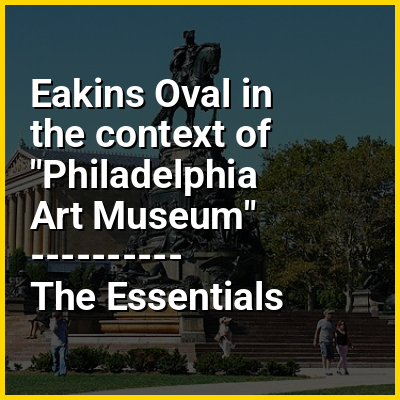
Eakins Oval in the context of Philadelphia Art Museum


Eakins Oval in the context of Philadelphia Art Museum
HINT:

In this Dossier

Eakins Oval in the context of Rocky Steps

The Rocky Steps are 72 stone steps leading up to the East entrance of the Philadelphia Museum of Art in Philadelphia that gained global fame after being featured in a notable scene from the 1976 film Rocky. In the scene, Rocky Balboa, an unpolished but ambitious boxer from Kensington played by Sylvester Stallone, begins intense physical training after deciding to fight Apollo Creed, the World Heavyweight Champion. The scene is widely considered one of the most iconic in the history of modern films.

Tourists often mimic Rocky's famous climb, which has become a physical metaphor for an underdog rising to a great challenge. A bronze Rocky statue is located at the bottom right of the steps, and is a popular photo opportunity for visitors. The top of the steps offers a commanding view of Eakins Oval, the Benjamin Franklin Parkway, and Philadelphia City Hall.

View the full Wikipedia page for Rocky Steps
↑ Return to Menu

Eakins Oval in the context of Philadelphia Museum of Art

The Philadelphia Art Museum (PhAM), formerly the Philadelphia Museum of Art, is an art museum originally chartered in 1876 for the Centennial Exposition in Philadelphia. The main museum building was completed in 1928 on Fairmount, a hill located at the northwest end of the Benjamin Franklin Parkway at Eakins Oval. The museum administers collections containing over 240,000 objects including major holdings of European, American and Asian origin. The various classes of artwork include sculpture, paintings, prints, drawings, photographs, armor, and decorative arts.

The Philadelphia Art Museum administers several annexes including the Rodin Museum, also located on the Benjamin Franklin Parkway, and the Ruth and Raymond G. Perelman Building, which is located across the street just north of the main building. The Perelman Building, which opened in 2007, houses more than 150,000 prints, drawings and photographs, 30,000 costume and textile pieces, and over 1,000 modern and contemporary design objects including furniture, ceramics, and glasswork.

View the full Wikipedia page for Philadelphia Museum of Art
↑ Return to Menu