Dress shoes in the context of "Suit"

Play Trivia Questions online!

or

Skip to study material about Dress shoes in the context of "Suit"

Ad spacer

⭐ Core Definition: Dress shoes

A dress shoe (U.S. English) is a shoe to be worn at smart casual or more formal events. A dress shoe is typically contrasted to an athletic shoe.

Dress shoes are worn by many as their standard daily shoes, and are widely used in dance, for parties, and for special occasions.

↓ Menu

>>>PUT SHARE BUTTONS HERE<<<
In this Dossier

Dress shoes in the context of Business suit

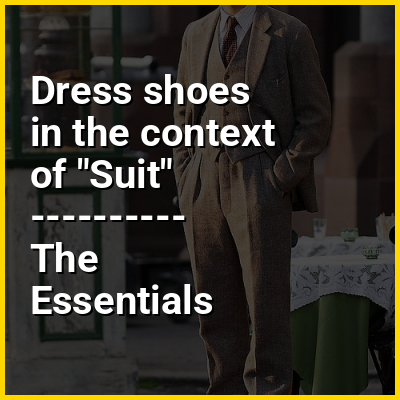
A suit, also called a lounge suit, business suit, dress suit, or formal suit, is a set of clothes comprising a suit jacket and trousers of identical textiles generally worn with a collared dress shirt, necktie, and dress shoes. A skirt suit is similar, but with a matching pencil skirt instead of trousers. It is currently considered semi-formal wear or business wear in contemporary Western dress codes; however, when the suit was originally developed it was considered an informal or more casual option compared to the prevailing clothing standards of aristocrats and businessmen. The lounge suit originated in 19th-century Britain as sportswear and British country clothing, which is why it was seen as more casual than citywear at that time, with the roots of the suit coming from early modern Western Europe formal court or military clothes. After replacing the black frock coat in the early 20th century as regular daywear, a sober one-coloured suit became known as a lounge suit.

Suits are offered in different designs and constructions. Cut and cloth, whether two- or three-piece, single- or double-breasted, vary, in addition to various accessories. A two-piece suit has a jacket and trousers; a three-piece suit adds a waistcoat. Hats were almost always worn outdoors (and sometimes indoors) with all men's clothes until the counterculture of the 1960s in Western culture. Informal suits have been traditionally worn with a fedora, a trilby, or a flat cap. Other accessories include handkerchief, suspenders or belt, watch, and jewelry.
↑ Return to Menu

Dress shoes in the context of Barong tagalog

The barong tagalog, more commonly known simply as barong (and occasionally baro), is an embroidered long-sleeved formal shirt for men and a national dress of the Philippines. Barong tagalog combines elements from both the precolonial native Filipino and colonial Spanish clothing styles. It is traditionally made with sheer textiles (nipis) woven from piña or abacá; although in modern times, cheaper materials like organza silk, ramie or polyester are also used.

It is a common formal or semi-formal attire in Filipino culture, and is worn untucked over an undershirt with belted trousers and dress shoes. Baro't saya is the feminine equivalent of barong tagalog, with the Maria Clara gown being the formal variant of the latter. Barong tagalog was also known as camisa fuera ("outer shirt") in Philippine Spanish.

↑ Return to Menu

Dress shoes in the context of Formal attire

Formal wear or full dress is the Western dress code category applicable for the most formal occasions, such as weddings, christenings, confirmations, funerals, Easter and Christmas traditions, in addition to certain state dinners, audiences, balls, and horse racing events. When formal dress is required, generally permitted alternatives include the most formal versions of ceremonial dresses (including court dresses, diplomatic uniforms and academic dresses), full dress uniforms, religious clothing, national costumes, and most rarely frock coats (which preceded morning coat as default formal day wear 1820s-1920s). In addition, formal wear is often properly worn when displaying official full size orders and medals.

The protocol specifying men's traditional formal wear has remained virtually unchanged since the early 20th century. Despite decline following the counterculture of the 1960s, it remains observed in formal settings influenced by Western culture: notably around Europe, the Americas, South Africa, Australia, as well as Japan. For women, although fundamental customs for formal ball gowns (and wedding gowns) likewise apply, changes in fashion have been more dynamic. Traditional formal headgear for men is the top hat, and for women picture hats etc. of a range of interpretations. Shoes for men are dress shoes, dress boots or pumps, and for women heeled dress pumps. In western countries, a "formal" or white tie dress code typically means tailcoats for men and evening dresses for women. The most formal dress for women is a full-length ball or evening gown with evening gloves. Some white tie functions also request that the women wear long gloves past the elbow.

↑ Return to Menu

Dress shoes in the context of Tuxedo

Black tie is a semi-formal Western dress code for evening events, originating in British and North American conventions for attire in the 19th century. In British English, the dress code is often referred to synecdochically by its principal element for men, the dinner suit or dinner jacket. In American English, the equivalent term tuxedo (or tux) is common. The dinner suit is a black, midnight blue or white two- or three-piece suit, distinguished by satin or grosgrain jacket lapels and similar stripes along the outseam of the trousers. It is worn with a white dress shirt with standing or turndown collar and link cuffs, a black bow tie, sometimes an evening waistcoat or a cummerbund, and black patent leather dress shoes or court pumps. Accessories may include a semi-formal homburg, bowler, or boater hat. In Britain, some individuals may rebel from the formal dress code by wearing coloured socks or a bow tie that is not black, such as red. For women, an evening gown or other fashionable evening attire may be worn.

The first dinner jacket is traditionally traced to 1865 on the then Prince of Wales, later King Edward VII (1841–1910). The late 19th century saw gradual introduction of the lounge jacket without tails as a less formal and more comfortable leisure alternative to the frock coat. Thus in many non-English languages, a dinner jacket is still known as the false friend "smoking". In American English, its synonym "tuxedo" was derived from the village of Tuxedo Park in New York State, where it was introduced in 1886 following the example of Europeans. Following the counterculture of the 1960s, black tie has increasingly replaced white tie for more formal settings in the United States, along with cultures influenced by American culture.

↑ Return to Menu