Doucai in the context of "Overglaze enamels"

Play Trivia Questions online!

or

Skip to study material about Doucai in the context of "Overglaze enamels"


⭐ Core Definition: Doucai

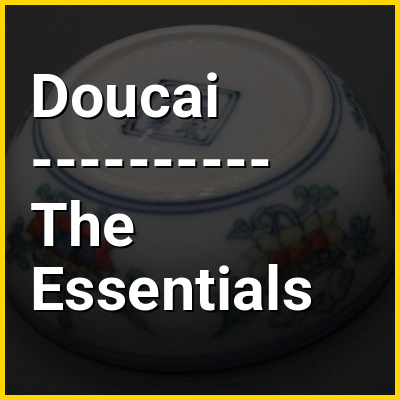
Doucai (Chinese: 斗彩; Wade–Giles: tou-ts'ai) is a technique in painting Chinese porcelain, where parts of the design, and some outlines of the rest, are painted in underglaze blue, and the piece is then glazed and fired. The rest of the design is then added in overglaze enamels of different colours and the piece fired again at a lower temperature of about 850°C to 900°C.

The style began in the 15th century under the Ming dynasty in the imperial factories at Jingdezhen, and its finest products come from a few years in the reign of the Chenghua Emperor, mostly small pieces like the famous Chicken cups. The style was discontinued after a few decades, as a suitable overglaze blue was developed, but later revived under the Qing dynasty. It is not to be confused with the wucai style, which was a related early technique for polychrome painting. Doucai can be translated as "contrasted colours", "fitted colours", "colours which fit together" or "dove-tailed colours".
↓ Menu

In this Dossier

Doucai in the context of Underglaze

Underglaze is a method of decorating pottery in which painted decoration is applied to the surface before it is covered with a transparent ceramic glaze and fired in a kiln. Because the glaze subsequently covers it, such decoration is completely durable, and it also allows the production of pottery with a surface that has a uniform sheen. Underglaze decoration uses pigments derived from oxides which fuse with the glaze when the piece is fired in a kiln. It is also a cheaper method, as only a single firing is needed, whereas overglaze decoration requires a second firing at a lower temperature.

Many historical styles, for example Persian mina'i ware, Japanese Imari ware, Chinese doucai and wucai, combine the two types of decoration. In such cases the first firing for the body, underglaze decoration and glaze is followed by the second firing after the overglaze enamels have been applied. However, because the main or glost firing is at a higher temperature than used in overglaze decoration, the range of colours available in underglaze is more limited, and was especially so for porcelain in historical times, as the firing temperature required for the porcelain body is especially high. Early porcelain was largely restricted to underglaze blue, and a range of browns and reds. Other colours turned black in a high-temperature firing.

↑ Return to Menu

Doucai in the context of Overglaze decoration

Overglaze decoration, overglaze enamelling, or on-glaze decoration, is a method of decorating pottery, most often porcelain, where the coloured decoration is applied on top of the already fired and glazed surface, and then fixed in a second firing at a relatively low temperature, often in a muffle kiln. It is often described as producing "enamelled" decoration. The colours fuse onto the glaze, so the decoration becomes durable. This decorative firing is usually done at a lower temperature which allows for a more varied and vivid palette of colours, using pigments which will not colour correctly at the high temperature necessary to fire the porcelain body. Historically, a relatively narrow range of colours could be achieved with underglaze decoration, where the coloured pattern is applied before glazing, notably the cobalt blue of blue and white porcelain.

Many historical styles, for example mina'i ware, Imari ware, Chinese doucai, and wucai, combine the two types of decoration. In such cases the first firing for the body, underglaze decoration and glaze is followed by the second firing after the overglaze enamels have been applied.

↑ Return to Menu

Doucai in the context of Wucai

Wucai (五彩, "Five colours", "Wuts'ai" in Wade-Giles) is a style of decorating white Chinese porcelain in a limited range of colours. It normally uses underglaze cobalt blue for the design outline and some parts of the images, and overglaze enamels in red, green, and yellow for the rest of the designs. Parts of the design, and some outlines of the rest, are painted in underglaze blue, and the piece is then glazed and fired. The rest of the design is then added in the overglaze enamels of different colours and the piece fired again at a lower temperature of about 850°C to 900°C.

It has its origins in the doucai technique. The usual distinction made with doucai, which also combines underglaze blue with overglaze enamels in other colours, is that in wucai only parts of the design include blue, and these cover wider areas, and are often rather freely painted. In doucai the whole design is outlined in the blue, even if parts are overlaid by the enamels and invisible in the finished product. Some parts may also be painted in the blue. However, this is not true of all pieces classified as doucai, especially from the 18th century onwards. Fragments of incomplete examples, only done in blue, have been excavated from waste tips at the kiln.

↑ Return to Menu

Doucai in the context of Chicken Cup (Chenghua)

A Chicken Cup is a bowl-shaped vessel made of Chinese porcelain painted in the doucai technique. Chicken cups were created during the Ming dynasty (1368–1644), during the Chenghua Emperor's reign (1465–1487) in China, and originally functioned as a vessel to drink wine from. Chenghua Chicken Cups were created in an imperial kiln in the Jingdezhen porcelain factory, in Southern China. The Emperor Chenghua had the Chicken Cup created in the 15th century as an act of devotion for his empress mother who was recorded to have an appreciation for small objects and valued a simple design taste.

Chicken cups are decorated with chickens, hens and cocks. There are a rooster and a hen which feed their young chick, as they grub for worms and stretch out their wings. The chickens on the cup are interpreted as representing core dynastic Chinese values, such as continuing the family line and nurturing the young. There are currently thirteen authentic Chenghua cups held by museums and three cups owned privately. Chicken Cups from the Chenghua period do not have specific dates of production or identified artists recorded.

↑ Return to Menu