Douay–Rheims Bible in the context of University of Douai


Douay–Rheims Bible in the context of University of Douai

⭐ Core Definition: Douay–Rheims Bible

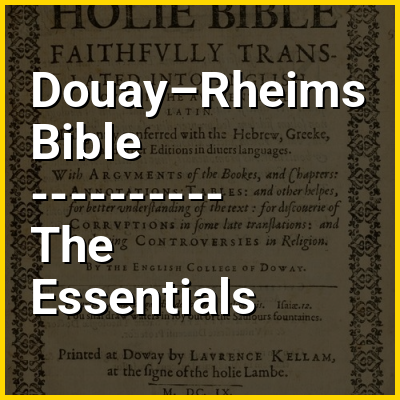
The Douay–Rheims Bible (/ˌd ˈrmz, ˌd -/, US also /dˌ -/), also known as the Douay–Rheims Version, Rheims–Douai Bible or Douai Bible, and abbreviated as D–R, DRB, and DRV, is a translation of the Bible from the Latin Vulgate into Early Modern English by members of the English College, Douai as a Counter-Reformation effort. The New Testament portion was published in Rheims, France, in 1582, in one volume with extensive commentary and notes. The Old Testament portion was published in two volumes in 1609 and 1610 by the University of Douai. The first volume, covering Genesis to Job, was published in 1609; the second, covering the Book of Psalms to 2 Maccabees (spelled "Maccabees") and the three apocryphal books of the Vulgate appendix following the Old Testament (Prayer of Manasseh, 3 Esdras, and 4 Esdras), was published in 1610. Marginal notes on translation and the Hebrew and Greek source texts of the Vulgate compose majority portions of the edition. In 1589, William Fulke collated the complete Rheims text and notes in parallel columns with those of the Bishops' Bible. This work sold widely in England, prompting re-issue in three further editions by 1633. Fulke's editions of the Rheims New Testament were of crucial significance to 17th-century English exegesis.

Much of the first edition employed Latin vocabulary, rendering it particularly difficult to read. Consequently, a revision of the translation was undertaken by Bishop Richard Challoner: the New Testament in three editions of 1749, 1750, and 1752; and the Old Testament (minus the Vulgate apocrypha) in 1750.
↓ Menu
HINT:

In this Dossier

Douay–Rheims Bible in the context of Seventy disciples

The seventy disciples (Greek: ἑβδομήκοντα μαθητές, hebdomikonta mathetes), known in the Eastern Christian traditions as the seventy apostles (Greek: ἑβδομήκοντα απόστολοι, hebdomikonta apostoloi), were early emissaries of Jesus mentioned in the Gospel of Luke. The number of those disciples varies between either 70 or 72 depending on the manuscript.

The passage from Luke 10 in the Gospel of Luke, the only gospel in which they are mentioned, includes specific instructions for the mission, beginning with (in Douay–Rheims Bible):

View the full Wikipedia page for Seventy disciples
↑ Return to Menu

Douay–Rheims Bible in the context of English College, Douai

The English College (French: College des Grands Anglais) was a Catholic seminary in Douai, France (also previously spelled Douay, and in English Doway), associated with the University of Douai. It was established in 1568, and was suppressed in 1793. It is known for a Bible translation referred to as the Douay–Rheims Bible. Of over 300 British priests who studied at the English College, about one-third were executed after returning home.

The dissolution of the college at the time of the French Revolution led to the founding of Crook Hall near Lanchester in County Durham (which became St Cuthbert's College), and St Edmund's College, Ware. It is popularly believed that the indemnification funds paid by the French for the seizure of Douai's property were diverted by the British commissioners to complete the furnishings of George IV's Royal Pavilion at Brighton.

View the full Wikipedia page for English College, Douai
↑ Return to Menu

Douay–Rheims Bible in the context of Richard Challoner

Richard Challoner (29 September 1691 – 12 January 1781) was an English Catholic prelate who served as Vicar Apostolic of the London District during the greater part of the 18th century, and as Titular Bishop of Doberus. In 1738, he published a revision of the Douay–Rheims Bible.

View the full Wikipedia page for Richard Challoner
↑ Return to Menu

Douay–Rheims Bible in the context of The Way of All Flesh

The Way of All Flesh (originally titled Ernest Pontifex or the Way of All Flesh) is a semi-autobiographical novel by Samuel Butler that attacks Victorian-era hypocrisy. Written between 1873 and 1884, it traces four generations of the Pontifex family. Butler dared not publish it during his lifetime, but when it was published posthumously in 1903 as The Way of All Flesh it was accepted as part of the general reaction against Victorianism. Butler's first literary executor, R. A. Streatfeild, made substantial changes to Butler's manuscript. The original manuscript was first published in 1964 as Ernest Pontifex or the Way of All Flesh by Houghton Mifflin Company, Boston, edited by Daniel F. Howard.

The title is a quotation from the Douay–Rheims Bible's translation of a Biblical Hebrew expression that is literally translated "to go the way of all the earth" and which signifies "to die". It is found in the First Book of Kings: "I am going the way of all flesh: take thou courage and shew thyself a man." (1 Kings 2.2).

View the full Wikipedia page for The Way of All Flesh
↑ Return to Menu

Douay–Rheims Bible in the context of Jehoash of Judah

Jehoash (Hebrew: יְהוֹאָשׁ, romanizedYəhōʾāš, lit.'"Yah-given"'; Greek: Ιωας; Latin: Ioas), also known as Joash (in King James Version), Joas (in Douay–Rheims) or Joás (Hebrew: יוֹאָשׁ, romanizedYōʾāš), was the eighth king of Judah, and the sole surviving son of Ahaziah after the massacre of the royal family ordered by his grandmother, Athaliah. His mother was Zibiah of Beersheba. Jehoash was 7 years old when he ascended to the throne, reigning for 40 years. (2 Kings 12:1, 2 Chronicles 24:1) He was succeeded by his son, Amaziah of Judah. He is said to have been righteous "all the days of Jehoiada the priest" (2 Chronicles 24:2) but to have deviated from fidelity to Yahweh after Jehoiada's death (2 Chronicles 24:17–19).

William F. Albright has dated his reign to 837–800 BCE, while E. R. Thiele offers the dates 835–796 BCE.

View the full Wikipedia page for Jehoash of Judah
↑ Return to Menu