Domus in the context of "Imperial Rome"

Play Trivia Questions online!

or

Skip to study material about Domus in the context of "Imperial Rome"

Ad spacer

⭐ Core Definition: Domus

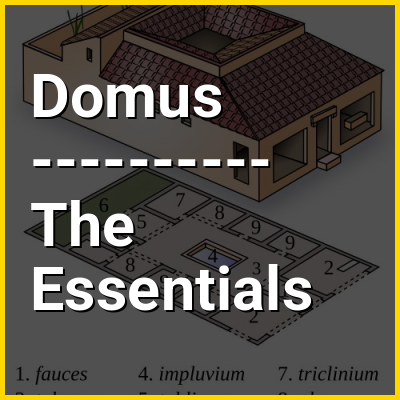
In ancient Rome, the domus (pl.: domūs, genitive: domūs or domī) was the type of town house occupied by the upper classes and some wealthy freedmen during the Republican and Imperial eras. It was found in almost all the major cities throughout the Roman territories. The modern English word domestic comes from Latin domesticus, which is derived from the word domus. Along with a domus in the city, many of the richest families of ancient Rome also owned a separate country house known as a villa. Many chose to live primarily, or even exclusively, in their villas; these homes were generally much grander in scale and on larger acres of land due to more space outside the walled and fortified city.

The elite classes of Roman society constructed their residences with elaborate marble decorations, inlaid marble paneling, door jambs and columns, as well as expensive paintings and frescoes. Many poor and lower-middle-class Romans lived in crowded, dirty and mostly rundown rental apartments, known as insulae. These multi-level apartment blocks were built as high and tightly together as possible and held far less status and convenience than the private homes of the prosperous.
↓ Menu

>>>PUT SHARE BUTTONS HERE<<<
In this Dossier

Domus in the context of Impluvium

The impluvium (pl.: impluvia) is a water-catchment pool system meant to capture rain-water flowing from the compluvium, an area of roof. Often placed in a courtyard, under an opening in the roof, and thus "inside", instead of "outside", a building, it is a notable feature in many architectural traditions.

↑ Return to Menu

Domus in the context of Roman villa

A Roman villa was typically a farmhouse or country house in the territory of the Roman Republic and the Roman Empire, sometimes reaching extravagant proportions.

Nevertheless, the term "Roman villa" generally covers buildings with the common features of being extra-urban (i.e. located outside urban settlements, unlike the domus which was inside them) and residential, with accommodation for the owner. The definition also changed with time: the earliest examples are mostly humble farmhouses in Italy, while from the Republican period a range of larger building types are included.

↑ Return to Menu

Domus in the context of Thermae

In ancient Rome, thermae (from Greek θερμός thermos, "hot") and balneae (from Greek βαλανεῖον balaneion) were facilities for bathing. Thermae usually refers to the large imperial bath complexes, while balneae were smaller-scale facilities, public or private, that existed in great numbers throughout Rome.

Most Roman cities had at least one – if not many – such buildings, which were centers not only for bathing, but socializing and reading as well. Bathhouses were also provided for wealthy private villas, town houses, and forts. They were supplied with water from an adjacent river or stream, or within cities by aqueduct. The water would be heated by fire then channelled into the caldarium (hot bathing room). The design of baths is discussed by Vitruvius in De architectura (V.10).

↑ Return to Menu

Domus in the context of Archbasilica of Saint John Lateran

The Archbasilica of Saint John Lateran (officially the Major Papal, Patriarchal and Roman Archbasilica, Metropolitan and Primatial Cathedral of the Most Holy Savior and Saints John the Baptist and the Evangelist in Lateran, Mother and Head of All Churches in Rome and in the World), commonly known as the Lateran Basilica or Saint John Lateran, is the Catholic cathedral of the Diocese of Rome in the city of Rome, Italy. It serves as the seat of the bishop of Rome and head of the worldwide Catholic Church, the pope. The only "archbasilica" in the world, it lies outside of Vatican City proper, which is located approximately four kilometres (2+12 miles) northwest. Nevertheless, as properties of the Holy See, the archbasilica and its adjoining edifices enjoy an extraterritorial status from Italy, pursuant to the terms of the Lateran Treaty of 1929. Dedicated to Christ the Saviour, in honor of John the Baptist and John the Evangelist, the place name – Laterano (Lateran) – comes from an ancient Roman family (gens), whose palace (domus) grounds occupied the site. The adjacent Lateran Palace was the primary residence of the pope until the Middle Ages.

The church is the oldest of the four major papal basilicas, and it is one of the Seven Pilgrim Churches of Rome. Founded in 324, it is the oldest public church in the city of Rome, and the oldest basilica in the Western world. It houses the cathedra of the Roman bishop, and it has the title of ecumenical mother church of the Catholic faithful. The building deteriorated during the Middle Ages and was badly damaged by two fires in the 14th century. It was rebuilt in the late 16th century during the reign of Pope Sixtus V. The new structure's interior was renovated in the late 17th century, and its façade was completed in 1735 under Pope Clement XII.

↑ Return to Menu

Domus in the context of Compluvium

Cavaedium or atrium are Latin names for the principal room of an ancient Roman house, which usually had a central opening in the roof (compluvium) and a rainwater pool (impluvium) beneath it. The cavaedium passively collected, filtered, stored, and cooled rainwater. It also daylit, passively cooled and passively ventilated the house.

The atrium was the most important room of the ancient Roman house. The main entrance led into it; patrones received their clientes there, and marriages, funerals, and other ceremonies were conducted there. In earlier and more modest homes, the atrium was the common room used for most household activities; in richer homes, it became mainly a reception room, with private life moving deeper into the (larger) house. The atrium was generally the most elaborate room, with the finest finishings, wall paintings, and furnishings.

↑ Return to Menu

Domus in the context of Taberna

A taberna (pl.: tabernae) was a type of shop or stall in Ancient Rome. Originally meaning a single-room shop for the sale of goods and services, tabernae were often incorporated into domestic dwellings on the ground level flanking the fauces, the main entrance to a home, but with one side open to the street. As the Roman Empire became more prosperous, tabernae were established within great indoor markets and were often covered by a barrel vault. Each taberna within a market had a window above it to let light into a wooden attic for storage and had a wide doorway. A famous example of such an indoor market is the Markets of Trajan in Rome, built in the early 2nd century by Apollodorus of Damascus.

According to the Cambridge Ancient History, a taberna was a "retail unit" within the Roman Empire and was where many economic activities and many service industries were provided, including the sale of cooked food, wine, and bread.

↑ Return to Menu

Domus in the context of Townhouse (Great Britain)

In British usage, the term townhouse originally referred to the opulent town or city residence (in practice normally in Westminster near the seat of the monarch) of a member of the nobility or gentry, as opposed to their country seat, generally known as a country house or, colloquially, for the larger ones, stately home. The grandest of the London townhouses were stand-alone buildings, comparable to the hôtel particulier, which notably housed the French nobleman in Paris, as well as to the urban domus of the nobiles of Ancient Rome. but many were terraced buildings.

British property developers and estate agents nowadays often use the term "townhouse" for terraced buildings, following the North American usage of the term, to aggrandise modest dwellings and attract buyers who associate the term "terraced house" with the cheap terraced housing built in the Victorian era to accommodate workers. The upmarket Victorian terraced housing, which can be found around many of London's garden squares, seems to be widely forgotten in these circles.

↑ Return to Menu