Domain of a function in the context of Analytic functions


Domain of a function in the context of Analytic functions

Domain of a function Study page number 1 of 6

Play TriviaQuestions Online!

or

Skip to study material about Domain of a function in the context of "Analytic functions"


⭐ Core Definition: Domain of a function

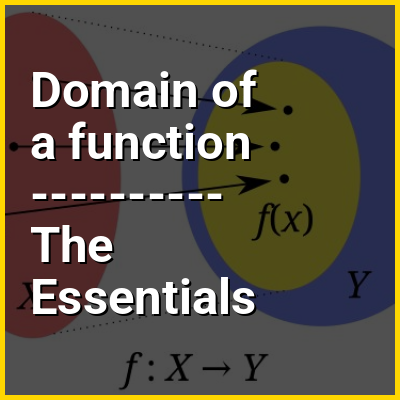
In mathematics, the domain of a function is the set of inputs accepted by the function. It is sometimes denoted by or , where f is the function. In layman's terms, the domain of a function can generally be thought of as "what x can be".

More precisely, given a function , the domain of f is X. In modern mathematical language, the domain is part of the definition of a function rather than a property of it.

↓ Menu
HINT:

In this Dossier

Domain of a function in the context of Arithmetic function

In number theory, an arithmetic, arithmetical, or number-theoretic function is generally any function whose domain is the set of positive integers and whose range is a subset of the complex numbers. Hardy & Wright include in their definition the requirement that an arithmetical function "expresses some arithmetical property of n". There is a larger class of number-theoretic functions that do not fit this definition, for example, the prime-counting functions. This article provides links to functions of both classes.

An example of an arithmetic function is the divisor function whose value at a positive integer n is equal to the number of divisors of n.

View the full Wikipedia page for Arithmetic function
↑ Return to Menu

Domain of a function in the context of Complex analysis

Complex analysis, traditionally known as the theory of functions of a complex variable, is the branch of mathematical analysis that investigates functions of a complex variable of complex numbers. It is helpful in many branches of mathematics, including real analysis, algebraic geometry, number theory, analytic combinatorics, and applied mathematics, as well as in physics, including the branches of hydrodynamics, thermodynamics, quantum mechanics, and twistor theory. By extension, use of complex analysis also has applications in engineering fields such as nuclear, aerospace, mechanical and electrical engineering.

At first glance, complex analysis is the study of holomorphic functions that are the differentiable functions of a complex variable. By contrast with the real case, a holomorphic functions is always infinitely differentiable and equal to the sum of its Taylor series in some neighborhood of each point of its domain.This makes methods and results of complex analysis significantly different from that of real analysis. In particular, contrarily, with the real case, the domain of every holomorphic function can be uniquely extended to almost the whole complex plane. This implies that the study of real analytic functions needs often the power of complex analysis. This is, in particular, the case in analytic combinatorics.

View the full Wikipedia page for Complex analysis
↑ Return to Menu

Domain of a function in the context of Domain (mathematical analysis)

In mathematical analysis, a domain or region is a non-empty, connected, and open set in a topological space. In particular, it is any non-empty connected open subset of the real coordinate space R or the complex coordinate space C. A connected open subset of coordinate space is frequently used for the domain of a function.

The basic idea of a connected subset of a space dates from the 19th century, but precise definitions vary slightly from generation to generation, author to author, and edition to edition, as concepts developed and terms were translated between German, French, and English works. In English, some authors use the term domain, some use the term region, some use both terms interchangeably, and some define the two terms slightly differently; some avoid ambiguity by sticking with a phrase such as non-empty connected open subset.

View the full Wikipedia page for Domain (mathematical analysis)
↑ Return to Menu

Domain of a function in the context of Analytic function

In mathematics, an analytic function is a function that is locally given by a convergent power series. There exist both real analytic functions and complex analytic functions. Functions of each type are infinitely differentiable, but complex analytic functions exhibit properties that do not generally hold for real analytic functions.

A function is analytic if and only if for every in its domain, its Taylor series about converges to the function in some neighborhood of . This is stronger than merely being infinitely differentiable at , and therefore having a well-defined Taylor series; the Fabius function provides an example of a function that is infinitely differentiable but not analytic.

View the full Wikipedia page for Analytic function
↑ Return to Menu

Domain of a function in the context of Function (mathematics)

In mathematics, a function from a set X to a set Y assigns to each element of X exactly one element of Y. The set X is called the domain of the function and the set Y is called the codomain of the function.

Functions were originally the idealization of how a varying quantity depends on another quantity. For example, the position of a planet is a function of time. Historically, the concept was elaborated with the infinitesimal calculus at the end of the 17th century, and, until the 19th century, the functions that were considered were differentiable (that is, they had a high degree of regularity). The concept of a function was formalized at the end of the 19th century in terms of set theory, and this greatly increased the possible applications of the concept.

View the full Wikipedia page for Function (mathematics)
↑ Return to Menu

Domain of a function in the context of Graph of a function

In mathematics, the graph of a function is the set of ordered pairs , where In the common case where and are real numbers, these pairs are Cartesian coordinates of points in a plane and often form a curve.The graphical representation of the graph of a function is also known as a plot.

In the case of functions of two variables – that is, functions whose domain consists of pairs –, the graph usually refers to the set of ordered triples where . This is a subset of three-dimensional space; for a continuous real-valued function of two real variables, its graph forms a surface, which can be visualized as a surface plot.

View the full Wikipedia page for Graph of a function
↑ Return to Menu

Domain of a function in the context of Maximize

In mathematical analysis, the maximum and minimum of a function are, respectively, the greatest and least value taken by the function. Known generically as extrema, they may be defined either within a given range (the local or relative extrema) or on the entire domain (the global or absolute extrema) of a function. Pierre de Fermat was one of the first mathematicians to propose a general technique, adequality, for finding the maxima and minima of functions.

As defined in set theory, the maximum and minimum of a set are the greatest and least elements in the set, respectively. Unbounded infinite sets, such as the set of real numbers, have no minimum or maximum.

View the full Wikipedia page for Maximize
↑ Return to Menu

Domain of a function in the context of Vertical position

Vertical position or vertical location is a position along a vertical direction (the plumb line direction) above or below a given vertical datum (a reference level surface, such as mean sea level).Vertical distance or vertical separation is the distance between two vertical positions.Many vertical coordinates exist for expressing vertical position: depth, height, altitude, elevation, etc.Points lying on an equigeopotential surface are said to be on the same vertical level, as in a water level.A function with domain along the vertical line is called a vertical distribution or vertical profile.

View the full Wikipedia page for Vertical position
↑ Return to Menu

Domain of a function in the context of Double integration

In mathematics (specifically multivariable calculus), a multiple integral is a definite integral of a function of several real variables, for instance, f(x, y) or f(x, y, z).

Integrals of a function of two variables over a region in (the real-number plane) are called double integrals, and integrals of a function of three variables over a region in (real-number 3D space) are called triple integrals. For repeated antidifferentiation of a single-variable function, see the Cauchy formula for repeated integration.

View the full Wikipedia page for Double integration
↑ Return to Menu

Domain of a function in the context of Zero set

In mathematics, a zero (also sometimes called a root) of a real-, complex-, or generally vector-valued function , is a member of the domain of such that vanishes at ; that is, the function attains the value of 0 at , or equivalently, is a solution to the equation . A "zero" of a function is thus an input value that produces an output of 0.

A root of a polynomial is a zero of the corresponding polynomial function. The fundamental theorem of algebra shows that any non-zero polynomial has a number of roots at most equal to its degree, and that the number of roots and the degree are equal when one considers the complex roots (or more generally, the roots in an algebraically closed extension) counted with their multiplicities. For example, the polynomial of degree two, defined by has the two roots (or zeros) that are 2 and 3.

View the full Wikipedia page for Zero set
↑ Return to Menu

Domain of a function in the context of Indexed family

In mathematics, a family, or indexed family, is informally a collection of objects, each associated with an index from some index set. For example, a family of real numbers, indexed by the set of integers, is a collection of real numbers, where a given function selects one real number for each integer (possibly the same) as indexing.

More formally, an indexed family is a mathematical function together with its domain and image (that is, indexed families and mathematical functions are technically identical, just points of view are different). Often the elements of the set are referred to as making up the family. In this view, an indexed family is interpreted as a collection of indexed elements, instead of a function. The set is called the index set of the family, and is the indexed set.

View the full Wikipedia page for Indexed family
↑ Return to Menu

Domain of a function in the context of Smooth function

In mathematical analysis, the smoothness of a function is a property measured by the number of continuous derivatives (differentiability class) it has over its domain.

A function of class is a function of smoothness at least k; that is, a function of class is a function that has a kth derivative that is continuous in its domain.

View the full Wikipedia page for Smooth function
↑ Return to Menu

Domain of a function in the context of Random variable

A random variable (also called random quantity, aleatory variable, or stochastic variable) is a mathematical formalization of a quantity or object which depends on random events. The term 'random variable' in its mathematical definition refers to neither randomness nor variability but instead is a mathematical function in which

  • the domain is the set of possible outcomes in a sample space (e.g. the set which are the possible upper sides of a flipped coin heads or tails as the result from tossing a coin); and
  • the range is a measurable space (e.g. corresponding to the domain above, the range might be the set if say heads mapped to -1 and mapped to 1). Typically, the range of a random variable is a subset of the real numbers.

Informally, randomness typically represents some fundamental element of chance, such as in the roll of a die; it may also represent uncertainty, such as measurement error. However, the interpretation of probability is philosophically complicated, and even in specific cases is not always straightforward. The purely mathematical analysis of random variables is independent of such interpretational difficulties, and can be based upon a rigorous axiomatic setup.

View the full Wikipedia page for Random variable
↑ Return to Menu

Domain of a function in the context of Differentiable function

In mathematics, a differentiable function of one real variable is a function whose derivative exists at each point in its domain. In other words, the graph of a differentiable function has a non-vertical tangent line at each interior point in its domain. A differentiable function is smooth (the function is locally well approximated as a linear function at each interior point) and does not contain any break, angle, or cusp.

View the full Wikipedia page for Differentiable function
↑ Return to Menu

Domain of a function in the context of Functions of a complex variable

Complex analysis, traditionally known as the theory of functions of a complex variable, is the branch of mathematical analysis that investigates functions of a complex variable of complex numbers. It is helpful in many branches of mathematics, including real analysis, algebraic geometry, number theory, analytic combinatorics, and applied mathematics, as well as in physics, including the branches of hydrodynamics, thermodynamics, quantum mechanics, and twistor theory. By extension, use of complex analysis also has applications in engineering fields such as nuclear, aerospace, mechanical and electrical engineering.

At first glance, complex analysis is the study of holomorphic functions that are the differentiable functions of a complex variable. By contrast with the real case, a holomorphic function is always infinitely differentiable and equal to the sum of its Taylor series in some neighborhood of each point of its domain.This makes methods and results of complex analysis significantly different from that of real analysis. In particular, contrarily, with the real case, the domain of every holomorphic function can be uniquely extended to almost the whole complex plane. This implies that the study of real analytic functions needs often the power of complex analysis. This is, in particular, the case in analytic combinatorics.

View the full Wikipedia page for Functions of a complex variable
↑ Return to Menu

Domain of a function in the context of Holomorphic functions

In mathematics, a holomorphic function is a complex-valued function of one or more complex variables that is complex differentiable in a neighbourhood of each point in a domain in complex coordinate space . The existence of a complex derivative in a neighbourhood is a very strong condition: It implies that a holomorphic function is infinitely differentiable and locally equal to its own Taylor series (is analytic). Holomorphic functions are the central objects of study in complex analysis.

Though the term analytic function is often used interchangeably with "holomorphic function", the word "analytic" is defined in a broader sense to denote any function (real, complex, or of more general type) that can be written as a convergent power series in a neighbourhood of each point in its domain. That all holomorphic functions are complex analytic functions, and vice versa, is a major theorem in complex analysis.

View the full Wikipedia page for Holomorphic functions
↑ Return to Menu