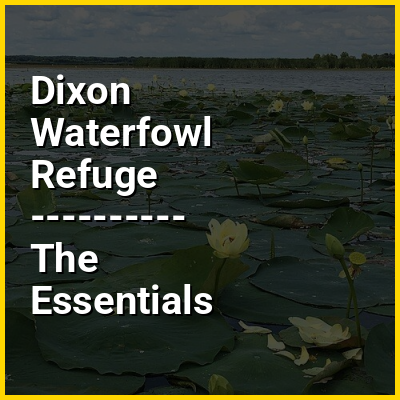
The Sue and Wes Dixon Waterfowl Refuge is a 3,100-acre riverine wetland in Putnam County, Illinois. Located just south of the county seat of Hennepin, it occupies the former site of Hennepin Lake and adjacent Hopper Lake. The reclaimed wetland is a Ramsar treaty site, a wetland of international importance.
HINT:
In this Dossier
Dixon Waterfowl Refuge in the context of Illinois River
The Illinois River (Miami-Illinois: Inoka Siipiiwi) is a principal tributary of the Mississippi River at approximately 273 miles (439 km) in length. Located in the U.S. state of Illinois, the river has a drainage basin of 28,756.6 square miles (74,479 km). The Illinois River begins with the confluence of the Des Plaines and Kankakee rivers in the Chicago metropolitan area, and it generally flows to the southwest across Illinois, until it empties into the Mississippi near Grafton, Illinois. Its drainage basin extends into southeastern Wisconsin, northwestern Indiana, and a very small area of southwestern Michigan in addition to central Illinois. Along its banks are several river ports, including the largest, Peoria, Illinois. Historic and recreation areas on the river include Starved Rock, and the internationally important wetlands of the Emiquon Complex and Dixon Waterfowl Refuge.
The river was important among Native Americans and French traders as the principal water route connecting the Great Lakes with the Mississippi. The French colonial settlements along these rivers formed the heart of the area known as the Illinois Country in the 17th and 18th centuries. After the construction of the Illinois and Michigan Canal and the Hennepin Canal in the 19th century, the role of the river as link between Lake Michigan and the Mississippi was extended into the era of modern industrial shipping. The Illinois now forms the basis for the Illinois Waterway, extending the river's capabilities for navigation and commercial shipping.
View the full Wikipedia page for Illinois River