Devastations of Osorio in the context of "General Archive of the Indies"

Play Trivia Questions online!

or

Skip to study material about Devastations of Osorio in the context of "General Archive of the Indies"

Ad spacer

⭐ Core Definition: Devastations of Osorio

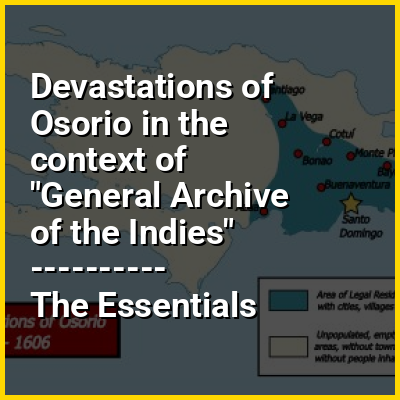
The Devastations of Osorio were an event in the history of the Spanish colony of Santo Domingo (now the Dominican Republic and Haiti) in the early 17th century. The devastations took place as the result of the order given by King Philip III of Spain to the governor Antonio de Osorio, to depopulate the western and northern regions of the Caribbean island of Hispaniola, by force if necessary, in order to end the smuggling that flourished in those areas. Osorio then implemented this order between 1605 and 1606.

The Spanish crown believed that depopulating the western part of the island would put an end to the smuggling that so severely impacted the royal coffers, but the devastation made possible everything it had sought to prevent: the establishment of individuals from another nation in the western part of the island. The devastations were the event that allowed the French to establish themselves in western Hispaniola. The Spanish tried to expel the French from the western part of the island on several occasions, but were unsuccessful.
↓ Menu

>>>PUT SHARE BUTTONS HERE<<<
In this Dossier

Devastations of Osorio in the context of Saint-Domingue

Saint-Domingue (French: [sɛ̃ dɔmɛ̃ɡ] ) was a French colony in the western portion of the Caribbean island of Hispaniola, in the area of modern-day Haiti, from 1659 to 1803. The name derives from the Spanish main city on the island, Santo Domingo, which came to refer specifically to the Spanish-held Captaincy General of Santo Domingo, now the Dominican Republic. The borders between the two were fluid and changed over time until they were finally solidified in the Dominican War of Independence in 1844.

The French had established themselves on the western portion of the islands of Hispaniola and Tortuga thanks to the Devastations of Osorio. In the Treaty of Ryswick of 1697, Spain formally recognized French control of Tortuga Island and the western third of the island of Hispaniola. In 1791, slaves and some Creoles took part in a Vodou ceremony at Bois Caïman and planned the Haitian Revolution. The slave rebellion later allied with Republican French forces following the abolition of slavery in the colony in 1793, although this alienated the island's dominant slave-owning class. France controlled the entirety of Hispaniola from 1795 to 1802, when a renewed rebellion began. The last French troops withdrew from the western portion of the island in late 1803, and the colony later declared its independence as Haiti, the Taino name for the island, the following year.

↑ Return to Menu